Michael’s Blog: October 11, 2021
The Disease You Didn’t Know You Had
“This water cures aches and diseases I didn’t even know I had!”
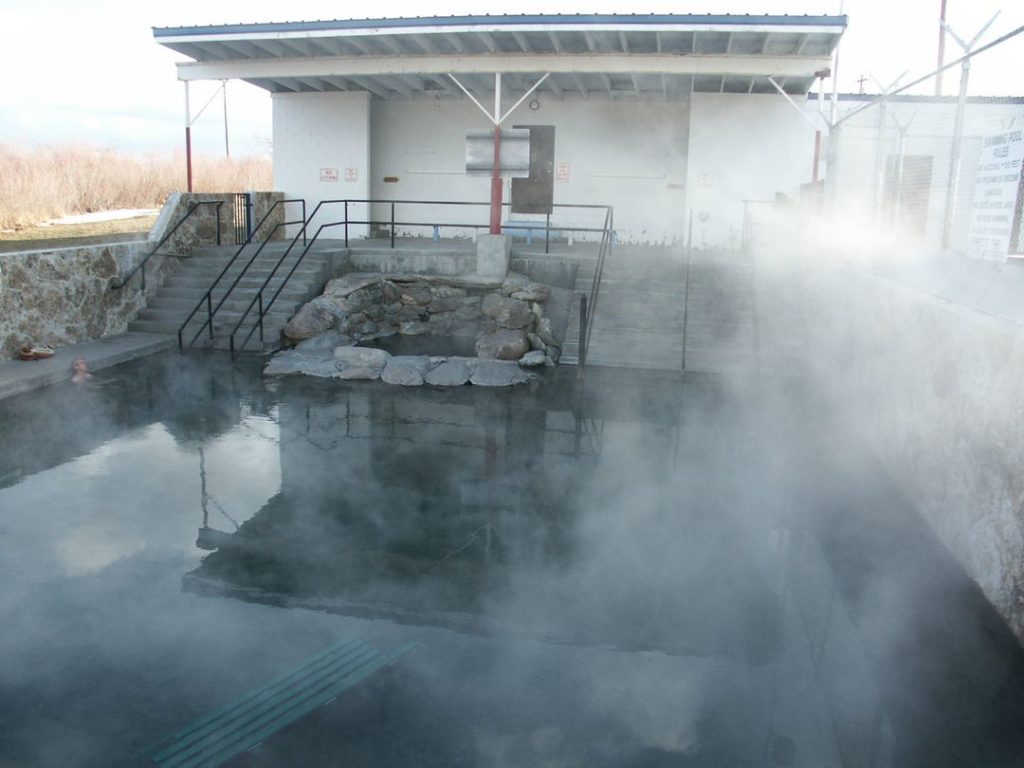
Elaine and I overheard a woman say this at the ‘Hobo Hot Springs’ in Saratoga WY, open 24/7 and free to anyone. After the gig and a late dinner, a midnight soak seemed like a capital idea. Only a few other people, hot (even for me) water, and a cool mist of night rain put me in a contemplative place, not about the woman’s unknown maladies, but about Place.
I was curious about its origins and name. I’ve since learned that besides the one in Saratoga, there are ‘hobo springs’ throughout the west, in Nevada, the Kern Valley of California, others. They were often first established while municipal and land management projects needed an influx of workers. During the Great Depression, they were often kept open for itinerant people who had no other way to clean up.
Before that, hot springs were a revered stopping place for the nomadic Indigenous Peoples of the region. The Utes considered what we now call Glenwood Hot Springs as ‘Yampah,’ or ‘Big Medicine.’ They and other nations decided that the springs were neutral, sacred—and free—Places to be enjoyed by all, whether friendly or hostile.
Hobo. Nomad. Itinerant. These words carry very different connotations today than they might have when the Ute thought about Place in a very immediate ‘I-am-Here’ kind of way. Places were to be protected for the next season’s hunting; parking and ownership seemed antithetical to survival. Today, those words pose a problem for a society that wants its people’s roots planted deeply in debt and servitude.
So—I’m not just thinking about Place, but Time and Place. Have you ever considered how today there are few places that a person can occupy without paying for that privilege? You can take your own inventory of signs encountered that prohibit being, well,… somePlace. No overnight stays at a Rest Area. No Loitering. Camping by Permit Only. It’s like a return of the ‘Sundown Laws’ (look it up) in the 21st Century.
We accept the notion that ‘nothing is free’, granting license to that notion with the understanding that ‘nothing should be free.’ How about Nestle Chairman Peter Brabeck, proclaiming a couple years ago as his company secured access to water, one of the very basic components of sustenance across the entire planet: “Water is not a human right.†I’m guessing they would not have been proponents of hobo springs, preferring a desiccated, dehydrated sub-stratum of society, never mind that a healthier sub-stratum might buy more of their sub-standard chocolate, soda, and quasi-food products.
Apparently, even the things we pay for but throw away aren’t free. Over the weekend, on that Even-Sillier-Than-Facebook platform known as NextDoor, someone was ranting about a ‘dumpster diver’—how dare he rummage through the detritus I’ve decided is no longer part of my life?
We could easily have dropped 30.00 for the other springs in town, and satisfied our quirky love for hot, healing mineral waters, a favored activity after biking or camping excursions—and now, at my age, the occasional post-gig aches and pains. We have many throughout the West that we visit regularly. But I will hold these Hobo Springs in a special regard from now on.
I’ve purposely deployed certain words above that trigger me a bit: Privilege and Entitled. Find your own contemplative pool, actual or allegorical, to ponder these things this Indigenous People’s Day.
© 2021 Falling Mountain Music
Michael’s Blog: August 15, 2021
Loud Parenting
The keering is unmistakable—an osprey providing some parental wisdom, everything from how to catch a thermal to “eat-your-dinner-fish-is-best-served-fresh.†Just outside our rented cabin’s door was an osprey family, the parents and a couple of young ones. All during our four day stay in this ‘aerie-bnb’, courtesy of a bit of lucrative giggery in Grand Lake CO, Elaine and I hear them: Parenting in action. Loud, maybe, but beautiful.
The day after my gig we make our way to the marina to rent a kayak for a day of exploring Shadow Mountain Lake’s islands and lagoons. Unfortunately, we arrive at the same time as the family we would henceforth refer to as The Alaska People. Before I have time to say “After you†they proceed to make us after them. With her own shrill keer, Alaska mama admonishes her kids non-stop, who were merely being kids, loud enough on purpose to make sure that no one within earshot could possibly miss her quippiness. She and Alaska papa make themselves at home in the storage shed trying on life preservers. The outfitter tries to explain that they are not allowed in there, that she can find what they need because it’s all in order, or at least it was until their trespass. Alaska mama says in a self-explanatory way that explains nothing: “We’re from Alaska.†Then, a quick glance at us, a dismissive shrug, and: “Different country, different rules.†As she corralled her family into one of those big flat-bottom boats that takes tourists around the lake, parenting volume still up to 11, I couldn’t stop musing how much she looked and sounded like Sarah Palin.
Parenting-as-performance-art is a bit of a pet peeve of mine. It says more about the parent’s need than the child’s. And it’s usually attenuated more for those unfortunate enough to be in earshot than the child in need of her parents’ infinite moment of wisdom. Like when Dad explains “That’s a timber hitch, and that’s a bowline†to Junior, too young to even know what a rope is for. But hey, he got his message out to the rest of us: he earned his knot-tying merit badge at Scout camp.
The day before, our first blue-sky day in weeks, we hiked up to the headwaters of the Colorado River, where we encountered a most welcome form of parenting. Here, the Mother River murmurs before meandering its way through forests, canyons and deserts in search of the Pacific Ocean. Here, in this lush green forest spared the devastating fires of last year, we remove our shoes and socks and let our tired feet slide into the cold water, an unspoken sacrament of optimism. And I’m sad—it’s not enough.
Maybe it’s the novel I finished just before coming to the high country, “Migrations,†by Australian author Charlotte McConaghy. Ever since Mad Max, I’ve had a soft spot for Australian dystopian tales. The parental warnings were loud and clear, and largely ignored. Evidence? Here in Colorado, those once-blue skies are now filled with wildfire smoke one day, ozone the next. A few days before leaving for Grand Lake, I ran a quick errand to our local market. The sky, a jaundiced yellow-gray with no rain in sight; meanwhile, the lawns of the condo community are being watered from below, with water sequestered from that mighty river, before it can be sucked through the straws proffered by California and Arizona and others. The Mother River tries in vain to get to the Gulf of California, but I can have fresh blueberries for breakfast from hundreds of miles away. Water politics in the West are complicated, a whole other heart-rending blog for another time. But it struck me during that walk to the market: we’ve turned our world upside down.
Entering Rocky Mountain National Park from the Grand Lake side, you see this upside-down world up close. That end of the park, perceived as the jewel of the entire national park system, suffered heavy casualties in last year’s Cameron Peak fire that devastated over 200,000 acres in Arapaho and Roosevelt National Forests and RMNP. As we drove through the blackened landscape, what charred trees that were left standing stood in stark relief against the sky.
It’s here now, our upside-down world that waters from below to keep grass its illusory lush green color. Human activity has created a cycle of destruction that is going to be hard to break: greenhouse gases raising temperatures, melting ice packs, creating drought and flooding in extremes. Slowing the jet stream so that meteorological events that would normally last an inconvenient day or two can now last for weeks. What does all this have to do with wildfires? Wasn’t it caused by an unattended campfire? Weren’t most of the trees that burned already devasted by pine-bore beetle infestations? Yes, but…listen to the murmur of The Mother. In more normal times, the beetle devastation would have been checked by the typically frigid winters of the Rockies. Without those uber-cold days, the devastation continued for another season, and another. Eventually, The Mother stops being the patient parent, and, like Terry McMillan’s character Bernadine (‘Bernie’—get it?) in “Waiting to Exhaleâ€, finally just torches the joint.
In her wisdom-filled book “Braiding Sweetgrass,†Robin Wall Kimmering talks about how the almost-extinct language spoken by the Potowatomi in not-so-far-away Oklahoma is made up of 70% verbs, all with a variety of peculiar conjugations that depend on whether the action in question is performed by an inanimate object or living thing. Meanwhile, she observes that the English language is comprised of 70% nouns. Given our propensity for things over action, I’m not surprised. We’re quite possibly past that tipping point of talking about things instead of taking action to correct the course. Now—in the most immediate sense of the word—we must figure out how we live in a world that will require us to mitigate the results of our thing-thirst because we didn’t exercise the right verbs.
Like dipping one’s feet in those baptismal waters, vacations engender optimism. So now, look closer. A new green, an unbelievable verdancy, has begun to carpet the forest floor, with purple fireweed and baby aspens emerging. A lone moose wanders through the devastated forest like a survivor of the Dresden firebombing, nibbling what tender shoots it can find. Mitigating. Listening.
So much wisdom in that soft voice.
© 2021 Falling Mountain Music
Michael’s not-Tour Blog: July 6, 2021
Better is Better
A bald eagle, on a better day, can in one fluid motion power dive at speeds of between 75 and 100 miles per hour and come up with a hold-it-with-both-talons dinner. Returning from Aspen recently, Elaine and I witnessed this feat while skirting Georgetown Lake on I-70, us barely touching 65 mph, trying to get home to wrap our talons around leftovers that needed to be eaten before some eastbound travels. The eagle was being its better self. We were merely trying to return home, repack, refuel and leave again.
But earlier that day…
Jay and I took a bike ride out the East of Aspen trail. At one point, we were watching a paraglider doing his thing on the thermals, when he went into an end-over-end tumble toward Earth, his talons clutching whatever mechanism is designed to keep this thing in the air. He disappeared from sight; we headed toward the landing spot, a well-known clearing down the trail. We knew one of two things awaited us—a messy tragedy, or the nailing of a magnificent landing. Thankfully, it was the latter.
That paraglider, on that Sunday morning, was being his better self. And then some.
We continued our ride out the trail, then stopped for some water, when a pair of cyclists approached. The man, for some reason, came to a dead stop; the woman who was riding with him, going too fast on an e-bike, slammed on her brakes so as not to crash into him. She and the bike went down hard on the gravel—I immediately knew she was hurt.
And this is where everyone, almost, became their worst selves.
She was bleeding, but I had seen worse, even with the sizeable flap of upper arm skin torn loose. I wanted to make sure nothing was broken, to stanch the bleeding, and to try to calm her as she was becoming quite agitated. Her companion, curiously, seemed distracted by the whole thing, being no help whatsoever.
She began screaming: “I need an ambulance! Now!â€
At that moment, a good Samaritan in a pick-up stopped to see if he could be of assistance. “I’ll take you to the hospital right now, we can load your bikes in the back.†She was rapidly becoming hysterical, going into shock: “I need an ambulance, right now! Call the ambulance….take me to the hospital!…†“Lady, I can’t do both—if I call for an ambulance we have to stay here until it arrives…†She continued to demand both things happen; I continue to try to calm her and at least assess the damage best I could. The pick-up truck guy threw his arms up in patronizing surrender, saying: â€I’m done here—if you want my help, tell me which way you want to go…â€
Jay called 911. Then HE started being something other than his best self, cursing the person on the line for asking ‘stupid’ questions…â€I’ve told you 4 times where we are…just get here, OK?†(dispatchers often keep people on the phone while dispatching, not unusual in my experience). I asked the truck owner if I could put her in the truck—shock was setting in, I wanted to get her upright and hydrated, plus I was applying pressure to her arm wound and running out of hands. He helped me get her in, then proceeded to holler along with Jay at the 911 people. Her companion? He just remained off to the side, doing nothing, not-engaging in a very intentional way.
I try to calm her down with some conversation while keeping pressure on the arm. “Where are you guys from?†“Washington and Miamiâ€â€¦her companion, who had earlier tried to refer to her as his ‘wife’ lamely tries to explain the dual zip codes, but she abruptly cuts him off. I tell her I was originally from DC, what neighborhood was she from—â€I think my arm is broken!†as her long-nailed talons dig into my arm. “I’m not gonna lie, you’re a bit cut up, but I don’t think you broke anything. Here, do exactly what I ask…†and I have her do some very simple hand/wrist/arm movements while I maintain the pressure. “You’re likely going to need some stitches though.†She sees blood on her legs and clothes. “Is the rest of me OK?†I hold up one bike-gloved finger: “I’m going to touch your chin, OK?†I wipe a bit of blood. “My face! Not my face!†“Don’t worry—no cuts on your face…†I wanted to say: ‘your face that likely cost more than I net in a year’; OK, perhaps I was also not being my best self, at least in thought. “It just spattered a bit. Keep drinking water, OK?â€
Jay and the pick-up truck guy are still screaming, while the ‘husband’ is still pacing around like he’s trying to solve something else entirely.
The ambulance finally comes, Jerry and I prepare to leave. I go over to the ‘husband’ and pull out my phone—“I’d like to text you later and check up on her, she’s pretty shook up. Can you give me your number?†He pulls out a phone—he had a phone the whole damn time, though obviously wasn’t wanting to use it, happy to let us use ours. He texts me his number. A couple hours later, I texted him. ‘She is at the hospital (he didn’t stay with her?) getting stitched up, held for some observation, I’ll text you an update.’ Nothing so far, no surprise.
In a situation that demanded that everyone be their better selves, well, that didn’t happen.
But the day before that…
Since I’m writing this in reverse chronology, I should explain why we were in Aspen to begin with—a celebration of life for author and dear friend Bruce Berger, taken by Covid this winter.
The gathering for Bruce is beautiful. It is illuminating to learn how many lives he had touched, and the ways he touched them—a vector of the most positive force. So many conversations and introductions begin with “And how were you and Bruce connected?†and end with heartwarming tales of how he managed to draw the better part out of each of them.
And now, the story circles to the post-Aspen travels east, on thermals that dip and climb while defying linear storytelling. Elaine and I have spent a long day driving, Lawrence KS to Chattanooga TN. Somewhere in Tennessee, in the late afternoon while the traffic is picking up, I spot a snapping turtle on the highway. A little swerve allows me to miss it; the pickup truck behind me, a tailgater, doesn’t have time to react.
Looking in the rearview mirror, I watch with horror as the pickup hits it dead on. It occurs to me in that moment that for all the flattened carcasses I’ve seen over my decades of crisscrossing the country, I had never witnessed what actually occurs when a car moving at a high rate of speed and a turtle moving at, well, a turtle’s crawl, meet in space. Every part of that turtle that isn’t exoskeleton is vaporized, popped like a water balloon that I could see in stark detail in my mirror. The truck passes me a moment later, the two passengers laughing. Maybe hitting the turtle was not being their better selves, but perhaps it was unavoidable, unintentional. But it was their very worst selves to fist-bump the moment. My talons, white-knuckled, close tighter around the steering wheel. With my wanting to catch up, pass them, glare at them, swear at them, gesticulate at them, as if their worst selves in that moment could have been given a do-over, complete with a re-inflated snapper—it was not a better-self moment for me either. I sigh, and let them go.
Sometimes it’s better to be better than to be right.
© 2021 Falling Mountain Music
Michael’s Blog: May 24, 2021
Hey Buddy, Eyes Down Here…I’m Talking to You
As we ease into summer, and summer eases the restrictions we’ve all been enduring, I’ve been hearing a lot of renewed conversation about masks. Do we still need to wear them, and where, and within what parameters. This blog isn’t about that—personally, I still think masks are a good idea in many settings, a behavioral model set forth years ago by people in other parts of the world where it’s considered just as much a practice of good health as washing your hands after a trip to the ‘loo.
So I’ll let others debate this. Me, I’m looking not at the mask, but south, at the feet. While our faces still rage in debate over whether to mask or unmask, our feet have quietly usurped attention. Let me explain.
Last week I did my second live performance post-pandemic, a gala event for the Museum of Boulder. A nice crowd (all masked), dressed in the Boulder equivalent of finery, which is to say: they tried. A quick digression here. No one will ever accuse Boulderites of riding the very edge of fashion waves. It’s, literally, not how we roll. The disposable income tends to be disposed on high-performance toys, especially bikes, and the hi-tech clothing that comes with that gear. With some bikes costing more than some automobiles, people do tend to put their money into the horse they rode in on, not the t-shirt that rode the rider. Consequently, ‘gala affairs’ tend to be, shall we say, rather casual, hitting the style-o-meter somewhere between ‘Meh’ and ‘Mmm, khaki.’.
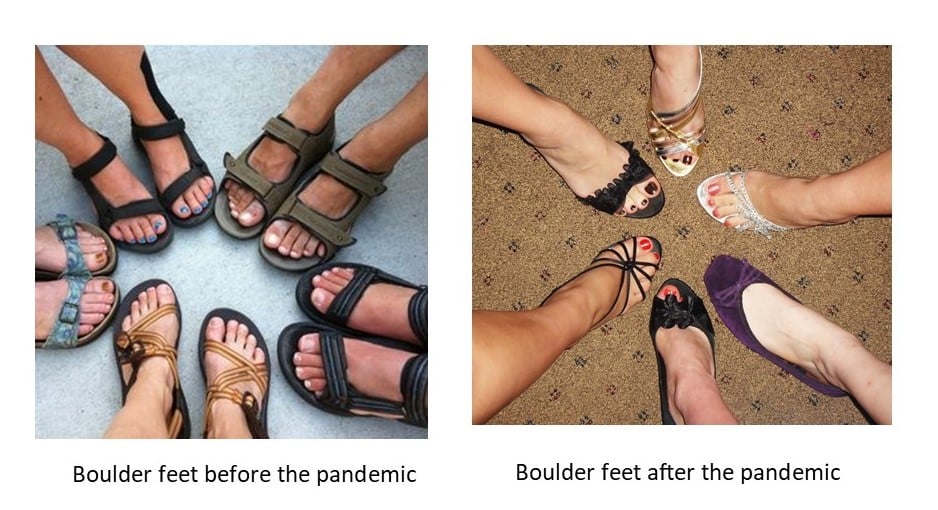
During some moment of that performance, my eyes were in their typical closed mode—I don’t know why that happens but I seem to concentrate better, or be more thoroughly in the musical moment. At some point I opened my eyes to notice a pair of feet two socially-distanced units away. Flawlessly pedicured, peeping out of a stylish pair of open-toed shoes. Toto, this isn’t Kansas anymore—Boulder toes tend to be pretty dinged up from all that stump-jumping and groovy self-stylized barefoot dancing on the Pearl Street Mall bricks. These feet were magnificent.
But this person a few yards away wasn’t an anomaly. I began to notice other feet. Nail polish that perfectly matched handbags (nobody carries handbags in Boulder—I’m surmising it was to bring attention to the toes). Still more feet, pampered to the sculpted ideals of the Renaissance masters, tucked into shoes whose purpose was to show them off, not increase performance. It was hard to close my eyes again and do the deep dive back into the music.
I’ve been pondering this ever since. While others argue in typical binary fashion—wear a mask/don’t wear a mask as restrictions ease, I suggest a diversionary tactic. Wear the mask when common sense dictates. But dress up a bit, and show off your feet. No one will patronizingly tell you “You know, you don’t need your mask anymore.†Instead, you will dazzle them with the very appendages with which you chose to step back into the world.
© 2021 Falling Mountain Music
Michael’s Blog: March 29, 2021
Sorry, no pics (Except this one before the curtain went up)
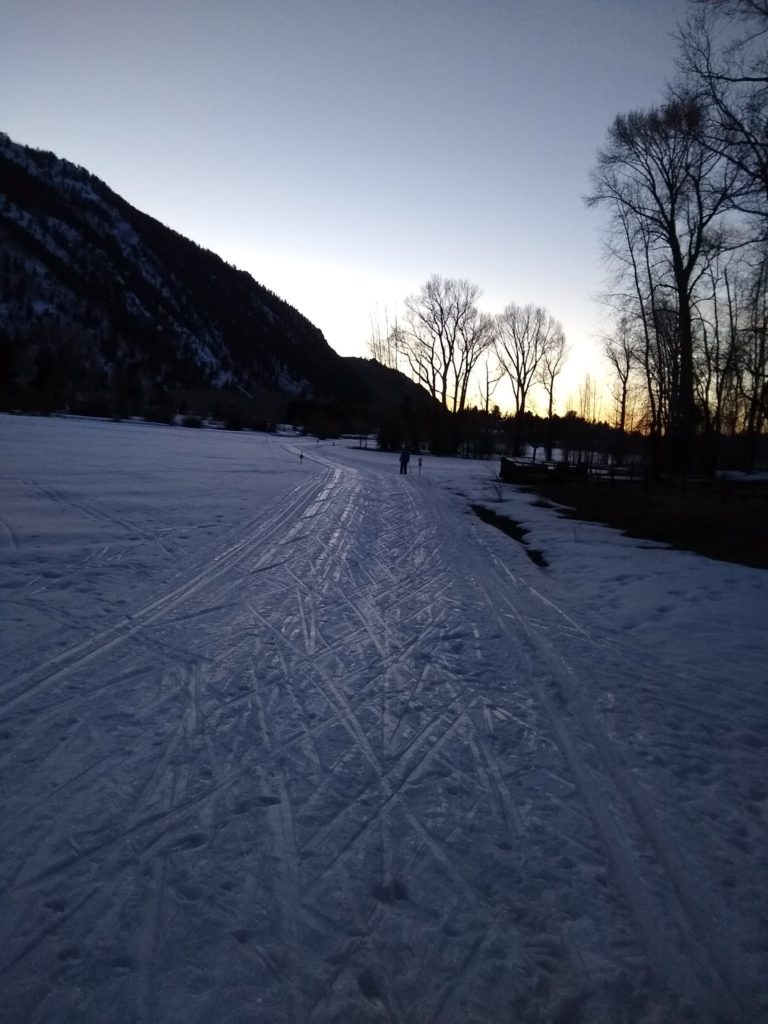
Last night was a beautiful, contemplative way to wrap up this Aspen jaunt–a dusk visit to the Northstar Nature Preserve so we could watch the full moon rise while on our XC skis. Except for some furtive four-legged creature we only heard but never saw, we had the entire preserve to ourselves and the stars in a cloudless sky.
And what a show. Down on the Front Range, the sun sets and the moon rises at roughly the same time. Two and a half hours after sunset, the moon was still hidden behind the mountains, save for a glow along the ridge as the light crept into the valley, slowly illuminating Aspen Mountain in a teasing veil first visible just on the top of the ridge, the moonlight gradually lighting the whole slope.
It was a sexy little strip-tease of luminosity.
Given the dark events of this past week, it was most welcome, but I also couldn’t let go of the idea of light happening even when its source is still shrouded. In astronomy, luminosity refers to an object’s intrinsic brightness, undiminished by factors such as distance. Or, for that matter, any other factors that can diminish its lustre.
Luminosity is still there, even through the acrid haze and putrid smell of gunfire; it’s still there after the wailing and mourning. It’s still there, patiently waiting to be embraced, when attentions drift to the next calamitous headline.
© 2021 Falling Mountain Music
Michael’s Blog: 02/11/2021
Three Days in the Life, With Dancing at the End
The good news: I’m sparing you the photo of the incisions.
The bad news: I’m not sparing you the photo of the Pandemic Ponytail.
It’s been an interesting 3 days, framing a bit of minor surgery–a laparoscopic repair of a small hernia—and a bit of dancing. Let me explain.
The Day Before: a phone call from the Surgery Center goes like this:
“Just a reminder, Mr. DeLalla: no (Everything Pleasurable In My Day-To-Day Routine). And nothing at all, food or drink wise, after midnight.â€
“Thanks, got it.†Or, as the case may be—don’t got it.†(a muffled chuckle on the other end)
“And when you arrive at Foothills Surgery Center at 6:00 AM, no valuables…â€
“Valuables?â€
“You know, no bags of cash, the family jewels…â€
“Ms. R____, you do know that you people are getting paid in bags of cash, don’t you? Which I have procured by selling the family jewels, and a few nefarious promises I’d rather not divulge…oh, never mind.â€
(A beat or two of silence). “Mr. DeLalla, we so appreciate you’re bringing a little humor to a call like this; people are usually either cranky or scared. See you tomorrow AM.â€
Not 15 seconds later, I get this email:
Hello,
Please do not use any marijuana for 24 hours prior to your surgery as it can interfere with anesthesia drugs.
Thank you,
K____ R_____ RN
Pre-Surgical Testing
Foothills Surgery Center
The Day Of: A pre-dawn drive to the Surgery Center, Elaine behind the wheel. The music shuffle brings up Nick Cave’s “Red Right Hand.†Low hanging fruit, as it were, as we slide into our usual practice of coming up with new lyrics, every verse in increasingly worsening taste:
“I gotta a barber’s close shave along the line of the loin…tomorrow it will be swollen into a blue left groin..â€
“To pay this bill there is much to purloin…sorry to jack your car for a blue left groin…â€
He sharpens his scalpel on a rusty old coin..he’ll awaken in an hour with a blue left groin
“…toyin’…oh, never mind.
Later, during admission:
A fire drill. Really. I told the very nice attendant “This is going into my blog.â€
Later still:
“I’m Emily, the nurse practitioner assisting Dr. J____. Just going to get you prepped. Um, the gown goes on the other way, open in back.â€
“Sorry, this is my first surgery since a tonsillectomy when I was 12.â€
“DeLalla—that’s a great name for a musician.â€
“Thanks. I like your name, too. My daughter also wears a badge that says ‘Emily/Nurse Practitioner.’ The Cosmic Messenger is smiling; I’m feeling very lucky. Tell me, are you a Nick Cave fan?â€
Rachel, the anesthesiologist, another attendant (Karen? Katherine? I’m starting to get a little fuzzy at this point) all do their thing, so to speak, around my…oh, never mind. Off I go.
Then a sleepy ride home.
The Day After:
“Mr. DeLalla? This is the Surgery Center, with your follow-up call. How are you managing? Was the pain serious enough to take the Oxy?â€
“I took one yesterday when I got home. I found myself re-reading the same paragraph nine times, about the Dodgers pitching rotation for the coming season. So I stopped, I’ll be fine with Tylenol.â€
“Any odd thoughts? Depression?â€
“Well, yes; I mean, the Dodgers…â€
“I’m sorry?â€
“Me too. I’m a Nationals fan.â€
Feeling fine, all things considered. Thanks, Dr. J____and crew, you were all rock stars. I can Rumba tonight (CHICK-chick-a-BOOM, hand protecting incisions). Tango will have to wait a couple of days.
© 2021 Falling Mountain Music
Michael’s Blog: February 8, 2021
We Can Fix This (He says Anthemically), or: The ‘Four-nication’ of the Star Spangled Banner is the Wrong Rant
It’s that annual February ritual that indicates there is still plenty of winter left to battle through. Not Ground Hog Day, but the Monday after the Super Bowl. A certain argument has again crawled out of its hole, looked for evidence of its shadow to answer its own existential crisis, and confirmed that there is indeed six more weeks before the baseball season begins.
I haven’t watched a Super Bowl in years; I’ll save all the reasons for another blog. But I always smile at the Monday morning arguments about how the Star Spangled Banner fared, whether it went down in a cannonade of critical flames or still flew to be badly performed another day. Today is no different—opinions are flying about Eric Church and Jazmine Sullivan’s performance. Me? Meh.
I don’t care—it’s the wrong song to get worked up about. I’ve maintained since college, when I had to craft an arrangement of SSB for a class, that this song needs to go. You do know the history, don’t you? Francis Scott Key watching the bombardment of Baltimore’s Fort McHenry from a ship out in the Chesapeake Bay, thus beginning the time-honored tradition of watching July 4th fireworks from a boat with appropriate adult beverages. The tune itself was, shall we say, sampled (stolen) from a drinking song, “To Anacreon in Heaven,” popularized by the Anacreontic Society, a “Gentleman’s Club†in Britain. They were evidently gentlemen because they would hole up in their paneled rooms with cigars and brandy to belt out this tune instead of foisting it on the Commonwealth. It was more than 100 years—that’s twice as many Super Bowl performances of the ditty—before it was officially adopted as the National Anthem, by Herbert Hoover in 1931. I’m guessing Stalin had the extortionary equivalent of a golden shower video on Hoover; a brilliant stratagem to twist his arm to adopt a ridiculous national anthem to hold up in comparison to the equally pompous USSR’s every Olympiad. If he would just keep saying “Prosperity is just around the corner.â€
It’s a hard song to sing. Few can navigate those 19 semitones accurately, so it’s no wonder performers exercise such melismatic efforts, much the same way a fusillade can exact as much damage as a direct hit. One of those notes will, in fact, be the intended target. To hear people wail against the ‘four-nication’ of the meter is laughable. Originally written in 3, all the better for hoisting a pint, recent performers have tried to put it in common meter, hoping that will fix everything. Even more recently, the trend is to tripletize the 4-4, putting it in 12-8, like a slow, sultry rhythm and blues tune. There is a decidedly racist tone to these objections—we shouldn’t want to slow-shimmy to our National Anthem. The early Church potentates, in wanting to keep their chants meterless, knew that rhythm led to dancing—and we all know what dancing leads to. Puritans would prefer that we not sex up the Star Spangled Banner.
I’m not here to rant without remedy. For years I’ve been on record advocating that we adopt a different piece for our National Anthem. I’m talking about ‘America the Beautiful.’ Rather than firepower and idolatrous worship of a piece of cloth, it speaks to purple mountains’ majesty, amber waves of grain, and, ignoring the plunder of Manifest Destiny for a moment, sea to shining sea. More importantly, it’s singable. Anyone, other than perhaps the late Leonard Cohen, has the vocal range to sing its largest interval of a Major 6th. Politics and puritanism aside, it’s just better musically.
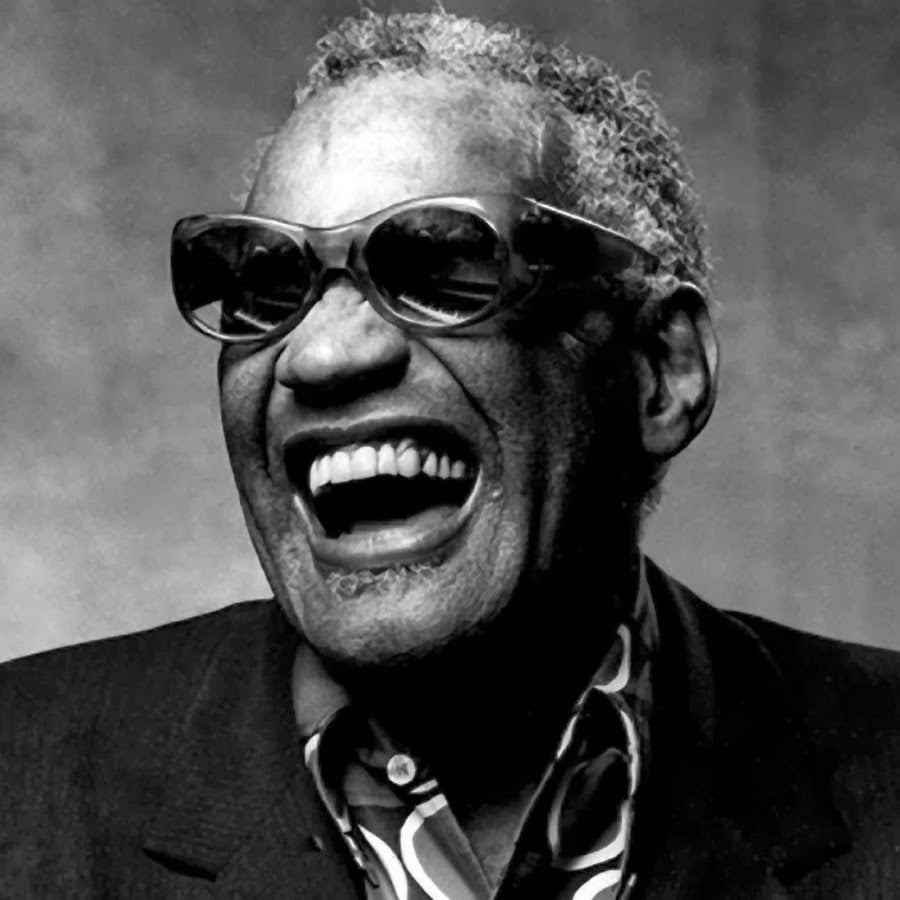
Not only would we have a stellar National Anthem, we would even inherit the definitive performance: that of Ray Charles. Consider for a moment the textual abuses that the current song suffers. If you’re at an Orioles baseball game the ‘OOOOOO….say does that star-spangled banner…’, or the ‘…rockets’ REEEEDDDD glare…’ while awaiting the drop of the puck between the Capitals and Penguins (a team that, by the way, brings nothing clever to the song, because, well, Penguins)—these irreverences would be replaced with reflection.
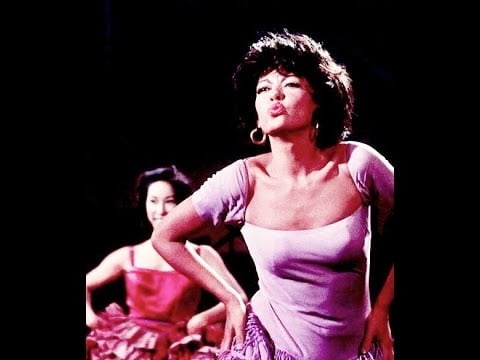
If you can’t warm to Ray Charles and “America the Beautiful†then consider Rita Moreno’s performance of “I Want To Be In Americaâ€, from Leonard Bernstein’s “West Side Story,” because if you can’t warm to Rita then you need to consult your local undertaker. Before you tell me “I know a boat you can get on,†Bernstein combines duple and triple meters, a canarios rhythm, that will satisfy the most staid and salty, and—since it’s a pretty cynical take on Anglo-centrism—sardonic tastes.
As a compromise, perhaps a medley of Ray and Rita. Let’s celebrate with the earthy huapango/merengue dance rhythms, then segue to the more meditative “American the Beautiful.†Imagine if, when Brother Ray got to his “Now wait a minute…â€, we actually did—if we held a minute of silence, since as a culture we seem to be so badly behaved we need a retributive 60-second time out with every headline. “America†would be like going to confession and exercising penance, only to party on again until next Sunday.
© 2021 Falling Mountain Music
Michael’s Blog: December 26, 2020
Lessons learned from “My Octopus Teacherâ€
I know, we’re late to the party. But Elaine and I finally got around to watching “My Octopus Teacher.” What a beautiful–and sobering–documentary. The real lesson is what metric do we, as humans, bring to the comparison of ‘intelligence’ between species?
As a decadigital (I made that word up) guitarist, I was positively humbled by the octopus’ 2000+ suction cups, all able to be independently operated like a team of tiny hands. Much of this animal’s ‘intelligence’, then, is found in the tactile, in the tentacles. When there are days, and concerts, when it seems one finger doesn’t know what the others are doing, and the brain is not succeeding in the herding of those ten cats, well, this is humbling.
And perhaps there is a larger lesson to be learned. In the coming year that is to follow such a daunting one, there may be a lesson about hubris and exceptionalism, both of which have caused us so many problems of late–in trying to mitigate a raging virus, in relations both international and domestic. I could enumerate more problems, but I only have 10 fingers.
“The Octopus Teacher” provides some clues to navigating what I will refer to as this ‘post-hubris’ time. The allegory of an embrace, not between a human and an octopus, but of thousands of suction cups, all of one organism, working in concert to make a connection, of an invertebrate making lightning-fast decisions to save its own life, and then, living that life knowing its time here is precious and limited, is a powerful, optimistic roadmap. Here’s to hope.
© 2020 Falling Mountain Music
Michael’s Blog: November 8. 2020
Realignment
“Somewhere beyond right and wrong is a field. I will meet you there.â€
Rumi
“So here’s what I’m seeing and feeling. Your ribcage, it basically got knocked back a few millimeters. That’s why you’re feeling that pressure in your chest—your heart is a little closer to your sternum than it’s used to….also, it seems your ribs didn’t just get knocked back, but a little tilted to the right side. I’m guessing you’ve also felt some discomfort in that shoulder? And likely, your lower right back or hip…â€
One consequence of my auto accident a month ago is an unintended realignment via that airbag uppercut to the sternum. The day before Election Day, the above conversation happened during an appointment with a chiropractor, a Tui Na practitioner. She nailed it.
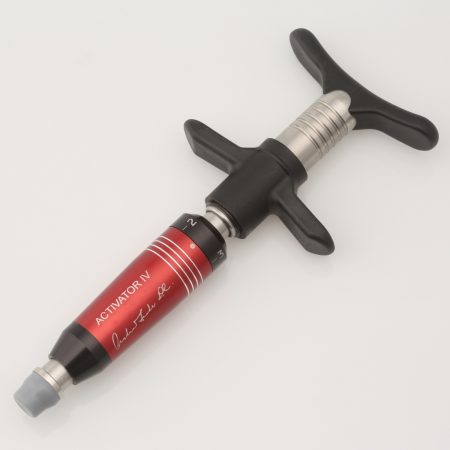
No, I mean it—she nailed it. She used a device called an activator, which gives a quick, pulsing adjustment, like a nail driver. I felt much, much better afterwards. “That’s the ‘honeymoon,’†she warned; I would feel that adjustment in a couple other places in a day or two.
And here we are, a people who are badly in need of a realignment. And like the various quadrants of my body feeling the ripple from a major impact to my chest, we’re all feeling reverberations—from this election, from this administration, from the intransigence between tribes, from the incitement to escalate disagreement into division into conflict, sometimes armed. 50% of the population thinking the other 50% is an existential danger to the ideals they hold dear.
Did you know the average adult head weighs about 13 lbs.? But if it tilts a bit forward—if you walk by ‘leading with your nose’—it can feel like 33 lbs. on your spinal column. I can only imagine how much of a misalignment can happen if one’s head is even heavier—with conceit, with a lacquer holding every combed-over hair in place, with fake-tan make-up, with a lantern-jaw defiantly thrust out to the world like some bird that puffs up to twice its size to ward off any threat of predation. What misalignments have the last 4 years of lies, the discrediting of those who call out the lies, and defiance of those sycophants who can’t decry the lies, caused us? How do we get back some semblance of flow and symmetry in our national psyche? Where do we find that field where critical analysis and dissent can meet ideas and policies without being cast as ‘radical’ (right or left) or ‘unpatriotic?’
And let’s be honest—these pulls and tugs on our societal tendons and ligaments precede the guy currently packing his bags. We’ve been here before. In 1828. In 1852. 1860-65. 1866-68. !920. 4 years ago, I compared this president to Andrew Jackson, but perhaps you need more recent history. Watch “The Trial of the Chicago 7.†Recall all of the ‘Not my President’ memes, bearing the crossed-out image of both this president and his predecessor. If you’re not happy with the current make-up of the Supreme Court, there’s plenty of blame to be found on the timeline preceding McConnell and the current POTUS, going back decades. Down that path lies more intransigence; I’m for looking for a path forward.
We need an activator. We need something or someone that will transcend some profound divides. I don’t know if Biden is that someone; more importantly, in this context, an activator needs a cooperative body willing to say ‘Let’s try this.’ But in that metaphorical field referenced above, the seeds have been planted: in a year when Colorado sent a pistol-packing woman aligned with QAnon to Congress, Oklahoma elected the first Muslim non-binary woman in US history to its statehouse. The president-elect owes his victory to black and brown people who showed up bigtime (again); yet, his opponent garnered the highest percent of nonwhite voters of any Republican in 60 years. If your worldview has been defined by neatly drawn lines, welcome to a field where the seeds are intermingled like Meadow-in-a-Can. I can hope.
Once upon a time, a new president could expect a ‘honeymoon’ with a new Congress. I wouldn’t count on that this time. But with very real problems that cross party lines—start with the pandemic, but there’s plenty more, including conversations about race, the economy, our lost stature as a global citizen, and a likely Senate Majority Leader already committed to obstruction—we better find that field beyond Me/Right, You/Wrong. Grab your activator. Take your shot.
© 2020 Falling Mountain Music
Michael’s Blog: September 16, 2019
The Folly of Athleticism
After a busy week of music making had exacted a fair amount of abuse on my body—hands, shoulders, hips were all complaining—I needed that Sunday morning yoga class. During which, I had one of those ‘aha!’ moments (thanks, Cindy Lusk). Not just a yoga aha, but also a guitar aha.
She was breaking down a twisting pose that I’ve been doing a long time, some days better than other days, that provides a nice twist in the torso. I’ve always approached that pose from the standpoint of the athleticism needed to put that elbow outside the deeply bent knee. That day, Cindy presented it from a more foundational perspective—legs, pelvis, and torso. That little turn of the crystal changed the way I’ve approached this twist for years—better foundation allowed for more (and easier) twist–it no longer felt ‘athletic.’
I know so many ‘athletic’ guitarists, both students and pros. Their focus is on how fast/how far/how-the-hell-do-you-do-that finger choreography. Most of them bore me to something else. Don’t get me wrong—sometimes we need velocity, and sometimes even more velocity. Elliott Carter once put a direction in a score that read “As fast as possible.†A half-page later: “Faster.†But by only focusing on the athleticism, many guitarists miss the point: the artistry, the commitment to express something…what? Express something! I’ve maintained for years, in workshops of a few dozen to a private lesson, that if you, dear student, attend to the foundational elements, the athleticism will come, naturally and musically. Fast fingers without musicality isn’t, in yoga parlance, the yoking of skill and action.
I’ve found the same attention to athleticism to be folly in other endeavors. In cycling, my lack of attention to foundational elements has at times almost resulted in spectacularly bad news items with headlines like “Guitarist goes ass over teakettle for going too slow and too fast at same time!â€. Meanwhile, I can say with some certainty that I made the best bouillabaisse I’ve ever made this weekend because of the attention paid to the foundational elements, from the vegetables I personally selected (Amazon Prime, while nimble and athletic, isn’t going to necessarily give me the best plum tomatoes I can get on a given day in the produce section), right down to my home-made fish stock. No athletic shortcuts—just a damn fine kettle of fish.
If you’re fidgeting right now and thinking: “Sure, DeLalla, but you know what? Just make me play faster…â€, well, I can do that for you. In one lesson, I’ll give you everything you need to be the next fretboard speedster. But don’t ask me for a second lesson.
Time will tell if I’ve also learned those lessons for my yoga practice. Meanwhile, I’m toying with an idea. My first book outlined my approach to guitar and creative process through the allegory of my yoga practice. Maybe the next book will be how to approach yoga through one’s guitar practice. Given where I am at on that yoga journey, the subtitle might have to be something like: “For Forever-Beginners Only.â€
© 2019 Falling Mountain Music
Michael’s Tour Blog, July 31, 2019
Lessons
Saul Bellow was here. So was Milton Babbitt. John McPhee, one of my favorite writers, holds a faculty position. And Albert Einstein rode his bicycle here. So naturally, it seemed a good idea to take the bike for a spin around the town and campus of Princeton, the morning after the last show on this tour.
It was a good idea, until my chain broke, which, I learned later, happened because my cassette has been worn down, by a chain that needed changing…Einstein would probably have a pithy quote about the circular nature of causality attributed to him, maybe an update to:
e=mc2, where energy equals mass times the speed of light squared.
Perhaps this:
ie=mcc
where ie equals inertia and mcc equals mangled chain and cassette. Ride, and lesson, aborted after only a few miles.
But I didn’t have time to investigate. It was time to get to Kent OH, another storied university town. There, we connected with friends, Jena Root and Doug Smith. Last year, I followed Doug’s blog as he rode his bike cross-country and wrote about it with sheer eloquence—check out his blog: https://www.crazyguyonabike.com/doc/?o=1mr&doc_id=20929&v=kK Lessons on two wheels and carried in 5 panniers.
Doug loaned us bikes (it was he who issued the post-mortem on the cassette, rest in pieces), and off we went to meet Jena for breakfast in town and then on to Kent State’s most profound memorial to the tragic events of May 4, 1970, where kids with guns fired upon kids without guns. I can’t recall a more moving memorial as we circled the site of that tragedy. I pondered the pagoda, where the bullet hole that pierced it is a vivid reminder of what occurred as the shots rained down from that high ground onto the protesters below. Did the bullet piercing the pagoda get knocked off course and spare a life? Did its trajectory get re-routed into an unsuspecting body? Like so many other aspects of the day’s events, we’ll never know.
We said good bye to Doug and Jena, and off we went to Ann Arbor, yet another college town, for some hang-time with Elaine’s sister and brother-in-law, some good food, and an impromptu round of Mah-Jongg. A quick walk around a neighboring nature preserve, then a stock-up stroll through Zingerman’s (cheese!); we were also able to pull together an edible house-warming present for daughter Lauren and her partner Conor, recently re-located to our next stop, Oconomowoc WI.
The dairy farm where Lauren and Conor have landed is absolutely beautiful. The house, dating from the 1870’s, exudes a woody warmth that likely holds its own lessons for a Floridian transplant like my daughter; class begins this winter. Lauren rocked a salmon dinner that we had al fresco on the patio, cows nodding approvingly as none of their brothers made it onto the table. Later that evening, the town and its lakes—so many lakes—were a perfect setting for an evening gelato.
So tonight, as I savor my La Espanola gelato (sour cherries and cream), I’m thinking about lessons. The cities I visited on this tour—Washington, Baltimore, Hagerstown, Winchester, New York, Newark–all trying to rejuvenate themselves, and largely succeeding, despite disparaging comments from a president intent on upholding divisiveness—provided their own lessons in how places once devoid of hope can rediscover it in their own neighborhoods. In each, I remember whole blocks of boarded up storefronts; now, the streets are alive again with the pulse of community. It’s been a pleasure to breathe it, to taste it, to hear its polyphony/cacaphony.
Here in tiny Oconomowoc, a town without a university, there is still much to learn. I awoke this morning around 5:15, gazing out the window from bed as the first light was emerging from the black starry sky. A bird, another bird, more birds; as the early light revealed the fog, both shrouding and illuminating, the unmistakable throaty call of a sandhill crane. 45 minutes later, I wanted to applaud the soundtrack and light show. And the lesson? I’m sure it will manifest itself, perhaps in a piece of music. Much to ponder as we point the car west.
© 2019 Falling Mountain Music
Michael’s Tour Blog, July 26, 2019
Pay it Forward
Dateline: a tollgate somewhere along Delaware Hwy 1
“That red car that just came through? She just paid your toll.â€
“Wow, how sweet.â€
“Right? People’ll surprise you!â€
“We’ll pay it forward down the road.â€
And off we went, our road-ransom paid by a total stranger. Just the day before, as we were crossing the Chesapeake Bay Bridge on our way to Rehoboth Beach, I had told Elaine about the flirtatious little game people would play in my youth as they headed toward the beach—if you spotted a car of women with whom you exchanged knowing smiles, you would pull ahead at the toll gate, pay their toll, and they were supposed to follow you to the beach for all the usual, albeit largely imagined, debauchery. I can’t remember one instance where that paid-for promise was fulfilled. Nor do I recall having an understanding of Pay It Forward.
Just minutes later, we’re listening to Bruce Springsteen’s new release “Western Stars.†Warning: to Bruce-philes—blasphemy ahead.
I hate it.
“Same old cliché…I’m a wayfarer baby, I drift from town to town…when I go to sleep I can’t count sheep for the white lines in my head…â€
Really, Bruce? Did this come from the same pen as “Just wrap your legs ’round these velvet rims and strap your hands ‘cross my enginesâ€? I’m scratching my head as I listen to the recording in its entirety. Elaine offers some context—he wanted to pay tribute to those 70’s songs I was never fond of, the formulaic California sounds squeezed out of the tube by Burt Bacharach/Hal David, Glen Campbell, others, all dressed up with over-wrought string parts. Clarence Clemons must be biting through No. 4 tenor reeds and spitting them out in disgust.
Given our recent encounter of pay-it-forward at the toll gate; this strikes me as PIF’s antithesis. Bruce’s new project pays it backward. With interest.
Later that night, we wound up at the Blue Note to hear Meshell Ndegeocello, for whom the accurate adjectives have not yet been written. Brilliant is only a starting place, the toll gate that gets you on the road of superlatives that I heap on very rare musical beings. Before the show, two young people were seated at our table. I can sniff a college music student in a faint breeze—it turns out they were studying music at The New School. We started talking about different musical streams we all had swum in. Bass players came up. Said Elaine—“How do you like Esperanza Spalding’s new one?†They looked at each other and burst into laughter. The young woman points at the young man as if to say “you take this one.†“Yeah, I better like it—I play on it, and Esperanza recorded one of my songs…†That’s how Esperanza pays it forward. Best of luck, Matt—and don’t forget to pay it forward when the opportunity arises.
It’s late, even by New York standards, so I’m not sure how these three things connect. But by showtime on Saturday in Princeton at the Café Improv, perhaps I’ll have it figured out for a new tale by The Cosmic Messenger, and pay that forward. Here’s hoping to see you there, final show of the tour. In any event, take an opportunity today to pay forward some small kindness. It’s infectious.
© 2019 Falling Mountain Music
Michael’s Tour Blog, July 12, 2019
Where it started
Dateline: Washington DC/Dupont Circle
“This your first time here?â€
“The first time in 40 years. I played here once. And only once—it didn’t go well.â€
“You played here? I’m one of the managing partners here….Wait—I’ll be right back!â€
As I wait for him, I gaze at the guitars hanging on the walls, the drum set cordoned off in a corner like a museum piece, the LP jackets, artwork instantly familiar, as I owned many of those same albums, the soundtrack ingredients that make up the recipe of Guitarist/Composer Michael DeLalla. It’s called The Dive now, but, I’m standing in a place that I will always call The Childe Harold.
From 1973 on, everyone played the Childe. Bruce, when he still needed two names. Bonnie Raitt. Emmilou Harris, for whom I lied about my age so I could crush hard and up close. Danny Gatton. Tom Waits. The Beastie Boys. A local punk band, Balloons for the Dog—I would open for them years later at the Cellar Door, the night they melted down and publicly, and somewhat violently, disbanded.
As stated earlier, I played there once, and it didn’t go well. Back then as a young aspiring—what?—I didn’t even know what I was aspiring to. It was years before I found my musical voice, as a guitarist/composer, not covering others’ stuff. The crowd at The Childe Harold could be wild—you might get a chance to play there, but you were more likely not to get a second one.
There are other places along Connecticut Ave/Dupont Circle that became my early circuit Gallagher’s (gone). Food For Thought—a convenient booking, as I had just turned vegetarian—gone. Kramerbooks/Afterwards Café, where I first broke out the idea of original guitar works—wow, still there. But the Childe Harold was the anchor of the neighborhood.
The tall ebullient managing partner returns. “Here—you gotta take this. And this…and here’s my card…The first this was a Dive guitar pick. OK. Now I own 5 picks, which I use a minute a year. But the other this: an autographed copy of Cerphe Colwell’s memoir “Cerphe’s Up.†“Check out the Appendix—every act that played hereâ€
They were missing one, but I don’t think I’ll ask them to stop the presses. Cerphe remains a radio legend in the greater DC area, and was helpful to me early on. I’m standing in history, I’m holding history. And maybe a bit of future:
“You know, we want people to not just think of this place like a museum. Come in for dinner, but if you want to just pick up an axe and play, then do it! Wanna play one now?â€
“Thanks, no—it’s getting late. But I’ll tell you what. I have a concert coming up over on 16th at Church of the Holy City. We’ll come here for a bite and drink afterwards. Maybe play a little.â€
Will I? You can find out if you come to Saturday’s concert at Church of the Holy City, 7:30 PM, 1611 16th St., and then make a little party for the short walk—after 40 years, I still know the way—to The Dive/nee Childe Harold. Meanwhile, thanks for the 80=proof shot of memory.
© 2019 Falling Mountain Music
Michael’s Tour Blog, July 9, 2019
Please Sir, May I Have Some More?
TO: Why Tours Are Fun (WTAF) Tour Management
FROM: Michael DeLalla, MIN (Minion Identification Number) 0000001
SUBJECT: Upgrading Tour Support
To Whom it May Concern,
First, I want to thank WTAF for putting together another piece of tour magic for me—after the first few nights out, it dawned on me that I’ve come to recognize your handiwork by the quality of the details. How you manage to get each and every hotel room to smell exactly like the same cocktail of Listerine and Deet, for that special feeling of familiarity we all crave when we travel, is beyond me.
While I appreciate such niceties, I do hope we can find the budget for some upgrades. Do you remember the overnight bag you issued me, what was it, 12 years ago, so I wouldn’t have to lug my big case in every night? It was brilliant then, but its luster has been replaced by a greasy sheen that only Army-issue green canvas can attain. I wonder if it’s time for an inexpensive replacement from Target? Do keep in mind, it’s likely to reduce the inquiries from hotel and airline people who think such a bag suggests a decidedly negative profile that usually ends with handcuffs and batons.
I know the goatee is a personal choice we’ve discussed, but as long as I have it I’d like to keep it in some semblance of order. The trimmer just doesn’t cut it anymore, so to speak. Yes, I could continue to use my grandson’s toy plastic garden rake and those sewing scissors you issued to keep down wardrobe costs, but it takes away from my productivity in the morning, the time I usually need to craft promotional items that look like they come from you, as per our 30 year agreement. Give it some thought, will you?
The cargo shorts from…when and where was it, perhaps that stopover in Boise one February when it hit 10 below and you thought it would be ‘Colorado-esque’ to wear them around town? Well, the pockets have been patched, the hems are fraying, and frankly, cargo shorts with a gazillion pockets (did I mention the patches?), along with the greasy canvas bag, is attracting a lot of attention from the local constables. We’ve discussed this, and I thought we were in agreement: not all publicity is good publicity.
I’m sure other once-useful items need to be phased out as well, but realistically, I keep my expectations low ever since I couldn’t even score the newest flavors in Kind bars, though that was devilishly cheeky of you to repackage the old flavors with labels that read ‘breakfast,’ ‘lunch’ and ‘dinner.’
So. There it is, then. Thank you, WTAF, for your attention to these matters. All for art, right?
Yours, it would seem, for perpetuity,
0000001
© 2019 Falling Mountain Music
Michael’s Tour Blog: July 1, 2019
Dateline: Northern VA.
Tour travails: that moment when your newly washed, dried and folded load of laundry is the landing spot of the cup of coffee that went flying as you slipped on the steps. But this tour is going so well, there’s nothing to do but laugh. And rinse/repeat.
© 2019 Falling Mountain Music
Tour Blog: June 19, 2019
Objects in Mirror are More Synchronous Than They Appear
I’m heading east for five weeks of concerts, festivals, workshops, and whatever wisdom The Cosmic Messenger can impart, if I’m paying attention. Those of you who have been to one of my concerts have likely heard me talk about The Cosmic Messenger; if you haven’t, well, get thee to a show this tour so you can keep up. Commercial over.
I’m making the long contourless drive through Nebraska, dropping into Iowa. The fields that normally have corn and soybeans well on their way are nothing but mud and Missouri River. I didn’t plan it this way, but my playlist for this afternoon stretch is “Floodplain†by the Kronos Quartet, cranked really loud. According to Nonesuch Records, Kronos’ label, “The album was inspired by the idea that floodplains…will experience new life after a catastrophe, just as cultures that undergo great difficulty will experience creative fertility.†From the liner notes: “[The compositions] come from cultures based in areas surrounded by water and prone to catastrophic flooding,” Egypt, Serbia, India, Ethiopia, and more. At the moment, I’m hearing “…hold me, neighbor, in this storm…” by Serbian composer Aleksandra Vrebalov. Do they read cummings’ in Serbia? Or does flooding take away all sense of capitalized self-importance? It’s the perfect soundtrack to the scene before me. I sense The Cosmic Messenger is knocking at the door, as I’ve been navigating some creative floodwaters of my own.
You would think that I have a steady stream of music playing throughout these long-drive days. In fact, I’ve spent some quality hours in silence; at least, external silence. A raging flood of ideas inside: I’ve been contemplating collaborative projects in my proverbial rear-view mirror, past ‘guitar &’ entities that included guitar & oboe & mandolin & bass, guitar & voice, guitar & percussion, guitar & guitar (& guitar). Guitar & dance. Guitar & poetry. The fact is, I like inserting myself in other artists’ creative process, find that common ground, or torrent that sweeps us down to a distant place, drenched, exhausted and satisfied. Pondering all this, between Ogallala and Omaha I did some mental sketch work for some future work(s) for a guitar & string quartet, or perhaps guitar & clarinet & cello, with some improvisational chops needed by all involved. Embrace the ampersand.
Time for more listening. I hit the random button; it calls up Dutch classical guitarist Tom Kerstens and the G Plus Ensemble. Synchronous? The Cosmic Messenger again? Though Kerstens is the embodiment of adventurous collaborations involving guitar and other instruments, I was ready to settle for coincidence, when I glanced in my rear-view mirror. A beautiful sunset with silhouetted wind turbines spinning their peculiar dance, spinning like whirling dervishes—spinning in time with the G Plus Ensemble. I pulled over to grab a quick clip, below.
I have no idea how all this synchronicity manifests itself in the concerts in the coming weeks. At the very least, perhaps a new Cosmic Messenger story or two. Here’s hoping to see you at a show.
Click here for video:
https://www.facebook.com/michael.delalla/videos/10219862110807289/
© 2019 Falling Mountain Music
Michael’s Blog: May 10, 2019
(in Celebration of Teacher Appreciation Day)
Epilogue as Prologue

Mary King, my middle school music teacher
The Ouroboros is an ancient image that throughout human history has been used to symbolize the cyclical nature of all things. Something is initiated, it grows; paradoxically, this growth is self-consuming, using life-energy to bring about the thing’s own destruction, which gives way to another beginning. And so on. It’s the never-ending cycle of order and chaos. Birth and rebirth. Eternal Return. Time is cyclical, not linear.
The ancient Egyptians used the image to describe the world’s periodic renewal. Plato used it to describe the universe as an immortal, ceaseless existence. Interestingly, his being had neither eyes nor ears since there was nothing outside of him to be seen or heard. If you think my reference to “him†is mired in confusing sentence structure—the snake, or Plato?—well, any confusion is purely intentional. Nothing existed beyond himself: that’s how Plato rolled. Gnostic texts describe the sun as a disc comprised of a 12-part dragon with his tail in his mouth. Ancient alchemists, who seemed to be intuitively aware, if not factually on target, of the transformative nature of things, employed this image. The Ouroboros represents infinity, or wholeness. It epitomizes the process of “feed-back†as destroyer of the preconceived. It depicts immortality: the snake slays itself, fertilizes itself and gives birth to itself. Again and again.
For me, the motif of the Ouroboros is a powerful image that represents both the learning and creative processes. When we learn something, we unlearn something else. By showing you how to move a finger I’m also showing you how not to move a finger. By creating a simple four-measure phrase, you destroy the silent place where no phrase existed. Again and again.
If you accept that premise as I do, if you accept that this Epilogue is also Prologue, we’ve created a fascinating dynamic between us, exemplified by Mary King’s quote. Everything that I present in this book that is new to you destroys something else—a preconceived notion. A previously held paradigm. A bad habit in need of being swallowed and reborn as a healthy practice. Learning is also unlearning. It’s what’s left when all of the old ideas are devoured.
And if I accept that you have accepted this premise, then I must also accept that I am a condemned teacher. My ideas will be shot to hell as you find your own voice, your own path. You’ll devour me too, and be reborn a different musician than when you first put your tail in your mouth for the trillionth time. At least, I hope so. I’ll accept that fate if you embrace yours to become a lifelong learner. If you do everything I ask of you in this book you will continually begin again.
Teacher as facilitator
“I had only one teacher, myself, and only one student, myself.â€
Andres Segovia
Perhaps a better name for this book would have been “Devouring Segovia.†I don’t mean to keep taking issue with the Maestro, but the above statement is wrong on so many levels that I can only hope that I’ve missed some crucial context to make it more comprehensible. First, it’s factually incorrect: Segovia had many notable students that evidently slipped his mind at the moment he uttered this self-aggrandizing statement, the likes of John Williams (Segovia’s prize pupil described him as “bullying†and “dismissiveâ€[1]), Oscar Ghiglia, Alirio Diaz and countless others who became a generation of notable guitarists and teachers. He may have some claim to having only himself as a teacher; with little previous pedagogy for a reference point, he certainly elevated the instrument and its study to a place that today’s players may take somewhat for granted.
In my perfect world a student has several teachers, including himself. While you may find this book useful (I hope so), a teacher might help you turn the crystal of understanding a little differently. Try to find a teacher that resonates with you. You may only need this teacher weekly, twice-monthly, monthly or occasionally. I have longtime students whom I see infrequently, sometimes only once a year as I pass through their town while on tour. With students across many time zones, holding a lesson via the internet isn’t unusual anymore; it also isn’t optimal. As the technology improves—currently, evaluating a student’s tone through squashed bandwidth is challenging—I’ll likely stay in touch with even more students. Life is complicated; I don’t have a one-size-fits-all formula to help you progress.
While it’s helpful to have someone who can demonstrate what you’ve read here, to put a visual on the literary, go about the process of selecting a teacher carefully, mindfully. At the risk of generating a lot of angry correspondence from teachers, I think a first lesson should be free. I offer this not as a commercial enticement, but as a way to see the possibilities. Mine and the student’s. I get to see what kind of teaching strategy I can employ, based on what kind of learner the student is. The student gets to decide if what I have to say and how I present it rings true. I ask about expectations, I offer a few thoughts on mine. Sometimes, I might recommend another teacher, for a whole range of reasons, which I may or may not explain to the student. Nadia Boulanger had exactly one lesson with a young George Gershwin and cryptically told him “I can’t teach you anything.†There are at least two ways to comprehend that assessment. The point is that the relationship between teacher and student, when it’s a good fit, is a special one.
Sometimes, too special. I once knew a noted voice instructor who wanted to exert total control over his students. His theory was that if they were students, in his studio, then they wanted to sound like him, and it was his pedagogical and artistic duty to oblige them. I could walk by a practice room and know immediately that the student inside was his student. He was very good, and many of his students went on to become very good. He would select their recital program. He would also pick out their recital wear. He might have mandated hairstyles and makeup routines; I don’t know. It wouldn’t surprise me in the least. He was that controlling.
I’ve said it before: I am a vehicle to help you find your own musical voice. I’ll let a story turn the crystal a little differently. Many years ago, I, along with a small group of other guitarists from around the world, had occasion to spend a couple of weeks studying with Pierre Bensusan during one of his residential seminars. As we all fell into the rhythm of the days, an interesting pattern developed. Early in the morning, we students would gather in the courtyard with our coffee and tea, and chat about the guitar. Mostly, the conversation centered on how Pierre did this or that on the guitar. One day, when it was time to begin, Pierre emerged from his second-story balcony window, listened to the conversation taking place below for a bit. He then gave a mock wave of one hand, like a tousle-haired pope, signaling that we should all gather for the day’s instruction. Later, I told Pierre that his entrance reminded me of the Monty Python movie, “The Life of Brian,†about a reluctant messiah-esque figure and his zealots. Finally, in exasperation, Brian shouts from a similar balcony to the growing throng: “Why don’t you all just fuck off!†To which they replied: “But Master, HOW do we fuck off?†Pierre laughed, telling me he loved that movie. But he also understood my point: be careful what you tell your loving students to do, because they will most certainly do it. And HOW.[2]
I’m wary of zealotry, of both sides of the dynamic–those who lead and those who mindlessly follow. I don’t need to hear another me. Please. If I stumble upon someone performing one of my pieces on a video clip, I may or may not like it. But I won’t base my like or dislike on whether or not it sounds like me. Be your own Master.
I have had some very dedicated students over the years. I had one study with me for 11 years—somehow he managed to avoid becoming a zealot and found his own voice. He’s now teaching and composing. I hope his students devour him. He was a singular case, but I’ve had more than a few people study with me for between 5 and 7 years. I’ve had countless students work with me for between 3 and 5 years. All in all, counting private students and workshop attendees, I’ve taught many hundreds of students. So many of them are on the path that they, not I, forged. A Flamenco maestro. A performer and teacher now living in Honduras. A rising-star jazz guitarist in New York. Another comes to mind in California, still another lives, plays and teaches in a Palestinian school. The list goes on; people not being zealots, keeping it real for themselves, devouring me bit by bit as they rebirth themselves.
And what of the so-called Masters, those who paved the way, who set the table, to continue the gustatory metaphor? Said post-Impressionist artist Paul Gauguin, in 1895:
“Follow the masters! But why should we follow them? The only reason they are masters is that they didn’t follow anybody!”
That may be a harsh line to toe. The masters do need to be studied. Not because they need to be imitated, but because their creative process might serve as a crystal-turning moment for those who followed and are seeking their own path. Maybe it was the intoxicating beauty of Tahiti, but Gauguin seemed to overlook the notion that before one can veer off a path, one must know from what path he veers. Otherwise, it’s not a mindful departure so much as a mindless wandering. Know the masters. Then devour them.
The meanings of Practice
The word Practice carries a few meanings. To some, it means to do something over and over, until it’s automatic. The daily work of practice is dull, laborious. Practice also defines what one does once one has achieved proficiency, and perhaps credentials. A doctor or lawyer’s means of earning a living is defined as her practice. One hopes that a lot of practice went into that practice at those hourly rates.
Practice can also describe that which is intrinsic, immutable, important. Your practice becomes ingrained, part of your life. It becomes ritual, but never feels repetitious. Of course—today’s practice devours yesterday’s practice, every day. Hence, we’re all beginners again, every day.
The meanings of Play
Play is another word loaded with meanings. To play is to recreate. It is also to re-create. Rejuvenate. Revitalize. When you play your guitar, try to keep all of these meanings close to you. How you view the meaning of Play will inform your thinking on what it means to Practice.
Finally, a few stray takeaways that you should remember as you continue to explore this wonderful thing called Music on this wonder instrument called Guitar:
· Spending a small amount of time playing daily is better than picking up the guitar once a month for the occasional marathon of music. Even 15 minutes daily will do wonders. More is better, but more less often may not be.
· Lose the image of a “learning curve,†where you measure and graph your practice and playing by a steady arc of progress. Instead, your progress will often be marked by periodic plateaus, followed by surprisingly steep rises—the shape of that graph is more staircase than curve. Don’t think of those plateaus as lack of improvement. They are the moments of order before new moments of growth. Embrace that stability as you also embrace progress.
· Unlike Plato, or his snake, your Ouroboros comes equipped with eyes, ears and heart. Listen outward, not just to your own music. Listen to the vast array of music around you, every day; try to sense how you are part of a rich sonic tapestry and not just a single thread.
· Play with, and for, other people when you can.
· If you breathe, your music will breathe. Cultivate a sense of phrasing that breathes as you do.
· Some days you will sound better than others. Don’t drown in the futility—it’s all transient. See Ouroboros, The.
· As you work your fingers, remember that the most important muscles to work are those that turn up the corners of your mouth. Smile.
FINALLY (FOR THE LAST TIME)
Be light and be joyful in your music. Your lightness and joy will be so evident to your audience, even your audience of one, more so than your perfect recitation of a piece.
Take in all of the advice and lessons and technique and practice you just read, but don’t forget to keep learning. All along the way, keep what works, what rings true. All the rest, discard. Once upon a time someone told you things about music and about the guitar. Things I’ve written may come into conflict with some of those things. They may shatter them completely. You are the agent of your own change. If you accept these principles, it means conflicting principles need to be discarded. And someday, my principles may be replaced.
It’s the nature of the universe, a birth out of chaos, a life moving toward order, only to explode into chaos once again. Over and over. This is your practice.
© 2019 Falling Mountain Music (reprinted from The Mindful Guitarist, © 2015 Falling Mountain Music)
Footnotes:
[1]Alberge, Dalya. The Guardian. 14 October 2012. Website. 8 September 2014 https://www.theguardian.com/music/2012/oct/14/john-williams-accuses-segovia-snob
[2] Full disclosure: When Pierre and I had this conversation at his home in Bouresches I was actually misremembering and rolling together two different scenes from “The Life of Brian.†One scene, with Brian on a balcony, goes like this:
Brian: No, no. Please, please, please listen. I’ve got one or two things to say.
The Crowd: Tell us! Tell us both of them!
Brian: Look, you’ve got it all wrong. You don’t need to follow me. You don’t need to follow anybody! You’ve got to think for yourselves! You’re all individuals!
The Crowd: Yes! We’re all individuals!
Brian: You’re all different!
The Crowd: Yes! We’re all different!
Man in crowd: I’m not…
Man in crowd: Shhh!
Brian: You’ve all got to work it out for yourselves. (continued on next page)
(cont.)
The Crowd: Yes! We’ve got to work it out for ourselves!
Brian: Exactly!
The Crowd: Tell us more!
Brian: No! That’s the point! Don’t let anyone tell you what to do! Otherwise – Ow! Ow!
And this, on a mountaintop:
Brian: I’m not the Messiah! Will you please listen? I am not the Messiah, do you understand? Honestly!
Girl: Only the true Messiah denies His divinity.
Brian: What? Well, what sort of chance does that give me? All right! I am the Messiah!
Followers: He is! He is the Messiah!
Brian: Now, fuck off!
[silence)
Arthur: HOW shall we fuck off, O Lord?
I always say: never let the facts impede a good story. But the vice-versa is also true.
Michael’s Blog: April 9, 2019
A Plane, A Train, An Automobile; or, A Long Day’s Journey into Night, Part 2
I’m back in Colorado after a night flight. Yesterday, I intimated that there might be more to the Car Rental story. I was right…this happened on concert day at the Loudoun Co. middle School All-County Guitar Festival:
“Good afternoon, and thank you for coming to today’s concert. I’m Michael DeLalla, and I know what you’re thinking: ‘These folks from Colorado, they dress so casually, even for a guitar orchestra concert.’ (I’m in my jeans, ‘My Bicycle is my Mobile Device’ t-shirt and hoodie )…In fact, as I speak, there is an 1800.00 Armani suit hanging in my rental car, which I can’t get into, because it has locked me out of it. I contacted the company two hours ago demanding that they get my 2500.00 suit out of the car, and leave me with a replacement car for the rest of the weekend; they said they would send someone right over.
“I just want to thank a few people: JanMarie, our volunteer, who called and identified herself as ‘Michael-DeLalla’s-Personal-Assistant, and-boy-is-he-pissed-and-he-wants-his-2800.00-Armani-suit-IMMEDIATELY;–I hope, JanMarie, when you’re a teacher some day you’ll remember this day and how you helped keep me cool and graceful with the students as you did the heavy lifting.
“I also want to thank composer Miroslav Loncar, who is here today, as we perform his piece; I apologize for not being able to don my 3800.00 Armani suit for the occasion, but I’m sure you understand. On with the show.â€
Yesterday, as I returned the car, a young woman at the Company A counter greeted me with “can I help you?†I asked for her supervisor, that I doubted she deserved the wrath I was about to impart. She smiled gratefully, got her boss.
Long story short. A refund happened, though not 100%, better than nothing.
Oh, and a final thank you to Banana Republic for the blazer that, through a darkened car window, passed as a 4800.00 Armani suit.
© 2019 Falling Mountain Music
Michael’s Blog: April 5, 2019
A Plane, A Train, An Automobile; or, A Long Day’s Journey into Night
(As I’m hoisting my guitar into the overhead bin) “Hey there, you’re not putting that away are ya? Whyn’tcha play us a tune?â€
Before I could tee up one of the many time-honored rejoinders I’ve accrued over the years, I hear from behind me, in a diphthong-dripping Texas lilt:
“You just leave the guitarist alone. And if you ask for the Stairway song I’ll have you taken off the plane in cuffs.â€
Good-natured chuckling all around, as is usually the case on a Southwest flight. I turn around to thank my champion. I try not to stare: she looks amazingly like Ida Lupino, circa 1938. I mouth a silent ‘thank you’; she smiles and gives a shrug and a bit of a head-waggle that says “just doing my job.â€
The sunset flight east is otherwise uneventful. Strike that—having an empty seat next to me is an event. I actually get some sleep as darkness falls beyond my window. I awaken in time for a textbook touchdown at Dulles. I have arrived in Virginia for a couple of days of working with middle-school students who will make up Loudoun County’s All-County Guitar Festival.
Dulles, like Denver’s DIA, uses a train, but without the cowboy voice announcing “The train is ar-RIVING!â€. Maybe they could hire the Ida Lupino lookalike to make it more interesting. Oh well. Nothing left to do but get my rental car, make the 45-minute drive that won’t likely begin before midnight and let myself quietly into my daughter’s house, where all would be asleep by the time I will have arrived.
I wait for Car Rental Company A’s shuttle to take me to the office and whatever car awaits me. Shuttle after shuttle comes, not mine. I ask a driver of Car Rental Company B’s shuttle: “Any chance you’ll drop me off at Company A? It’s after midnight and they are going to close soon.†I different kind of head waggle, nothing like Ida Lupino’s, more South Asian, where the head oscillates between a yes/no shake but the nose never moves, “So sorry, but I only drive to Company B.â€
I call Company A. They say they will send a shuttle right over. 20 more minutes, no shuttle. Four times that Company B driver came back around and my Company A shuttle never appeared. The last time, he opens the doors and says “Get in—I’ll take you to their gate, but you’ll have to walk in.â€
I walk to the Company A office, now dark. I knock on the door and surprisingly, someone appears, someone who looks nothing like Ida Lupino, but he also talks with a South Indian head-wag. We do the paperwork. Not-Ida-Lupino leans over the counter and says, “You’ll see a dashboard light come on—‘oil/filter maintenance’. Don’t worry…(mumble….head-wagging)….â€sensorâ€. “Sure, fine, gimme the keys.†“Take the car to the gate—the man there will inspect it before you go.â€
The Oil/Maintenance light does indeed come on. So does the Tire Maintenance light. I walk back in and tell Not-Ida-Lupino this. He shrug/waggles and says “He’ll inspect it.â€
I drive to the gate. A large man—a very large man—is waiting for me. I don’t know if he has 2 Ida Lupinos hiding in his jumpsuit, but neither do I know that he doesn’t. I say: “Before I sign this, I want you to see these service lights.†He gives me the same waggling explanation about sensors. He pulls his large self onto each of the tires and bounces up and down, while I cringe thinking about how the Dulles Toll Road will feel on four oval tires. He pronounces them fit and ready for service. “Might you have a tire gauge in there with Ida Lup—in your pocket?†“No tire gauge. You need to go back to the office.â€
Which I do. After more haggling and waggling, I tell him I’m only taking this car (the last on the lot of the only company still open) if he initials next to my initials the stated issues I have with the car, plus what I expected in compensation if this car in any way impedes my ability to perform my contracted duties this weekend. None of which is likely legally binding, but it’s now south of 1:00 AM, and my bullshit takes on a waggle all its own.
I return to the Very Large Man at the gate. He waves, and for whatever reason I roll down the window and ask: “By any chance do you know Ida Lupino?â€
“Jazz tune Ida Lupino? I love Ida Lupino! I play jazz—piano.†I say: “No shit—I just saw Carla Bley a couple of weeks ago…I was hoping she’d play it…â€
I start to add “But I meant the actress†but he leans his large self in, saying “Let me set you up†and starts pushing radio buttons till it lands on 89.3 FM, WPFW, DC’s signature jazz station, which, as a longtime Washingtonian, I could have done myself. But sometimes, in the middle of the night robbed of two hours of time zones and who knows what automotive functionality, one takes whatever modicum of service one can, even when all the service warning lights are blinking at you.
Note to Self: next time, heed the service warning lights, if not the actual ones, then the metaphorical ones. More on that in our next episode. Until then, good night.
© 2019 Falling Mountain Music
Tour Blog, March 29, 2019
Dateline: Santa Fe
“I said to myself, I have things in my head that are not like what anyone has taught me – shapes and ideas so near to me – so natural to my way of being and thinking that it hasn’t occurred to me to put them down.†Georgia O’Keeffe
I can relate to this.
Twice before I had attempted a visit to the Georgia O’Keefe Museum. Both times, the museum was closed as it prepared for an exhibit. This time I was luckier—barely. The website said “Open 9-5â€; Elaine and I dutifully arrived around 9:30. The sign on the door said “Open 10-5.â€
With a long drive to Sedona ahead, we pondered the wisdom of waiting—we needed to bike back to our motel to check out by noon. We decided to stay. While we waited in the museum courtyard, the light put on quite a show with a flowering cherry tree against an adobe wall and azure sky.
I’ve owned not one but two of those huge Georgia O’Keefe coffee table books. I’ve been enamored with her stark beauty for as long as I can remember. I’m not sure I was totally prepared for how immediate these works are, viewed up close in a museum: how a desert scape of a multi-hued mesa is brought into the same relief as the cottonwoods in the foreground, dispelling time and distance for the sheer abstract hell of it. The clitoral calla lilies, at once sensuous and innocent. When you can see, inches away, how she shaded the upper edge of a pelvic opening to bring the viewer’s eye into an infinite moment of blue sky and moon—it’s masterful. I almost wish I didn’t have the referential titles, so I could just savor their beauty without descriptors.
We get so wrapped up in what things mean. For the rest of the day, driving through the desert to Flagstaff, I ‘saw’ differently. The striated mesas were a counterpoint to the blue-to-white sky layers (with the occasional descant of a contrail), all resting on a ground both solid and dynamic. Did Bach secretly visit the Arizona desert? I’m here to tell you, it’s hard to turn off the meaning machine: that’s a cliff, that’s a cloud, that’s a rattlesnake skeleton. It’s a similar curse in music, where I can analyze a piece as I hear it, to the point where often the tendencies are downright predictable. And I have names for all of those indicators: sonata-allegro form, here comes a bridge, yep, I knew it. What if I didn’t tell you what one of my pieces ‘means’, but just played it? Would you enjoy it as much (or dislike it as much) without the verbiage?
Come to Synergy Lounge Music Box tonight in Sedona. Let’s not-talk about music. Doors at 7:00, music without qualifiers begins at 7:30.
© 2019 Falling Mountain Music


Tour Blog, March 27, 2019
Dateline: somewhere on the Cosmic Highway in the San Luis Valley, en route to Santa Fe.
If you were a fly on the windshield listening to Elaine and me riff through the San Luis, you heard these, and other, nuggets:
(From the stereo: “What am I to do….I can’t help it.â€)
“Who’s that singing “Falling in Love Again?â€
“Marion Rampal. Thoughts?â€
“I like her take. Most singers make it too precious. Hers is….flippant.â€
“Flippant.?â€
â€Like a shrug—(“I can’t help it.â€) check it out: a baritone sax solo. Was there ever a more flippant instrument than the baritone sax?â€
Later…
( Robert Earl Keen’s “Porch Songâ€)
“I like those junior mints and the red hots tuuuuuuuuuuâ€
“That vowel doesn’t exist in any known language. Singers invent vowels sometimes…â€
“Tom Waits—his vowels are so hard they’re consonants…Joni Mitchell in her gravel period…Vinicius…â€
“There is absolutely nothing wrong with any of Vinicius’ vowels.â€
Later…
“Sigur Ros, that piece covered by the Kronos Quartet…â€
“But we don’t know what those vowels sound like since it’s a made-up language…â€
If you make a seven hour road trip with someone, be sure that someone is someone with whom you can converse about the important stuff.
© 2019 Falling Mountain Music
Michael’s (one and only) Blog: March 26, 2019
Singularity
A quote from a recent item about this Friday night’s show in Sedona AZ: “an intimate concert evening with the one and only Michael DeLalla…”
I’m flattered, but I must set the record straight. I’m actually not the one and only Michael DeLalla. There is at least one other Michael DeLalla that I know of, a retired toy maker in Massachusetts. Interestingly, we both have daughters named Lauren, both of whom would point at us and take game/set/match with: “But the other one is the famous one.”
Since we became acquainted online some years ago, I’ve always wanted to meet him–I can’t imagine a better doppelganger than a toy maker, as we both endeavor to make Play happen.
This naturally begs the question: if there is one other ‘one and only’ Michael DeLalla, why couldn’t there be others? Maybe a pie-maker. A crafty ambidextrous relief pitcher. And maybe we need to look beyond this ‘one and only’ moment. A friend who describes herself as a channeler,–a person who conveys thoughts or energy from a source believed to be outside the person’s body or conscious mind–once told me that I had been, in various past lifetimes, an Andalusian monk, a Watusi medicine woman…I’ve forgotten the others, because what else do I need to remember after Watusi medicine woman?
Our notion of being singular beings takes on a special meaning in higher mathematics and physics. Be careful what you ask for: singularity is defined as
“a point at which a function takes an infinite value, especially in space-time when matter is infinitely dense, as at the center of a black hole.†You may view yourself as a singular human being, but you might just be densely sucking the oxygen right out of the room. Finally, Singularity is described in some esoteric circles as “a hypothetical moment in time when artificial intelligence and other technologies have become so advanced that humanity undergoes a dramatic and irreversible change.â€
If this is the case, I’d rather not be the one and only.
Back to the other Michael DeLalla I know—I hope we can meet, and talk about how we each manifest Play. Maybe someday. Meanwhile, come Play with me, Friday March 29, at Synergy Lounge Music Box, details below.
© 2019 Falling Mountain Music
Michael’s Blog, January 1, 2019
Fill Your Cup
“Dream up, dream up, let me fill your cup with the promise of a man.â€
Neil Young, “Harvestâ€
It’s a new year. I need a new word. Let me explain.
I may have a few modest talents, but the ability to guess the measurement of time, distance and volume is not one of them. Time—this one gets an asterisk. As a musician I know time in terms of rhythm, meter and duration as a means of demarcation. But time as a linear function, not so much—in my world, sometimes it seems that all time exists all the time–past, present, future. It can make deadlines challenging. The second, distance—at least it doesn’t seem to have done me harm. I can be out on a bike ride for some length of time, then think I can extrapolate from that time the distance I travelled. Invariably, that calculus indicates cycling time x, distance y, minus several overestimated miles because I don’t know shit about how far I can ride in an hour. However mathematically improbable, for me, y < y.
Then there’s volume.
It never fails. I tend to cook more food than we can possibly eat in one sitting. This is by design, as I know there will be a night that will not allow adequate time to cook, only time to warm the left-over Moroccan stew made the day before. So after the first dinner, I need to stash the leftovers in a Tupperware container. I stare at the stew in the pot; a bead of sweat appears on my brow as I look into a 4-qt container, 9 inches across, but with only about 2 inches of stew…will it into one of those Number 3 containers, which holds 6 cups…did I miss that day in 9th Grade Geometry class…why didn’t I take it in 10th grade like most of my friends…I had no business…here goes—I start ladling the stew into the container…it’s going to be close…
It’s not even close.
So what’s the big deal, it goes into 2 containers—easier to store, right? But that’s not the point. Evidently, I have very limited capacity to evaluate capacity. Is there a word for this? Dys-something? A word to indicate my inadequacy with measurement, the world of metrics? How’s this for a neologism:
Dysmetric.
At my age, the last lap of my 50’s, my miscalculation of Tupperware volume isn’t likely to change. But my new word has me thinking about its implications on a larger cultural and social level, where we may be dealing with an advanced condition of dysmetric behavior—let’s call it ‘dysmetricity.’ We fill each other’s vessels by ladling out our opinions, our fears, our anger, our too-hip-by-half cleverness, without any sense of the capacity for others to absorb it. It just leaves a big obdurate spill all over the table of shared ideas.
For a certain Ladler-in-Chief, this is by design. Divide with divisiveness, with untruths reiterated, over and over, until the facts throw up their hands in surrender. Ali had his rope-a-dope strategy, this president prefers repeat-a-tweet. He keeps ladling; his supporters keep nodding, until there’s a hot mess on the stove. It suggests to me a more dangerous form of dysmetrics—the notion that no volume of facts and informed opinion to the contrary will displace the unflagging support which already fills their cups. That’s not a problem of this president. That is a problem of Us.
While the investigative wheels continue to turn, while he continues to foment divisiveness, we need to figure out a new way to talk to each other, or it will be more of the same, well beyond this administration. If you want to understand how to talk to someone who holds different views than you—you do, don’t you?—stop thinking in terms of a Democrat/Republican divide. This is an economic, social and cultural divide. Much of what many celebrate have left others out in the cold, marginalized. Try to understand why a truck driver with a high school diploma hurls the invective ‘elite’ at an associate professor when that associate professor begins lecturing on economic conditions. Try to grasp that a surging stock market is pretty meaningless to someone whose portfolio is the paycheck that needs to last till the end of the month. Maybe leave room in your vessel to allow people of a different background to fill you up a bit with their story. When filling theirs, pour slowly and know their capacity, when they’ve had enough. Then, they may come back for more.
A few years ago, at an international conference in Munich, Senator John McCain and Congressman Adam Schiff were sharing a dinner with Bono and Bill Gates. They were all getting along famously, sharing jokes and the like. Bono then turned serious and said, ‘You know, I love Ireland, I’m a proud Irishman. Ireland is a great country, but it’s not an idea. America is not just a country; it’s an idea.’
As a dysmetric, I might be tempted to try to fill my bowl beyond the brim with such a romanticized sentiment, even though I know intellectually that I need to temper it with my wariness of American exceptionalism, the notion that whatever we do is acceptable because we’re just so darn special. Instead, I’ll pour it into the larger vessel of perspective. I like to think we have the capacity to rediscover what made us so widely admired in the first place (while we continue to work on that exceptionalism thing). Today, that’s challenging as we watch nationalistic and autocratic leaders fostering antithetical objectives to Bono’s ‘idea’ of America while this president not only doesn’t refute them but openly admires them and, consequently, enables them.
I know never to underestimate our capacity to keep filling our cups with dangerous nonsense, amid the shrugged notion that someone else, maybe our children, will mop up the mess. But maybe Bono is on to something. Maybe next year someone will sport campaign hats that read “Make the Idea of America Great Again.†Then we can raise our cups together and figure out what that means.
I was hoping to keep this blog to 600 words…dysmetrically challenged again. Pass me another Tupperware container. Happy New Year, dream up, and may 2019 fill your cup with all that nourishes.
© 2019 Falling Mountain Music
Michael’s Blog: December 21, 2018
A Solstice Remembrance
There is one story and one story only that will prove worth your telling:
Whether as learned bard or gifted child; to it all lines or lesser gauds belong
That startle with their shining
Such common stories as they stray into.
Is it of Trees you tell, their months and virtues,
Or strange beasts that beset you,
Of birds that croak at you the Triple-will?
Or of the Zodiac, and how slow it turns below the Boreal Crown,
Prison of all true kings that ever reigned?
Water to water, ark again to ark, from woman back to woman:
So each new victim treads unfaltering the never-altered circuit of his fate;
Bringing twelve peers as witness both to her starry rise and starry fall.
Or of the Virgin’s silver beauty, all fish below the thighs:
She in her left hand bears a leafy quince, when with her right she crooks a finger smiling;
How may the King hold back?
Royally, then, he barters life for love.
Or of the undying snake from Chaos hatched whose coils contain the ocean?
Into whose chops with naked sword he springs.
There in black water, tangled by the reeds,
Battles three days and nights, to be spewed up beside her scalloped shore.
Much snow is falling, winds roar hallowly; the owl hoots from the elder.
Fear in your heart cries to the Loving Cup:
Sorrow to sorrow, as the sparks fly upward;
The log groans and confesses: There is one story and one story only.
Dwell on her graciousness, dwell on her smiling:
Do not forget what flowers the Great Boar trampled down in my time.
Her brow was creamy as the crested wave, Her sea-blue eyes were wild;
But nothing promised that is not performed.
(To Juan: At the Winter Solstice, by Robert Graves)
© 2018 Falling Mountain Music
Michael’s Blog, November 22, 2018
Thanks for the Giving
This is the day when it’s customary to be thankful, and to enumerate those things for which one is thankful. Here goes a short list:
These are interesting times, to be sure. But if we’re lucky, all times are interesting, all the time. I’m thankful for the wealth of people in my life who keep it interesting minute by minute, if I would just pay attention.
Sometimes ‘interesting’ happens randomly: the elderly woman who tools around Niwot in some kind of walker/wheelchair—Elaine and I ran into her as we walked into town yesterday. She was waiting at what passes as a busy crosswalk in our little village; drivers hesitated, indicating for her to wheel into the street. She’d smile, wave, then wave them on. A lot of time spent with no one going anywhere is not always a bad thing, but we thought it wise to walk into the street and direct traffic on her behalf. “Want us to stop the cars for you?†“Oh, thanks, I’m just resting for a minute, I thought I’d wave at people while I catch my breath…†So we stopped for a moment and chatted with her, exercising the time-honored rule of crosswalk decorum: if a group of people are engaged in conversation, they likely aren’t trying to cross. Niwot was spared a Thanksgiving Eve traffic jam.
Another way that times are interesting is when there is silence. It’s so rare. When true silence happens, it’s precious, and I’m thankful. Thankful for the respite from the sonic clutter, clatter and chatter, of which I’m partly responsible, given my profession as a composer and performing artist, where I frequently have to navigate the liminal places that delineate Sound, Noise and Music. While I’m thankful for the opportunity to explore those boundaries, I enjoy the respite found in silence. This weekend, we found silence near Snowmass, at a Trappist monastery we happened upon; we found it again in a delightful Yoga class where we and our teacher were a class of three. This class is always fun when the crew is there, but the silence was golden.
I’m thankful for the people in my life, family and friends, the crazy-quilt mix of personalities that keeps on giving. For all its fallacies, this platform, Facebook, has allowed me to keep up with more people from more places and more times than I could have ever imagined. From 1750 miles away, we get to watch two little grandsons on their own discovery of interesting times, a small but vital salve against the pain of distance. My page’s feed is filled with people I’ve met at shows during a busy year of touring and teaching—I’m thankful we can stay connected until next time. It’s also populated with people I knew, then didn’t know, then knew again through the magic of becoming reacquainted by a Friend request.
And all that giving can get weird.
As polarizing politics sinks its talons deeper into us—a subtle nefarious act of taking, not giving, but let’s save that for another blog—the times become interesting in sometimes odd and alarming ways. I might have lost a longtime friend earlier this year because this person chose a scorched-earth tactic of discussing things on which we disagreed—there’s nothing left to be thankful for when all is in ashes. My attempts at letting this person have the last word failed—again, and again, and still again, as I refused to engage in a conversation intended to bait and destroy, not build a bridge of understanding—it was interesting, but in the end, it was simply sad.
So this Thanksgiving Day, yes—keep the times interesting. But keep it civil, and in perspective. My father loved nothing more than to engage in interesting, sometimes combative conversations. If he were here at the table this Thanksgiving, I could say with a straight face: “Fascinating, isn’t it, that Nancy Pelosi will be third in line to the presidency. More yams, Dad?†And we would probably laugh, shake his head and offer some rejoinder that wouldn’t impede the progression of the meal to dessert and post-dinner drinks.
Yesterday, I had occasion to be part of an online discussion about, alas, politics, with two friends of opposite political leanings. I asked each of them where we could all find a place of agreement. Spoiler alert—it didn’t happen. But later I pondered the three of us and our points of view. One, a conservative, shares my passion for cycling, if not much in the political arena of ideas. The other, a progressive, shares many political views (though not all), but views cyclists as much the same kind of impediment to road travel as a pothole. For me, there’s room for both at the table. And on the road. Sometimes, I’d rather disagree with someone on a bike ride than agree with someone on a couch.
Happy Thanks, and Happy Giving
© 2018 Falling Mountain Music
Michael’s Blog: September 26, 2018
It IS Political. And I’m OK with that
Things one ought to know about the Supreme Court, but (given the commentary I’ve been reading), many don’t:
1. Look, it IS political.
Those of you wringing your hands that this SC nominee is being treated unfairly because of political forces, just stop. The SC is, in fact, highly political. It always has been, at least with regard to those appointed to serve on its bench.
Jay was a political choice. Taney, Hughes, Thurgood Marshall, Sandra Day O’Conner–all appointed out of political expediency. Some went on to become brilliant. Others, like Taney (the Dred Scott decision), will live in infamy. Some non-seated appointees didn’t get their place on the bench because of politics. Bork has become a verb. Garland has become a travesty.
Political? Yes, it is. This nominee is only in the conversation, and the quagmire he is responsible for based on alleged past bad behavior, because he was the political price paid to powerful forces who helped win this election. In politics, it’s OK to call into question one’s honesty, one’s past actions, one’s political views, and how and where those things intersect in the public interest.
2. 9 justices? This isn’t in the Constitution. The number of justices is set by Congress. It’s been 3, it’s been 6. It’s, therefore, a politically driven decision. Roosevelt wanted to add justices to solidify his New Deal programs; Congress denied him. As it was, by the time he died after being elected to four terms, he had appointed 8 of the 9 justices.
3. “Justices should only utilize the content of the Constitution, not the context.” Really? Then Taney’s Dred Scott decision would still stand. Then African Americans would be considered 3/5 a person. Then women couldn’t vote. On and on. Literalists, as they are called, don’t have a legal leg to stand on, yet entities like the Federalist Society hold tremendous power in building lists of justices who will Uphold the Old. Both Gorsuch and Kavanaugh were on that list, submitted to the current president, who wouldn’t know a legitimate, qualified SC candidate from a candied date. Oops, there I go, politics again.
In a perfect world (and it has happened), a justice rises to the SC and transcends his/her politics. But when they are appointed BECAUSE of their politics, with a wink-and-nod understanding that those views will be pre-supposed on the bench, then it becomes problematic. And here we are.
This is why voting matters. It’s a political action–or inaction–that leads to this very moment, a moment with ramifications that will last a generation. Hold this thought on Nov. 6.
© 2018 Falling Mountain Music
Michael’s (longish) Blog: Sept. 1, 2018
Very Superstitious
“Very superstitious, writing on the wall…â€
Thursday night was in every non-calendar sense the last night of summer: every August, R & B singer Hazel Miller closes out our little outdoor summer concert series. With two of my guitars both landing on the disabled list in a matter of hours, thereby negating my evening practice (but not the stress about how to solve this with concerts looming), Elaine and I decided to walk over for a little diversion. If Aretha was queen, Hazel Miller is certainly a titled lady. Towards the end of the evening she absolutely killed Stevie Wonder’s ‘Superstition’, evoking Aretha’s version in a joyous tribute. And then it hit me. Maybe I’m superstitious. Let me explain.
There are times while on stage I feel the imperative urge to remind the audience of my shortcomings. This is different from when my shortcomings make themselves apparent via a buzzed note, a clam (the musical epithet, not the bi-valve), the momentary out-of-body experience known clinically as WTFAID (don’t ask). I’m referring to when I have to remind you, dear listener, that instrumentalists are different from, say, singer-songwriters. Singer-songwriters are sensitive and deep. As an instrumentalist, I have no sensitivity, no depth. We instrumentalists are an insensitive, shallow lot.
Need proof? I don’t name my guitars. They are tools for me—the vehicle (I don’t name my car either) that solves a musical problem. Don’t get me wrong—I appreciate each of them for the different jobs they are tasked to do. But they are guitars, not my children (the only reason I named my children was due to a lost argument with the school board).
Perhaps it was this shallowness and insensitivity that compelled me to do something I normally eschew—I entered a guitar competition. I need to get it right out there that I’ve never quite understood these competitions. Especially for guitar, where the mere act of playing the instrument takes on, at times, a certain mano a mano dynamic–the right mano doesn’t always know what the left mano is doing. But then to add to that the notion of someone doing this ‘better’ than someone else—what does that mean? Faster? Utilizes more Stupid Guitar Tricks? Explain it to this shallow and insensitive soul.
I should explain that for me the act of not-competing isn’t rooted in some grandiose sense of higher purpose. It’s about superstition. While studying at a conservatory, I never entered the concerto competition. But Michael, you say, one can’t win if one doesn’t compete. True, but one can’t lose either.
This superstition about not-losing runs deep, to the marrow. I grew up in Washington DC, where, despite what our current dotard-in-chief says, not a lot of winning happens. I never won the lottery. Bingo wins every time. Poker? I’m the house’s best friend. Women? Let’s not even…
So I surprised myself when I entered the One World Prairie Guitar Competition, which happened last week, in Cheyenne WY (or is it Why Cheyenne?). The prize was 1000.00 and a concert that night, with the two other winners from their respective categories.
I won.
I can say in all honesty that I played well, as well as perhaps two other players. All three of us come from very different stylistic backgrounds—it’s as if a tomato beat a banana. Any one of the three of us could have ‘won’; I enjoyed many of the other entrants as well. For someone who hates the notion of music as a competitive endeavor, why do it? Here’s where I can validate the ‘shallow and insensitive’ thesis. I did it for the money. I thought to myself, “Self, if you win, throw it into the pot for a new guitar.†(Hey, it’s a start, though a small one). My concert classical is 50 years old—I don’t even take it on tour (except a recent trip by train). The only reason I continue to tour but it doesn’t is superstition—I’m a little shy of a decade older than it is, and really not feeling the retirement bug. Knock on wood.
I played the concert, and was treated to a stupendous sidebar: the young woman who won the classical competition (I won ‘acoustic’) was brilliant. Fifteen years old, already a veteran at competing; she also took second in this year’s prestigious GFA young artists’ competition. Gwyneth was a delight, and I’ve been delighted by many a young and up-and-coming player this summer, from a young cellist who joined me for an impromptu collaboration at a festival, to a violinist in Telluride whom I had not met until showtime, to a roomful of young players bursting with sensitivity and depth during the PAVAN workshop. Here’s something about guitarists that is not typical of other musicians: while you’re trying to have a conversation or impart pedagogical wisdom, they can have a propensity to ‘noodle’—to play aimlessly while you talk. As we chatted backstage before the concert, Gwyneth did this as well, she’s 15 for goodness sakes. But when Gwyneth noodled, it was on the Castelnuovo-Tedesco concerto and Britten’s Nocturne. I didn’t shush her.
“Seven years of bad luck, the good things in your pastâ€
Then the story turns dark.
If I suddenly admit to possible superstition, does that make me sensitive/deep? Since that competition, my two classical guitars, a Ken Hill (nice for plugging in, and spruce-top) and a Kohno (the 50 year old, cedar-top, my main concert guitar) both needed emergency visits to the luthier. The timing couldn’t be worse—I need both of these guitars for some upcoming concerts, and the preparation that comes with those shows. The Hill had picked up a rattle or two, probably from the change in altitude coming home from the east coast. You know, 0 to a mile high…I often pick up a rattle or two myself. I timed it so I could get it tweaked between shows, but it meant I needed the Kohno for, well, everything that requires a classical guitar. While putting new strings on it Thursday night, I heard the unmistakable groan of a tuning machine finally giving out—the low E, which frequently must become a low D, which requires so many turns of said tuning machine (I could tell you exactly how many, if you need a stupid guitar trick).
“Rid me of the problem, do all that you canâ€
When I panic, two things happen concurrently. I spring into necessary, and hopefully, right action; and I let my imagination run away with me—many a composition has come out of such a panic (my pieces get named only so I can collect royalties). Despite my shallowness, this is where my imagination took me: are my guitars secretly peeved at a potential newcomer? Might one of them fear it is to be sold to accommodate this newcomer? Are they in rebellion? They once lived and aspirated as trees, flora from four different continents; do they all speak some secret Arbor Lingua? Am I doomed to the insurrections of my own private guitar union? “Go ahead, cross the line, punk. Make sure you kiss the wife goodnight first. Oh, and too bad in advance about that neck reset.†Damn tree-thugs.
“When you believe in things that you don’t understand
Then you suffer
Superstition ain’t the way.â€
Relax, guitars—I need all of you, especially the one I’ve begun shopping for. Knock on wood.
© 2018 Falling Mountain Music
Tour Blog: July 22, 2018
De-compressing from De-compressing
Dateline: An Amish Farmer’s Market in Southern MD
“So you’re a musician? I like band music alright, but only….(extends his arm its full lanky length)…from a distance. My only music is singing. Singing to The Glory. I love that.â€
I decided against trying to explain how I neither played in a ‘band’ nor would be readily heard ‘from a distance.’ And said: “Yes, I know a bit about your singing tradition. It’s powerful stuff. The musical term would be ‘full-throttle forte’.â€
“Yep, that about sums it up.â€
I take the vegetables that will become a full-throttle Thai dinner and head out into the full-throttle rainfall with Elaine and my sister Jean. It’s a perfect day for this kind of weather: Following Thursday’s performance to conclude this year’s PAVAN workshop, I really needed a day to decompress, so yesterday was spent off social media and with the 3 F’s: family and friends and food. It usually follows that a day of decompression is followed by decompressing from the decompression. That means I’ve answered a ton of emails and notes about Thursday’s concert, had a quick phoner with a violinist I’ve never met about a gig in Western CO that we’re doing in a couple of weeks, and finally was able to get outside, rain be damned. Decompression and de-decompression complete, I can try to process this year’s workshop.
I must say, being part of a multi-discipline collaborative project such as our rendering of “Scenes from Ellis Island†was moving beyond words. I was able to watch the video and was moved to tears. So many people to thank: Kevin Vigil, for his soaring, poignant solo and his priceless facilitation of bringing composer Benjamin Verdery into our rehearsal via FaceTime; Keith Filppu who helped shepherd the vocalists we brought into the project. The Theater and Visual Arts divisions gave the work both voice and context. All rocked it.
I’ve long been interested in exploring the creative process across the disciplinary boundaries that all artists inhabit. The practical demands of making a living in the arts necessitates my spending a majority of my time in my own yard—music. But what can I learn by peeking over the fence at a visual artist, a Thespian, a dancer, that I can bring back to the music? What do I have to offer to them? Do we share the same artistic principles? In the end, we’re all telling stories, contextualizing our observations, and hoping to be some gateway to insight into the things that delight us, scare us, sadden us, lift us up. Or, when needed, escape from all of that.
That’s why this year’s workshop concert was so satisfying. We, the guitarists, had a framework—Ben’s piece stands by itself as a beautiful story, allowing those other disciplines to peek over the fence at us and go huddle over what they could do to enhance it. They succeeded mightily. I will always treasure that process, and the moment it presented. Thanks to all of you involved.
I have no idea what my Amish farmer friend would think of this performance, and I won’t ever know. The pending video will not be available to someone who eschews modern technology. I wish we shared a fence line that I could peek over into his world, lanky arm’s length away. I am grateful that the fruits of his labor were available to me, who eschews quasi-food. I think I owe him, having gotten the better end of the transaction.
© 2018 Falling Mountain Music
Michael’s Tour Blog, July 17, 2018
What’s in Your Mirror?
It took some digging, an abacus and advanced metrics for me to figure out I’ve taught the guitar workshop for PAVAN Governor’s School for 30 years. To contextualize that number, I began teaching this 2-week workshop the year that one of my guitar co-teachers was born. I’ve officially crossed an interesting threshold: I’ve taught PAVAN more years than I haven’t taught PAVAN.
And if you think I and my colleagues are just rehashing what we’ve done for years, well, as my mother used to say: “yougotanotherthingcoming†(my wee ears thought that was all one word). Every year, the players are better; one auditioned with the Prelude from the PFA (don’t worry if you don’t know what that is, it’s badass). A Calton case or two is an indication that these young players have nice guitars. I’ve already mentioned the student who talks a mean game of Scriabin. All of this means we get to up our game accordingly.
Also notable: the breadth of cultures represented by this group, many first generation, some young immigrants themselves. Malaysia. Guatemala. Brazil. North India. South India. Ireland. Korea. Colombia. Peru. Spain. Mexico. Finland. Florida (he’s proud of that, so it’s included). Regardless of where you stand on the too-casually bandied about term known as the ‘immigration issue’, it might be informative to look into the faces of immigration, all assembled in one room, all ready to play guitar at a very high level, before forming a position about how ‘we have laws’, and ‘we can’t just have open borders.’ You might come to a new position: It’s Complicated. It is indeed complicated. It’s more complicated than a tweet. It’s more complicated than a bumper sticker, a t-shirt, a ‘like’ button. A wall.
Part of ‘It’s Complicated’ must include some reflection on history. If you choose to use the term ‘settlers’ to describe the first Americans, you might also want to consider how ‘unsettling’ it was for the indigenous peoples already living here. And those peoples would at times ‘unsettle’ each other—the trope of the Noble Native American is complicated too. For 60 years, Ellis Island was the busiest ‘processing’ point for immigrants wanting to enter the US. Some of what fell under the guise of ‘processing’ turns my stomach; you’ll have to do your own research. Start by googling ‘Ellis Island’ and ‘buttonhooks.’ My point is that some have drawn imaginary lines around the issue, and then ask that certain groups of people get ‘in line’ behind these lines. Where I come from, we call that a syllogism.
What’s not complicated, what becomes pervasive with a tweet or a soundbite, is the racism and xenophobia currently circling above some camps like a banner-pulling plane, for the purposes of giving voice to a political base that is still shockingly bigoted. Correction: the bigotry isn’t shocking. The easy enabling of it is. History has shown that fomenting fear and empowering hate isn’t that complicated.
With all of this in mind, it is immensely, intensely personal for me (a first-generation Italian-American), to make the concert performance at the end of the workshop a mirror reflecting the diversity of our 36 guitar students. Our guitar ensemble will be performing Ben Verdery’s “Scenes from Ellis Island.†Coincidentally, (OK, not so coincidentally), I’ve conducted this soaring, beautiful work a couple of times before, the first time shortly after similar national discussions about immigration were being tossed about in the months following 9/11. Besides Ben’s piece, that concert featured the works of composers who were products of the immigrant experience. I called that program “Those Who Came Before Us Became Us: A celebration of Immigrants, Their Gifts, and Their Legacy.â€
This year will be different. Because we have such a short time to prepare, all three of the guitar faculty—Dr. Kevin Vigil, Keith Filppu and I—are marshalling our collective energies to pull this together. I couldn’t possibly do it without them. Also jumping on board, as it were: the choral division will lend us some singers to help us literally give voice to all of the cultural traditions represented on stage. Likewise, the Theater division will be making a contribution; I’m awaiting ideas from the Visual Arts faculty. It will be a profound, cross-discipline effort.
I’m also mindful of the fact that I’m not there to proselytize (that’s what my blog is for, right?). However, a well-conceived piece of music can provide a teachable moment without me offering my particular political leanings. What the students and audience get out of it depends on their personal mirror.
Earlier on this tour I gave a chat in Leesburg VA about the importance of the arts beyond making us feel ‘cultured’, I mentioned how they can serve as a mirror, reflecting who we are—good, bad, indifferent—in ways that can foster empathy, and, hopefully, change. Or, one can just enjoy the pretty sounds and pictures. Regardless, you’re welcome to come witness it, Thursday, July 19, 7:00 at Sherando High School in Stephens City VA. It’s free. Almost. All it will cost you is a gaze in the mirror and some measure of self-reflection.
© 2018 Falling Mountain Music
Michael’s Blog: July 16, 2018
Gifts Along the Way
While on tour, I accrue things (hopefully offset by a reduction of things, like CD and book inventory)–an occasional zucchini bread this time of year, a dram of this or a splash of that, an unmeasurable amount of generosity and kindness, new and renewed acquaintances, and priceless memories. This work of art, painted during a show last week by young Madeleine McKnight–I will treasure it, my dear. Thank you–and looking forward to some quality time tonight with you and Andrew McKnight and Michelle Wileczek McKnight (and perhaps a dram of this and a splash of that.)

Tour Blog: July 5, 2018
What Do We Want to Be When We Grow Up?
“[With] art comes empathy. It allows us to look through someone else’s eyes and know their strivings and struggles. It expands the moral imagination and makes it impossible to accept the dehumanization of others. When we are without art, we are a diminished people — myopic, unlearned and cruel.â€
Dave Eggars
Dave Eggars is one of my favorite writers. Artists who touch me are the ones who give me the gift of experiencing our world through new eyes, ears and perspective. It starts with a brokered deal: the artist offers to dazzle; I, the recipient, accept the offer to be dazzled. The currency is the art itself.
As the attached article states, we’re living with forces that decline the opportunity to foster moral imagination. Dehumanization is easy when you look at others through a pre-judged filter that only shines a blinding light on a small part of the whole picture. “We have laws†is illuminated, while the qualifier “but we also consider the circumstances, and exhibit, when appropriate, mercy†(as any judicial officer not named Sessions will tell you), is left in the shadows.
Historically, the arts have been viewed on a spectrum: at one end, they are enthusiastically embraced as a means to experience The New, or The Familiar in a New Way. A bit further down the spectrum is circumspection—will this jibe with or upset my world view? Still further along that spectrum is dismissiveness, anger and fear: when art becomes a threat to those in power, they shut it down. This happens periodically throughout history, in a variety of ways: Hitler considered some composers not named Wagner enough of a threat that they sought refuge in other countries—mostly, this one. Thankfully, they weren’t detained, but then again, they were white Europeans. Stalin and Khrushchev mandated that composers such as Shostakovich write music in a certain Russo-celebratory style, or face consequences. Milan Kundera, author of “The Unbearable Lightness of Beingâ€, had his works banned by the Communist regime in what was then Czechoslovakia.
And today? The current administration chooses from the entire platter: a dismissiveness of artists as ‘elites’, effectively barring the enlightenment they may bring to the White House, which has traditionally celebrated the arts in all of its expressions, without regard to the political bent of the occupant. The anger exhibited both by the administration and those who brought it to power is antithetical to the notion that art can enlighten, can provide a new perspective to complex problems. As for fear—return to Eggars’ quote: the last thing this administration wants is to let light in and ‘expand moral imagination.’ That would be tantamount to admitting a moral flaw exists in the first place. Better to pull the drapes closed with fearmongering that distills every complex issue down to “us†and “themâ€.
Art, then, isn’t a luxury. It isn’t a passive activity we do in our ‘spare time’. It carries a moral imperative. Without its ability to broaden and deepen a world view, we become intellectually and culturally atrophied. Not only are we less than we can be, we are more easily manipulated by those whose ability to hold power is predicated on those they seek to control lacking the imagination to question or defy those actions. Nothing fires the imagination of possibilities like a good book, play, painting, dance, or piece of music.
And my place in this drama? I’m hoping that the music I bring to my upcoming shows fires the imagination, taps into something within you that might have gone untapped for a while, and, with a little help from the guitar gods, dazzles.
Here’s hoping you can make a show, and come prepared to receive all that.
Yesterday was about the fireworks and remembrance. Today, let’s begin to remember who we want to be when we grow up.
(Here’s a link to the entire essay by Eggars:
https://www.nytimes.com/…/dave-eggers-culture-arts-trump.ht… )
© 2018 Falling Mountain Music
Tour Blog: July 1, 2018
Today I’m the fly on the wall.
I’ve just reached the end of my morning bike ride. I’m sitting on a shady bench at the trailhead, cooling down as much as one can cool down, alternately squirting water in my mouth and down the back of my neck as the temperature and humidity vie for the century mark. Two riders approach, wearing matching jerseys that read “Black girls DO ride bikes!†One looks like a seasoned cyclist; the other might be a newbie.
The first thing I overhear:
“I think this seat’s a little low—can you fix that when we get home?â€
I approach:
“Would you like to fix it now? I can help with that.â€
“Thank you! I’d love that.â€
I ask her to straddle the frame, then sit up on the saddle—it’s definitely low. We chat about the interaction between the seat height, the frame, the stem, all the variables that go into a good ‘fit.’ She takes it for a spin; her companion (turns out she’s training for an Ironman) and I evaluate, call her back for another tweak.
As I work on her saddle height, the second thing I overhear:
“I’m gonna get Julio out here riding. Maybe he’ll get calves like that.â€
I’m still smiling. And blushing a little. Just the heat, I suppose.
© 2018 Falling Mountain Music
Michael’s Blog, June 17, 2018 (Father’s Day)
Dad Bod
Though I’m on the waning side of my 50’s, I like to think I’m in reasonable shape. Not perfect, mind you—my left hip is still pretty sore after a hard fall on the bike last weekend. If I overdo my wheat intake, as I did a few days ago with one of my more exquisite Puttanescas, I’ll feel the right hand and right knee joint pain for most of the next day. A retinologist and I have an appointment upon my return from the pending tour. My mind still seems sharp, except when it isn’t; my memory still pretty good, if I recall correctly. My waist is at least marginally smaller in circumference than my chest. So I’m not complaining.
I wasn’t complaining, that is, until last night, when, upon returning from a gig, Elaine and I were watching a bit of baseball—Rockies and Rangers. Shortstop Trevor Story was safe at 2nd with a textbook headfirst slide. As he got up I was impressed to see on the front of his purple jersey a perfect imprint of his ab-solutely perfect abdominal sixpack created by the red Texas dirt. Michelangelo couldn’t have painted it with more anatomical correctness; a printmaker’s roller couldn’t have given that dirt spot better definition. Bod-relief, to coin a phrase.
I got to thinking—if I had slid into 2nd headfirst (assuming I actually slid, instead of coming to a laughable halt, out by feet, as I haven’t done that particular bit of choreography since the annual Falling Mountain softball picnics I would host back in the Shenandoah Valley), the imprint left on the dirt wouldn’t look like a sixpack at all. More like a backpack, with a few of the pockets bulging a bit. Maybe like a russet potato.
Oh well.
Dad Bod. The term sounds slightly demeaning, as if the afore-mentioned scars are a result of, not coincidental with, being a father (and now, grandfather, twice over). Parenting leaves marks, to be sure—on all colliding parties. The best we can do is get up, dust ourselves off—but not before considering the dirt-dispersal pattern in the mirror–and then lean into the next base path.
I leave on an east coast tour in a couple of days. As with every tour, I’ll endeavor to eat well, get some exercise, keep the debauchery to manageable levels. I’ll probably bring a bike again—it’s still my favorite form of exercise, recreation, and vehicle for self-reflection. And music happens on bike rides, not through ear-buds (never), but through the rhythms of a body and bike and nature coming together in a peculiar kind of counterpoint. Last week, while in Aspen for a gig, Elaine and I were on ride—I forget where (that memory thing again). What I do remember is the rhythmic chatter of the hummingbirds, against the rhythmic chatter of my bike when coasting downhill—just out of phase enough to suggest the early minimalist works of Reich or Riley. Will those polyrhythms find their way into the music? We’ll see.
Biking facilitates not just inward but outward reflection. This Father’s Day, there are children in cages, apart from their mothers and fathers. Not in faraway squalid places—right here in this country, a place that used to place itself above such horrid behavior. Spare me any rationale as to why this is right. As a nation, we seem to be drifting toward a new kind of flabbiness—Mad Bod? The guy in the White House is flabby in body, ethics and intellect, as are his subordinates, so I’m not surprised that our national identity is taking on that endomorphic shape as well. The moral flabocrats that have tried to normalize this behavior, or excuse it for political expediency, or justify it with decontextualization of the verses they call sacred—they’ve got to go. Starting in November.
I’ve got to go, too. As on previous tours, I’ll be sharing some thoughts in my tour blog. Here’s hoping to see you at a show, or on a ride, or any of the other places where I endeavor to play in the red dirt.
© 2018 Falling Mountain Music
Michael’s Blog: May 25, 2018
Multi-Modal Therapy
When not gracing KGNU’s airwaves, my wife Elaine is a transportation consultant. She loves her work, often given to waxing poetic about ‘multi-modal transportation.’ She likes to say “It’s about moving people, not more automobiles.†I, as a performer and composer, also swim in multi-modal waters; while the meaning is different, there are, on occasion, similar instances of things crashing. Regardless, I think I did her proud earlier this week, travelling to a gig by train, then Uber, on foot walking city streets, light rail to the airport, plane back to Denver, the train at DIA that took me to the bus that brought me to Boulder, where my car was waiting to take me back home. It occurs to me that both of us are in the business of moving people.
I’ll spare you the analogous roadmap of how some of my musical compositions traverse many modalities and tonalities in what, on a good day, is a satisfying, purposeful wander. This happens in my improvisations as well, where the compositional process happens in a compressed time frame, what can seem like a single infinite moment—again, if it’s a good day. And just like when I’m travelling terrestrially, I can wind up in unexpected places on the musical map.
This cavalier attitude about what constitutes ‘arrival’ caused my daughters no small amount of grief as they grew up, as I would intentionally (well, sometimes) get lost while driving. They would also move through a variety of modalities, from sharing sideways glances of incredulity to stone-quiet fear, to the middle ground of wariness, as I tried to put them at ease with my inarguable logic that continues to inform me to this day, whether wandering lost on the roadways or in the musical wilderness: “It’s a round planet. We’ll eventually get home.â€
Come wander with me this weekend, at Wildwood’s Mini-Festival in Del Norte, in the beautiful San Luis Valley. I promise to get you home again, in one direction or another. Perhaps you’ll be moved.
© 2018 Falling Mountain Music
Michael’s Blog: March 28, 2018
Play Ball
On the eve of a new baseball season it occurs to me that most arguments can really be framed (see what I did there?) by the allegory of baseball. Take the current debate about guns, gun violence and what to do about it.
We’ve had a nice feel-good Grapefruit-League inning after the March, with Emma and the kids acquitting themselves nicely against some major-leaguers like the NRA and the cold-dead-hands folks. Those pro-gun forces have managed to change the discussion from gun violence to “They want to repeal 2A.”
We’ll not win that one. Statistically, this is why you don’t send your masher up to be the lead-off hitter. The pitcher will reformulate the argument at least 70% of the time in his favor. The NRA and its minions have done just that. Instead of swinging for the fences in inning one of a long afternoon, let’s concentrate on getting our lead-off hitter on base–maybe it’s the rising generation who have already proven their eloquence and understanding. Get out the vote. Win in November. Flip a Congress that can effect responsible laws to curb gun violence, and keep the man-child-in-chief in check. Changing the convo to repealing 2A is a sure way to take the long walk back to the dugout.
Play ball.
© 2018 Falling Mountain Music
Michael’s Blog: March 19, 2018 (Blog de Michael: 19 de Marzo de 2018)
Brain-dead: It’s Not Just in English Anymore (Estupor: ya no es sólo en Inglés)
Dateline: The couch, after a long week of uber-giggery (el sofá, después de un montón de conciertos)
With some performance opportunities possibly looming in some interesting places, I’ve decided it’s time to learn Spanish. I already do nicely with French and Italian, so Spanish shouldn’t pose much difficulty. I may go the Babbel route (¿tienes alguna opinión?), but I’ve also found that watching Telemundo, especially on brain-dead-the-day-after-a-long-week-of-shows timeslots, (como era el caso ayer) has proven helpful. TV in general is such a silly self-referential medium—it’s easy to pick up a lot of a foreign language by watching the most trite of programming.
In my most comatose moments, I’ve taken to watching ‘Master Chef Latino.’ One, I am already fluent in food and cooking; two, it’s a gas (muy divertido). The ‘celebrity chef judges’ (‘jueces de jefe celebridad’) and contestants (concursantes) are sheer fun just to look at: un hombre who could pass as the disheveled brother of KFC’s Colonel Sanders (desaliñado hermano del Coronel Sanders), a woman who is most certainly the doppelganger of Drew Carey’s nemesis ‘Mimi’ (el doble de la némesis de Drew Carey ‘ Mimi ‘), and a contestant who is a cooking nun (Monja de la cocina), shyly diverting her eyes from the provocatively attired women (mujeres muy calientes) with whom she is competing.
Whether or not I land a show or three in a Spanish-speaking country, this has been a fun venture. If the music thing doesn’t work out, maybe I could pitch my own show idea: “Learn to speak Spanish like an American who can’t speak Spanish†(“Aprende a hablar español como un Americano que no habla Españolâ€).
Off to work on my elevator pitch (consulta de ascensor). Oh look—it’s Don Francisco.
© 2018 Falling Mountain Music
Michael’s Blog: Feb 18, 2018
Lineage
This morning I woke up to two seemingly disparate ideas that I felt the need to process: last night’s Ailey II dance concert at CU and an online discussion with one of my students who talks about how we don’t need teachers anymore, he can learn whatever guitar music he wants via YouTube.
I’m fascinated by lineage in the arts—who begat whom. My lineage is informed by both an older pedagogy and a newer one to emerge from it–I was a ‘cusp baby.’ Not to mention the huge influence of musical traditions from across the planet, where lineage is vital—if you are going to play a traditional piece, you better be able to cite where you got it, or you are likely a dilettante. All of this was on my mind as we attended a dazzling performance by Ailey II, the company of emerging young artists of Alvin Ailey American Dance Theater.
Having collaborated with a few choreographers over the years, I know a bit about Ailey, and his lineage—you can trace a line back to Ted Shawn with a lengthy pit stop at Lester Horton, who made his dancers understand art and music and literature to be better dancers (present and former students of mine are rolling their eyes, saying ‘Oh no, another one!’). It sure seemed like the dancers of Ailey II get all of this—they know their lineage.
The pre-concert discussion was excellent, explaining the sheer physicality of Ailey’s ‘T-s’ and ‘hinges’—the kinds of things that set off Ailey from other modern masters. It’s like knowing how a Clare fiddler’s slide differs from a Donegal player.
The group of friends I was with all agreed the highlight was a newer work titled ‘Breaking Point’, described by choreographer Renee McDonald as a depiction of our heart’s desire, whatever it is—and what takes us to our limits. The music was provided by Audiomachine—worth checking out if you’re into gaming music. Most of the rest of our group wasn’t as impressed with Revelations—I was, because it’s Ailey’s signature piece, first premiered in 1960. For me it speaks of his lineage like no other.
The point of all this that I would like to make to my student: learning an art form, say, guitar, is more than knowing what fingers to put on what strings. There’s a ton of musical DNA that should also be absorbed during that process, and it’s hard work. But the alternative is the sort of barely informed approach that people seem to take today in much of their endeavors, from guitar playing to their political opinions. The information age has become the shortcut age. I fear that lineage will suffer.
© 2018 Falling Mountain Music
Here’s a clip of ‘Breaking Point’ for some reference:
Michael’s Blog: Dec 1, 2017
Once Upon a Time
This is the blog post where I try to convince you to buy a couple of CDs to give as gifts. Or my book “The Mindful Guitaristâ€. Or give someone you love some guitar lessons with me. Or host a house concert. Because music matters. But first, a story.
Once upon a time—well, a few days ago—a friend from high school, Laurie Rockelli, announced on Facebook that she had just bought a guitar, a Keith Urban model, complete with amp, DVDs of lessons—the proverbial works—after seeing Mr. Urban hawk the package on Home Shopping Network
Said Laurie: “I love him because he just said he can’t read music and he failed a music class. I can relate, having failed Mr. Q____’s music theory class at Oxon Hill High School.â€
“Congratulations!†I wrote. “Ah, Mr. Q____…you know, he wouldn’t write me a recommendation for music school, because I wouldn’t sing in his choir. Enjoy the guitar!â€
“Well, your career trajectory wasn’t too affected…I remember when you got accepted into the Conservatory. Mr. Q_____ and I definitely didn’t click. My mom was like ‘how can you play guitar and fail a music class!’ Lolâ€
Yep: lol. That would have been the end of yet another laugh-out-loud moment on a social platform, had it not been for a cascade of memories. And, with a nod to His Bobness (Dylan, for you youngsters), a simple twist of fate or three.
So, once again upon a time…
That teacher? He eventually left—retired, I believe. He was replaced by another person he had held in contempt, a music teacher who, coincidentally, had been quite an early influence on me in middle school. She was evidently a much better judge of talent–she mentored a budding singer/songwriter named Meshell Ndegeocello. Oh, and this teacher was briefly married to Barack Obama’s half-brother when she lived in Kenya. (Lord help me, here come the Birthers—ducking).
And once upon yet another time…
A few years ago, I heard from another old friend, Khalid Randolph, who was one of my student assistants during my early days of working at Shenandoah University. 20 years later, he was Dr. Randolph, and serving in the Department of Education of that same Barack Obama, as his Liaison for Minority Affairs in Education. In between, he took a job as a choral director at—you can’t make this up—Oxon Hill High School, replacing a brilliant teacher who had replaced someone watching his watch until his time was up.
I purposely didn’t tell this story in a linear fashion, because all of the levels of connection are still vital. There is no “And then this happened…†I’m reminded of the I Ching, the ancient Chinese oracle which operates on the principle that all time exists all the time: past/present/future, not past-then-present-then-future. At any given moment, your actions can touch, in wondrous and otherwise ways, past, present or future. What did Faulkner say? “The Past isn’t dead. It isn’t even past.†I think analogous aphorisms could describe Present and Future.
In concert, I’ll often invoke an entity I refer to as “The Cosmic Messengerâ€â€”the force of the universe that brings us Insight. Wisdom. It can come from anywhere. An encounter with a total stranger on the street (countless times). Or an animal in the woods (a few times). Even Facebook (this time). If we’re listening (all the time).
What is The Cosmic Messenger saying in this story? Maybe this: that the music does indeed matter. It matters more than a person in authority telling you it doesn’t matter, as it happened for both Laurie and me. Maybe she earned that failing grade; maybe I earned his dismissiveness. But in the end, the music won out, for both of us.
Or, maybe the Cosmic Messenger was just trying to say:
Clearly, everyone wound up where they were supposed to.
(Oops. ‘Time’ got away from me, I almost forgot: for music, books, blah blah blah….www.fallingmountain.com)
© 2017 Falling Mountain Music
Michael’s blog: Nov 22, 2017
Perspective
Dateline: the home office, a 3-way phone call, Elaine and I talking to our insurance broker helping us navigate the 2018 version of Connect for Health Colorado (We’ll call her “Câ€).
C: Can I do anything else for you guys?
M: We can’t thank you enough, C. You’ve been brilliant. We’re sorry it took four phone calls.
C: No worries—we want to get it right.
E: I’m sure it’s a tough time right now for you guys…changes coming…who knows what will happen. But I hope you have a fun Thanksgiving planned.
C: Well, my boyfriend and I are cooking for the family…it will be interesting. We’re going to make crème brûlée for fifteen people.
M: He must be a badass. It takes a big man to wield a kitchen torch.
C: Um, you might say he’s a badass. He’s a Green Beret.
M: Wow. So he’s home? Has he been over there?
C: He’s home now…(audible sigh)…you might say he’s too good at what he does. Three missions, he brought all his people home safe. They decided to make him a trainer…the guy who replaced him…one guy was shot through the arm…another…we’re going to a funeral on Saturday. Dessert’s easy. Holding a widow’s hand…
E: We’re so sorry…
C: Yeah, so are we…we may be getting married this year, if he’s going to be home…so all this stuff, the healthcare stuff…y’know, I just can’t get too stressed. Just try and keep other people from getting stressed, y’know?
M: C—I don’t do this often, but if you guys do get married, give me a call. I’ll do the music for you.
C: That’s so sweet—we just might take you up on that! Happy Thanksgiving. You guys make me smile–you’ve been so great to talk to.
M & E: Happy Thanksgiving, C.
Yes, our healthcare cost has gone up considerably (though C, bless her, went above and beyond trying to save us some money). Yes, I’m pretty pissed; it’s liable to be even worse next year. But first, Thanksgiving. I don’t know the recipe for crème brûlée. But I think I found a recipe for thankfulness: equal parts humility and perspective.
© 2017 Falling Mountain Music
Michael’s Blog: Nov. 11, 2017
Open Windows
Dateline: September 1999, Bouresches, France
This Veteran’s Day, I woke up thinking about an almost forgotten experience, almost 20 years ago. I had arrived in Bouresches for a 2-week guitar workshop with Pierre Bensusan. The days were structured so that in addition to the guitar material, we also had some free time to soak up the Champagne countryside.
I remember one day—it must have been early in the fortnight, since I wasn’t yet on Euro-time. Everyone else was taking advantage of the mid-day break, some napping. Unable to unwind like that, I took a mid-day walk. I remember walking through the village, past open windows, smelling all the great meals being prepared. I also recall walking past several windows and hearing arguing between spouses—what was the moon doing that night? I can’t recall.
I kept walking, and past town I spotted something a little out of context—an American flag in the distance. I was curious, so I headed toward it—I had stumbled upon the Balleau Wood battlefield and cemetery, where the first Americans fell after entering World War I.
For the moment, ignore the Garth Brooks song that references this place—intentionally or not, he mixed up two World War I stories. What did happen is that the 4th Marine Brigade met seemingly impossible odds, facing well-placed machine guns able to cut a human body in two. While they were repeatedly urged to turn back by retreating French forces, a Marine captain, Lloyd Williams, was said to have uttered the now-famous retort “Retreat? Hell, we just got here”. In later accounts, a Major Wise took credit for those words. I’m skeptical, having heard plenty of WWII stories from my dad, Tank Sergeant Luigi DeLalla about the propensity of officers to snatch credit (and the occasional captured motorcycle) from subordinates.
The French gifted this cemetery to the US in appreciation for their sacrifice that June of 1918. The shooting would stop five months later, on another long ago Nov. 11. It was to be the war to end all wars. Like with some senior officers, the truth fell a bit short.
I walked back to Pierre’s, past the several warring households again. Only now, instead of marital spats, I’m hearing the sound of mid-afternoon lovemaking from every one of the same open windows.
Sometimes, peace wins.
© 2017 Falling Mountain Music
Michael’s Blog: October 31, 2017
Compromising Positions
My original thought on General Kelly’s comments about how the Civil War could have been averted if both ‘honorable’ sides could have just ‘compromised’ was: “He’s daft.†But I’ve decided to compromise, and assume he is having some academic amnesia. Part of my compromise is to inform the general of the compromises that did indeed happen to influence the war, compromises learned by any 9th grader who uncompromisingly made it to Civics class.
For starters—literally–as it was a linchpin of the Constitutional Convention, was the so-called ‘3/5 Compromise’, where 5 slaves counted as 3 human beings for the purposes of establishing population (and, thus, congressional apportionment). Then there was the compromise that put off the abolishment of slavery until 1808, to keep the Southern states from walking out of the convention. A compromise to this compromise said that Northern states would extradite fugitive slaves. Then there was the Missouri Compromise of 1850 that said new states below the 36th Parallel could allow slavery if they chose. All this compromising…and still a war, whose history has been compromised by shifting the narrative to a more noble and less odious cause.
General Kelly, I’ll offer this compromise: you’re not a dolt, merely a victim of a toxic, self-serving administration that uncompromisingly makes the argument that there are always two sides to every story. Even when some principles, including human dignity, should never be compromised.
© 2017 Falling Mountain Music
Michael’s Blog, Oct 1 2017
The Curious Rise of Madam President Cruz, or, I Have a Sueño
Dateline, San Juan Puerto Rico, in the not-to-distant future:
After her island is recently devastated by first a hurricane and then a woefully inadequate aid response, San Juan’s mayor rises meteorically in popularity as she is the latest to expose the ineptitude and callousness of a certain sitting Chief Executive.
The clamor begins for her to run for US president, against an incumbent under impeachment proceedings for a number of charges, including merely being a tone-deaf and desultory dolt.
Technically, as a US citizen, she meets eligibility, except that she would have to move to the mainland to live for 14 years before running. She realizes: at the rate things are progressing (or devolving), this country doesn’t have 14 months, let alone years
She pushes hard for PR statehood. It passes, making her a citizen of a US state. Forces abound that oppose her as she campaigns and wins by a landslide in 2020. A constitutional crisis happens, with her election victory landing in the Supreme Court: the issue being whether she was in fact a citizen and therefore a legal winner.
She builds her case on the fact that the first 8 presidents were born under similar circumstances, in colonies that were not yet states. The Supreme Court decision is close, the tie broken by the only woman of Hispanic heritage on the bench, selected by the first African American president. Congratulations, Madam President Cruz.
I can dream, can’t I?
© 2017 Falling Mountain Music
Michael’s Blog: September 19, 2017
A Blog About a Blog
In the vernacular of my students, shit’s getting real.
First, dt refers to his Korean counterpart as ‘Rocket Man.’ Then, if the Borowitz Report is to believed (the Borowitz report should always be believed), and because one Elton John earworm isn’t enough, said Korean counterpart comes back with calling him ‘Honky Cat.’ Personally, I wish each of them could be launched somewhere, burnin’ out his fuse up here alone.
Borowitz brilliantly references other talking points and name-calling: ‘The Bitch is Back’…’Tiny Dancer’…and my personal favorite, ’Good-bye Yellow Wigged Toad’…but I think he stopped far short. Now, Elton John’s catalog is bigly huge (OMG—auto-correct just recognized ‘bigly’…sad!). I can imagine a full-on convo between these two pinheads, made up entirely of Reg Dwight’s titles. Going something like this (yes, all words framed with ‘…’ are actual titles of Elton’s):
“Yo, tr–all talk and ‘Ego’, like your endless ‘Border Song’…never any action.â€
“Hey ‘Rocket Man’, ‘Screw You!’ You’re just a ‘Madman Across the Water’â€
“Hey Yankee! ‘All the Nasties’ you putting on me—Did ‘Jamaica Jerk Off’�
“You and your whole family—‘Fascist Faces’, all of ya…â€
“If you can get somewhere without a golf cart, why don’t you take a short walk to ‘The Scaffold’, call it ‘Curtains’, because, you know, ‘The King Must Die’…â€
If only one of them would make the first move to walk this whole mess back. Maybe it would sound like this:
“You know, we ought to be ‘Breakin’ Down Barriers’ instead of promulgating this ‘Madness’…’Nobody Wins’…’Whenever You’re Ready We’ll Go Steady Again.’â€
© 2017 Falling Mountain Music
Michael’s Blog: August 23, 2017
Eclipsing expectations
First, let me just say I was moments away from cancelling a trip to Wyoming to watch the totality of the eclipse. I had just returned from a rather grueling 5-week tour; awaiting me at home was a mountain of prepping a semester’s worth of classes that would begin the morning after the celestial show. By the Friday morning we intended to depart for Wyoming I was exhausted, but in the end, Elaine and I were in the Glendo-bound car to witness the event with 29 other friends over 4 days of camping, biking, hiking and merriment.
You’ve already seen (or taken) spectacular photos, so I’m not going to add to the Facebook flotsam. I would like to share something more ethereal: some thoughts and observations as the eclipse was happening.
There were pelicans, down along the North Platte River. We watched them become more and more agitated. As totality neared, they arose in a kind of formation—did they rehearse this? More awe.
In the distance were hot-air balloons. I’d have loved to have seen what they saw, but then again, when one balloon fired its fuel at exactly the moment of totality, we got our own treat–the effect was like watching a solar flare.
Several of us had scoped out a prime viewing location with a reconnoitering hike and bike—Reflector Hill was our chosen spot for a 360 view. 360 degrees…it put an eerie perspective on the usually linear nature of sunset and sunrise, where a chromatic point in the west or east grows gradually across the arc of the sky. As the eclipse neared totality, pinks and reds and oranges streaked that sky—all of it, all around us, not just in the west. Then, darkness. Minutes later, a 360-degree ‘sunrise’, as the sun emerged once again. It was during these moments that amid the cheering and laughing and self-congratulation for merely being there to witness such an event, we collectively shushed ourselves. In the middle—literally–of such awesome beauty, for a few moments, there were no words. I will cherish that silence as much as anything I witnessed that day.
I can’t imagine what early witnesses of eclipses felt. Fear? Maybe. Relief when it was over? Probably. But I wonder if during some time in the course of human history it also became a symbol of optimism following despair? We catch our breath as the darkness devours all that is light, when knowledge succumbs to ignorance, when power devours placidness, a single brief moment when all illumination ceases to be.
Maybe this is our eclipse moment. We can hope. We can dance like agitated pelicans before we rise in a unison of joy and relief that this darkness too has passed.

© 2017 Falling Mountain Music
Tour blog: Aug 6, 2017
Oh, Canada
Dateline: somewhere on the Trans-Canada Highway, rolling through beautiful Ontario bogs and forests along the Ottawa River. I’m tapping hi-hats and pounding tom-toms on the steering wheel to the most excellent drummer on Kate Bush’s new live recording (3 hours!). Also on the soundtrack, courtesy of Elaine, as always: Tinariwen, Jane Siberry, Richard Thompson, Joni Mitchell, Kronos Quartet’s “Floodplain.†Along with the interesting and diverse music bed, I’m thinking about some of the interesting and diverse people we have met since entering the country for the final show of the tour, and smiled. It occurs to me: Canada is a happy country.
This isn’t my first Canadian rodeo, but my first time here in a few years. It’s been my experience that Canadians are always helpful, willingly, smilingly. Their national symbol is a happy maple leaf, not a dour eagle itching for a fight. The construction cones on their highways look like happy little Cat-in-the-Hat hats. One never hears a car horn honked in anger.
Canada isn’t just happy all the time; that would be unseemly, smug. They are also polite, even in admonishment. A road sign flashed as we approached a construction site: “Too fast! Slow down, please. Thank you/Merci.†Another: “Lane closed ahead. Sorry/desoléâ€
And their humor! Checking in at our funky little hotel near Montréal’s old city, the concierge bears not only a resemblance but speaks in a cadence similar to George Costanza’s father (“Festivus! For the rest of us!â€). He smiles through his Polish-inflected French and says “I have your room ready. Two rooms, in fact. We’ll see which one you get. But first a question: Do you, um, like your president?â€
More smiles: while biking around one of Montreal’s lovely parks I approach a trail intersection at about the same time as an elderly gentleman, also on a bike. I signal a left turn and stop to yield to him. He grins widely, and perhaps for the first time in his life gives a directional signal: a straight-ahead pointing a la “Charge!†as he continues through the intersection, chuckling all the way. Later, same ride, we stop to find a bathroom. When I come back Elaine is chatting with a Montréal couple, in her less-than-confident French. Both slow down their French for her, offering her encouragement and gentle corrections. As I join the group the husband says “Votre femme parle très bien le Français!â€
Sometimes the smiles are wry. That evening, while having dinner in North Bay (restaurants named Arugula just seem to automatically rock), our waiter says: “You’ve travelled a long way. And I know why you’re in Canada…†He assures us that we’d be welcomed with open arms should we decide to stay.
More smiles the next day: in Northern Ontario, we stop for gas. The young guy ahead of us was just about to start pumping. He stops, smiles, holds up a finger as if to say “just a minute.†He puts the nozzle back, pulls his car up so we won’t have to wait. In the states, I’d probably still be waiting for a similar guy to come out of the store with a super-sized Mountain Dew. And a different finger. I thank him; of course, he waves it off with a “No worries.â€
I go inside to pay for the fill-up, the woman behind the counter asks:
“Do you have gas points?â€
“No, we’re from the other side.â€
“Oh, the other planet.â€
“Seems that way, I’m sure…â€
“Where are you from?â€
“Colorado. We come in peace. Though I do wonder if our president is an alien.â€
“Oh, let’s not go there. All I know is I stopped watching (some Canadian comedian I didn’t recognize). Now, I just watch the news.â€
Humor. Helpfulness. Niceness.
Maybe instead of trying to Make America Great Again we should merely strive to Make America Happy Again.
© 2017 Falling Mountain Music
Tour Blog, July 26, 2017
In Search of the Sublime
“Wow, you make exactly three people I know who play the nyckelharpa.â€
We had stopped to listen to a street musician outside the Portsmouth Brewery, home to the most exquisite blackened haddock chowder.
“Oh, I only play oddball instruments…nyckelharpa, the hurdy gurdy, hammered dulcimer, the psaltry, lute, all kinds of whistles.â€
He said this with the kind of authority that was probably well-practiced for the tourists who don’t know those instruments or the traditions from which they emanate. Given the musical streams we swim in, it would have been easy enough to say something snarky like “But you said ‘oddball’ instruments…” In truth, we were on a mission for the sublime, and didn’t want to be distracted by someone playing a sublimely beautiful instrument less than sublimely. We put some money in his case, and continued inside.
This is the only place we know that makes blackened haddock chowder, besides Chez DeLalla/Erb. We learned it from them, years ago. Every time we find ourselves in Portsmouth NH, we make the dutiful pilgrimage. Every time since that first, no blackened haddock chowder.
Elaine even called them from several hours away. “I can’t recall the last time we made that chowder”…I’m thinking: we could. “But we have a few other great chowders…”
And they do, some of the best I’ve ever tasted. Sometimes, sublime is out of reach. You want to hear a really good nyckelharpa player, but the best you can do is good Swedish traddy fiddler (or a less-than-stellar nyckelharpa player in New Hampshire, who may or may not only play it because it’s ‘oddball’). The best we could do was a really fine chowder that wasn’t blackened haddock. Sometimes, sublime wasn’t part of that day’s catch.
If you’re within driving, biking or swimming distance to Lubec ME this Sunday afternoon, The Unfortunate Rakes and I will reach deeply for the sublime in music from the Celtic traditions. Yes, there are some oddball instruments. Don’t be distracted by the unfamiliar. Come for the sublime.
https://www.facebook.com/events/721283278058023/?
© 2017 Falling Mountain Music…
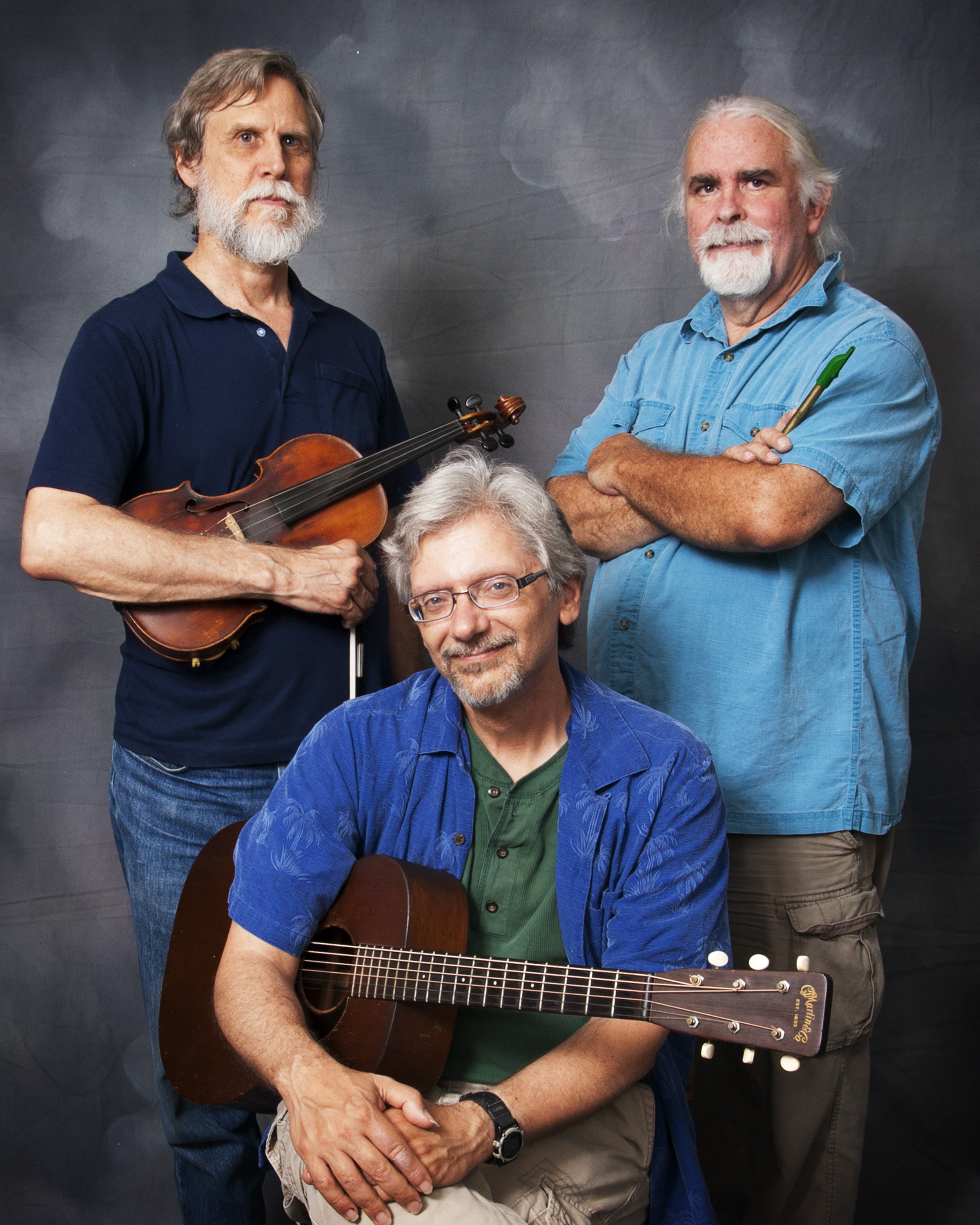
Tour Blog: July 16, 2017
Alchemy
If you could be a fly on the wall inside that chamber in my brain that succumbs to Monkey Mind (thoughts jumping from one neuro-branch to another) on long drives between shows, you would have heard musings about two seemingly disparate topics: alchemy and the Augustinians. Let me explain.
Lately, I’ve been thinking a lot about alchemy. Transformation. Conjuring. Magic. Merriam-Webster defines alchemy thusly:
1) a medieval chemical science and speculative philosophy aiming to achieve the transmutation of the base metals into gold, the discovery of a universal cure for disease, and the discovery of a means of indefinitely prolonging life.
2) a power or process that changes or transforms something in a mysterious or impressive way.
3) an inexplicable or mysterious transmuting.
Maybe gold is an allegory for anything that one considers intrinsically valuable. OK, let’s file that away and jump over to Augustine for a moment.
He was an early Christian theologian and philosopher; he was also patron of the Augustinians, who used to occasionally send one of their own to hold Mass at the church in which I grew up. I came to dread it when one from that white-robed monastic order appeared on the altar; it was its own alchemy, as their uber-intellectual sermons soared over my 9 year old head and transformed my semi-wakefulness to slumber between parental nudges. Alchemy…Augustine…welcome to Monkey Mind. Still hanging?
Elaine and I practice our own form of alchemy when we travel. We spin tales from characters we’ve made up, often rooted in history, sometimes our own history, individual or collective. This alchemy can become as entertaining (to us, at least) as any DVD or music bed, most people’s preferred pastime when in a car. We call it ‘riffing’, as it becomes its own improvisation with wordplay, as engaging (to us, anyway) as developing any musical idea I might explore in concert.
The latest bit of alchemy occurred on a recent drive to Aspen, just before this tour. It was spawned by an article in the New Yorker that we had both read on Augustine, who dedicated his adult years to his own peculiar alchemy—reconciling his sexual desires with his faith. In his mind, he did just this—he suggested that Eden, and Adam and Eve’s fall from it, was in fact, a sexual awakening, much like the one he was having with a woman to whom he was not married.
While that’s a fascinating enough proposition, Elaine and I theorized (riffed) on Augustine as we headed into the high country:
“But how did he have the authority to talk about this s#*t? I mean, in the 4th Century, who the hell was Augustine?â€
“Maybe he invented himself. How about this: he was actually Jewish, not Christian. He had to create himself as a Christian authority. And he didn’t have Manafort or Bannon to do it for him…â€
“Hmm…he wasn’t Augustine….he was….â€
“Gus Stein….â€
“I love it…Gus Stein….and he knew that gold was the goal in alchemy…how could he use that for his personal alchemy…â€
“…Gold…in the Periodic Table the symbol for gold is ‘Au’….â€
“…Ooh, I get it…Gus Stein puts gold into his name…
(Au)+Gus+Stein…Christianize ‘Stein’ to ‘Stine’…you get…â€
We say together, right around the apex of Independence Pass:
“Augustine!…â€
Our own personal Eureka moment. Something out of nothing. OK, sometimes it’s a different grade of nothing out of nothing. But improvisation is like that too. Augustine may have been thinking in entirely different alchemical terms with his paramour, but I’ve always been fascinated with the musical alchemy of conjuring something out of nothing, whether as a composition, an improvisation, or the alchemy-upon-alchemy of developing a composition with improvisation.
I’m practicing a lot of this alchemy lately. In the PAVAN workshop I’m currently teaching, we explore improvisational principles every day. Saturday, July 22, I’ll put these alchemical thoughts into practice. If you’re in the greater DC area, you’re invited to a special house concert in Northern Virginia. But even alchemy must deal with physical laws, such as volume—there are only a few seats left. If you’re interested, hit me up with a message for details. Or if you know an equally adventurous soul, pass this along.
Let’s conjure.
© 2017 Falling Mountain Music
Michael’s Blog: July 14, 2017
A Blog with No Words…
…Except:
Thanks, Craig, for all the fabulous music we made together over the decades. Rest in Peace.
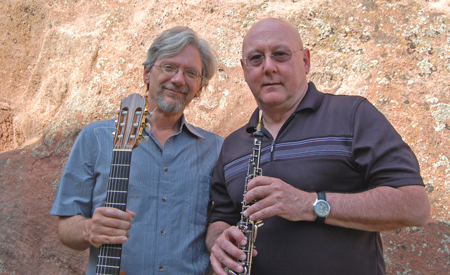
Michael’s Blog: June 27, 2017
“As if…â€
This is a review of a book about a 59-yr old cranky guy by a (not yet) 58-year old cranky guy. I’m sorry—I know that “A Man Called Ove†is the biggest hit out of Sweden since Ikea started serving havarte and cucumber sandwiches, but I couldn’t get past the first three chapters. The reason? Over. Modified. Sentences.
I lost count, but every other sentence seemed to be modified by a phrase beginning with ‘as if’ or ‘like a’ or something similar. (As if)…I couldn’t fill in the blanks myself without a semi-limp simile. (Like)…someone telling me a story ponderous detail after ponderous detail, further sub-explained; (it’s as if)…I just want to scream: “I get it—he’s staring at the iPad clerk like he’s an idiot who put both socks on one foot, leaving the other foot to wait patiently for its own sock, like the Messiah will bring it with the second coming, which may well be as exciting as the Cubs winning the Seriesâ€â€¦move on, will ya?
I love great descriptive writing. Chapter 3 of Steinbeck’s “The Grapes of Wrath†is entirely about the slow, deliberate, death-defying crossing of a US highway by a turtle. I remember reading that chapter over and over again, cementing in my mind the sheer power of taut, descriptive writing. Not one bit of filler like: he slowly put one clawed foot in front of the other, then the other , then the other, (as if) each step was a journey unto itself…no, that turtle was simply trying not to die. Period
If you loved “A Man Called Ove”, I’m sorry ((as if) I really care). I hear the movie is fabulous ((like) an ode to forgotten cranky old men). Maybe I’ll give the book another go ((like) a child climbs one more time onto a playground carousel moving just slow enough to trip him up and send him home bloody).
Oh, and why does this matter so much to me right now? I leave for an east coast tour in about 48 hours. I’ve decided that I will begin each solo concert with an improvisation. Improvisation can be treacherous terrain—it’s easy to over-modify. I describe improvisation as ‘spontaneous composition’, which means all of the tenets of good composing, including cutting out the superfluous, need to happen. In real time. Not ‘like’ or ‘as if’ anything. You’re in a single infinite moment; don’t waste time meandering around it
As for the book, maybe I’ll like it better when I turn 59
© 2017 Falling Mountain Music
Michael’s Blog: June 2, 2017
Hitting for Contact
“Can I help you?â€
“Can you turn back the clock 206 days? 
Blank stare.
“Never mind; I just need to hit something. I’ll take 2 tokens for 40 balls in the batting cage.â€
“Softball or baseball?â€
Blank stare.
“OK, I’m guessing baseball. You have to wear the helmet, by the way.â€
“Does one of the machines spit out orange balls?â€
Blank stare.
“Never mind. Thanks.â€
I hadn’t stepped into a batting cage in a lot of years. But as I told the young woman at Gateway today, between our respective blank stares, I just needed to hit something.
I used to be a pretty good contact hitter. You’ve heard of baseball’s proverbial five tool player? Hit/run/field/good arm/good glove. I was a four tool player, sort of—1) I was fast; 2) and 3) I had two gloves, right and left, because I can throw/catch ambidextrously. Oh, and 4) I was a pretty decent contact hitter.
Here’s the thing about hitting a fast moving object with a skinny piece of wood (or, today, wrist-rattling aluminum). It’s not how hard you swing. It’s how fast your hands are, and how good your eye is. I had forgotten that with the first 20 of those 40 balls thrown my way today. The second 20, it started to come back to me. Especially the part about having a good eye.
This president will continue to throw stuff at us; it’s up to us to remain focused. Getting pissed off about his over-staged announcement regarding the Paris Climate Accord is a huge swing and miss. It will take his whole term—if he lasts that long—for the US to extract itself from the Accord. As of this writing, 76 mayors of US cities, including Denver and Boulder, plus three states, plus a growing list of industries, have signaled that they will indeed honor the agreement signed by over 190 countries. It may well take less time to send him to the proverbial showers, if even one of the various investigations nails him. The international credibility and tall standing of the US that he has forfeit will cost him dearly, as other nations step into the leadership void he has created. The very ‘sovereignty’ he wishes to hold on to comes at the abdication of something far more valuable. He doesn’t get that. The world does. And the voters will. If we keep our eye on the ball.
© 2017 Falling Mountain Music
Michael’s Blog: May 15, 2017
Tick. Tick. Tick.
It’s been reported recently that the president of the United States holds the view that exercise is bad because it drains the body’s “finite†energy resources, like a battery.
Let’s set aside for the moment that no reasonable person believes this. No scientist I’ve heard or scholarly paper I’ve read supports this. Where our bodies are concerned, energy is the resultant transformation of what we take in as food, digest and metabolize. Plants do the same thing, via photosynthesis. This process of transforming energy isn’t restricted to flora and fauna; it’s the principle by which wind and solar energy is produced as well. It’s not analogous to a battery, as he states. The better analogy would be a rechargeable battery, which will indeed fail if not attended to. But for this president, analogous thinking may use up precious energy, so it’s best avoided.
Science also teaches us that our brains grow the same way, through ‘feeding’ of new ideas. These ideas ‘metabolize’ in wondrous ways, creating new neural mapping, analogous thinking, creativity. The more we know, the more questions we ask ourselves, gorging on new information, growing.
And here’s my biggest problem with the ‘sitting’ president (see what I did there?). It’s not that I disagree with him on so many things—I disagree with many people I number as friends. It’s his position that he doesn’t need to ‘feed’ on new ideas, or expend energy testing his old ones. He’s the smartest guy in the room. Always. Dissenting advisors are dismissed. Members of a scientific panel who might feed him facts he doesn’t like are dumped, like a toddler sending the bowl of Cheerios across the kitchen. His response to information that might cause him to exercise intellectually isn’t going to be “That’s interestingâ€â€”it’s going to be ‘You’re fired.’
We all need exercise, fueled by sustenance. What sustains him? A steady diet of himself. In a recent New Yorker article he was described as being his own favorite drug. I concur. But this isn’t only my opinion, or that of the press he refuses to feast on (except for the junk food known as Fox, et. al). He stated during the campaign that he doesn’t solicit advice from others, that he trusts his own decision-making. This voracious appetite for himself is exactly why I never, ever, use his name in print. The only algorithm he comprehends is “Google D______ T_______.†I prefer not to feed the beast.
The long-term consequences of this self-referenced world view is troubling. Besides miscalculating the actions of world leaders, being wrong on climate change, and not wanting to spend a few calories getting his facts right, he could be doing irreparable harm to children who wish to emulate him, or at least invoke him in their own weakly-fed alibis for wrongdoing: “Mom, I can’t set the table every night—I have finite energy, the president said so. You trying to kill me here?†Or: “Sorry, Michael, I didn’t practice too much this week—gotta watch how the energy flows, y’know?â€
And how are we to respond to this bizarre theory about finite energy? The Macchiavellian response would be “I hope he continues to wave the sedentary banner. He’s a heart attack waiting to happen.†Or “He’ll bring about his own downfall because he can’t expend the energy to do otherwise.†Far be it from me to wish anyone ill—that’s not the way I’m put together. Rather, I hope that somehow those who voted for him and, largely, still support him will see that they need a change in their diets. His empty calories don’t promote good energy; his carnival-barking politics aren’t Omega-3-loaded brain food. As for those of us who oppose him, we need a constant flow of new energy. The finite energy he speaks of could be the very thing that keeps him in power if we allow lethargy to settle in. To that end, we must counter his finite energy with ‘resistance exercise’. Every. Day.
 © 2017 Falling Mountain Music
Michael’s Blog: March 18, 2017
The ABC’s of Compassion
After I came home from my show on Friday afternoon, Elaine and I took a walk in Niwot, a downtown loop we often take where we’re sure to encounter friends, neighbors and businesspeople we know—our ‘village time’. It was 5:00-ish; we walked by a certain business with benches out front, and signs attached saying “DO NOT SIT ON BENCHâ€. Two doors down, another merchant is sitting out front of his antique store, with signs in the windows encouraging people to sit on his benches, that benches are happiest when sat upon.
“Michael! Elaine! Join us for a beer?†This may or may not be legal on the sidewalks of Niwot, but join him we did, sitting on his benches outside his business. The ABC’s of a most pleasant end to the day: Ass-on-bench, Beer, Camaraderie.
I’ve been thinking about the other merchant. I’ve never set foot in her shop. The Trump signs might have had something to do with it, but Niwot is a place that spans the political spectrum—I know this from earlier experiences canvassing neighborhoods for previous elections. In general, people get along. I may be stretching here, but I wonder if there is a connection between her lack of…community?…empathy?…kindness?…and the current administration’s budget proposals that seem to speak to our lowest demons.
I know a lot of people are wringing their hands about this president, his gaffs, his boorishness, his tone-deafness. I’m more concerned about a larger group of people at large—who voted for him, and feel enabled to exhibit those behaviors, and engender those feelings toward fellow human beings.
Look, it’s just a bench. In front of a store I have no intention of patronizing, in a village with plenty of inviting benches at virtually every business’s doorstep. But it represents such a deeply rooted sense of “I’ve got mine, go figure out where you can park your ass somewhere else (and forget about the beer and community)â€. It’s the mindset that informs the support for an administration that confuses ‘being great again’ with what made us great in the first place: compassion.
© 2017 Falling Mountain Music
Michael’s Blog: January 18, 2017
He is My President
For those of you who are longtime readers of my blog, this may seem to be a strange way to come out of almost two months of hibernation. Truth be told, this last election left me numb. In the days following it, I had students from places like Oaxaca and Oman wondering if they were going to have to leave. What could I tell them? What did I know? I certainly didn’t see this coming.
Well, OK, I saw it. I spent a lot of time this past year in non-Colorado zip codes. I saw a lot of signs, bumper stickers; I heard comments; I read editorials in small-town America newspapers. But I didn’t believe that what I was seeing and hearing was going to translate into the person taking the oath of office on Friday. I believe the medical term for my condition of paralysis since November is gobsmacked.
And as I tried to process where we go from here, I had to step back from the vitriolic backlash, on Facebook, in conversations, in print—from people I love and respect. I keep hearing “He’s not MY president.†“I can never support him.†And the like.
I don’t like him. But he IS my president. He was elected. Even if we put an asterisk next to his name, he wouldn’t be the first. Al Gore likely had the 2000 election stolen from him. The Electoral College has decided a couple of contests—maybe, in my lifetime, that dinosaur will finally sink into the tar pit of history, but I doubt it. And before you invoke Russia, espionage has played its part in our politics before as well. The US certainly has a laundry list of ‘actions’ that preclude any disingenuousness over Russia’s tampering: Iran. El Salvador. Cuba.
By saying he is my president, it doesn’t mean I buy into the current meme-speak that we must all unite, all pull together. Hardly—this was a divisive election. Those divisions need to be recognized, not swept away. To the Democratic Party, I would say: Reflect on what was lost here. Reflect on the portion of the electorate that you disenfranchised, allowing someone better skilled than anyone on the planet at picking up a bargain asset to tell them what they wanted to hear. To the Republican Party, I would say: now it’s your turn. Governance is hard work. Governance in a combative, scorched-earth environment such as the one you incubated for the outgoing president, is highly unlikely. You’ll see. To those not of either party, I would say: cultivate your tribe. Sitting this one out wasn’t a good plan. Articulate what you want to do, find a candidate who can articulate it to a larger audience, then begin the slow process of building a constituency. Schoolboards. Councilwomen. Supervisors. State senators and delegates. Then, in baseball parlance, move up to AAA, then the Big Show. Then, become adept at forming coalitions. That’s how you build this thing.
And to the president-elect, I would say: You are my president. That means we both have a responsibility. You need to move past a mindset of winning to a mindset of reflective leadership. My responsibility is to be vigilant, of you and the bicameral chambers that spent eight years being an obstruction to progress. You’ll be called out, you’ll be judged by what you do, what you say, how you do it, and how you say it.
Despite your tendencies, you don’t have to go it alone—history can be an ally. Oh wait, you are recently on record as having said that you see no value in looking at history. But If you can cease to be the smartest person in the room for just a moment, and take a look at presidents recent and long gone, maybe you’ll find a model. Which president would you emulate, if you could ever allow yourself that conceit?
That painting that will be hanging at your inaugural luncheon depicts a scene as divisive as we are today: the 1856 election. Pop quiz time: who won? Time’s up: James Buchanan. By most accounts, he didn’t rise to the occasion as a great force of unification. In fact, he may well have been the worst president ever.
Are you like George W. Bush, who, like you, saw as his destiny winning the presidency without having a clear articulation of what to do with that? His doe-in-the-headlights approach gave us two wars, a mountain of debt and a housing crisis that led to economic turmoil.
You might be more like Andrew Jackson—also of bad hair and bad manners. The ‘cultural elite’—Northerners, since California was still another country–were repulsed by his buckskin-badass behavior. Your two thumbs exact revenge with a Twitter account; his were ever at the ready on a brace of dueling pistols. Oh, and he had a fervent willingness to expel an entire race in the name of making the country ‘great’.
Need other examples? Harding, also the product of a contentious nomination, bounced from one scandal to another. Some actually evolved: Eisenhower didn’t even want to be president. Lyndon Johnson began as a bigoted misogynistic Texan to become the author of The Great Society. Lincoln heard it for five years: “Not my president.†To this day, I know people in Virginia who still consider John Wilkes Booth a hero.
Perhaps your best example by which to model your behavior into something more presidential than you may be capable of by yourself is the most recent. Barack Obama heard for eight years “He’s not my president†and “our goal, in the Legislative branch, is to obstruct him every step of the way†and even “He wasn’t even born here.†Oh wait, that was you. In any event, that was the terrain he had to navigate—8 years of obstructionism. You can expect much of the same.
You’re always looking for a deal, so you might ask—what do I, as president, get out of this? Support? Trust? Respect? You’ll have to earn that. So far, from me—not so much, but I’m open to negotiations, if you begin to assume some semblance of presidential decorum. Meanwhile, I refuse to sink to the level of those who said for eight years “He’s not my president.†But I and others will be watching. We will call out every despicable bigotry. Every convoluted conflict of interest. Every ill-considered insulting tweet. Every whiff of scandal. Every lie. Every oversight to the details of governance you can’t seem to be bothered with. You and the party in power can count on a 24/7 approach to accountability—now, in 2018, and 2020.
Because you are my president.
© 2017 Falling Mountain Music
Michael’s Blog: December 8, 2016
Face Time
I was comped a ticket to a matinee concert yesterday afternoon. I’m seated in Row D. Two women sitting in front of me in Row C get a little chatty during the concert. A gentleman in front of them, in Row B, calls up a .jpg on his iPhone that read in big loud letters: “Be Quiet Pleaseâ€â€”yes, I could read it, two rows back. Without turning around, he flashes his phone over his shoulder at the women in Row C(hatter). Naturally, I thought… of a nun I knew long ago.
I haven’t thought of Sister James Bernard in decades. She was my second-grade teacher at St. Michael’s while growing up in DC. Her eyebrows met—almost–just above her rimless glasses, and just below her sexless wimple that hid every follicle that wasn’t an eyebrow under that almost exoskeletal face-framing armor. She was smallish, soft-spoken, and didn’t tolerate chatter during classroom time. If she needed technology reinforcements to restore order, she could call upon her four-foot long wooden pointer that she used to metronomically pound the board, and certain mathematical truths into our brains, in 3/4 meter: “ADDend plus ADDend equals SUM!! (Rest-Rest).†If you didn’t feel like playing call and response with Sister James Bernard, that pointer would come crashing down on your desktop. She didn’t need a .jpg image in 24-point sans serif font when she could silence a room with her patented STFU countenance. She valued face time.
Sometimes, I miss good old-fashioned face time. I get it—this is the digital age. If you’re so inclined you can access my music, book, writings, scores, pics of me in digitized form. You can catch vids of me in performance without ever leaving your couch. You can even learn to play guitar by staring at me through a screen. And, it would seem, if you need to hush someone up just a foot behind you, you don’t need to even look at them—just show them your screen. Or post. We’re way too dependent on our phones.
And that guy in Row B(othered)? I think he should have turned around with an unmistakable look, or a finger to his mouth, or even a subtle ‘shhhh’. Instead of a genuine moment of connection that only a face-to-face encounter can provide, he chose to engage in just another impersonal screen moment. Where is the human connection in that?
For me, if a similar situation arises where I have to call someone out, I will do so by looking them in the eye from my perch in Row D(eLalla).
© 2016 Falling Mountain Music
Michael’s Blog: September 7, 2016
Allies
While packing to fly to Florida for a week of production, my mind wanders to the various ways one can avoid misfortune. Meanwhile, as I write this, I’m also immersed in a discussion with my online class Music Business I—we’re talking about the ‘team’ that one assembles to grab that brass ring of commercial success, if you choose to climb onto that particular carousel. Admittedly, not my chosen up-down-go-in-circles ride.
As it often happens between my ears, these two streams converge into a river of related thought. While I tend to not be superstitious, preferring to believe we make our own luck, good or bad, through our actions and inactions (that includes gold ring grabbing), I do worry about things beyond my control—specifically, luggage snafus. So I went shopping for an assistant. An AE (producers will know this). An ally.
Catholics petition saints, while the Yoruba of West Africa put out a shout to the Orishas; in the Caribbean, Santeria is perhaps a love child of the two. My Yoga practice introduced me to Hanuman, the quintessential ‘get-it-done’ ally. But I’d like to assemble a team with more specific skill sets. A quick Google search for “Patron Saint of Recording Gear†turns up nothing. Cecilia (Music) might be helpful, Anthony (Lost Stuff) is just one step above Jude (Desperate Situations). From the Yoruba culture, maybe I could bring along Eshu (both protector and trickster, he can both cause and prevent accidents or misfortune) with me to Baggage Claim.
So then I wonder: maybe I need a more comprehensive ‘team’ to get through the rest of the week with little scar tissue. Maybe I’ll start with some help in the Southwest Airlines cockpit (St. Therese of Lisieux). My client, longtime friend Marcille Wallis, always takes care of me, but just in case, there’s a patron saint of accommodations (St. Gertrude de Nivelles). There is a patron saint of engineers (curiously, St. Patrick; nice, because this project is a Celtic band), and one for ears (St. Cornelius). There’s even one to ward off the anathema of open-mic recording: coughs (St. Walburga).
Whew. Teams are expensive, a major headache (St. Teresa of Avila). I need a break, maybe a little diversionary time on Facebook (Isadore, patron saint of the Internet—really). Otherwise, my flight cases packed with mics, preamps, interface, Glyphs and assorted connectivity are at the mercy of Southwest. Superstition (St. Stevie of Wonder) be damned. Let’s go.
© 2016 Falling Mountain Music
Michael’s Blog: August 15, 2016
Tan Lines
(GIS Story Map Online rendered by Elaine C. Erb–click here)
I’m back home in Niwot CO after many weeks of touring/workshopping/vacationing. Over the top of my laptop I can see my toes. Nope, no pics–I don’t need you laughing at my toes; they’ve been through a lot. 4 badly bruised toenails look like they are ready to fall off, the scars left by high-country hiking, biking, camping…I even hurt one while conducting a guitar ensemble (don’t ask).
I’m OK with all of this–I think a good summer leaves marks. Maybe it’s tan lines; or, if you are an athlete in Rio, maybe it’s cupping hickeys, or a well-oiled Tongan torso. Regardless of the season, travel, and especially touring, leaves indelible memories. Or should. And while I didn’t score any gold medals, I did score the best crab cake (southern Maryland), the best ice cream (western Maryland), and the best cup of coffee (Hot Springs Arkansas).
Between the East Coast tour and shows in Colorado’s high country, the mileage total rang up around 6400. Once Elaine, with her stellar navigational skills, joined me in DC for the westward swing home, and with a little down time before needing to be in Aspen/Steamboat Springs, we managed to do this with surprisingly little interstate time. If you really want to understand the diversity of landscape and people in this vast country, you won’t find it on I-70, where every exit has the same corporate signage. Instead, try MD highway 231 to Benedict (the crab cakes); make time to stop for a sunset view of the house of Dr. Mudd, who, after being convicted for conspiracy in the murder of Abraham Lincoln, spent his last days caring for the ill prisoners in the Dry Tortugas. Then, take US 301 across the dizzying little bridge into VA, wind along the Caledon Woods Road—I promise, you’ll eventually get across the state to the Blue Ridge Parkway. Leaving Asheville, NC, instead of I-40, try US 129 across Deal’s Gap—The Tail of the Dragon, with 318 curves in 11 miles—a new view with every blink. Pick up the two lanes of the Natchez Trace in Franklin TN, then Hwy 46 into Leiper’s Fork if you want to find a town full of people who have metaphorically and literally eschewed the fast lane. Hwy 88 (AR)/Hwy 1 (OK) is a sublimely beautiful entry into Oklahoma via the Upper Kiamichi River Wilderness—I’ve never seen a roadrunner that far east and that high up. The Mother Road, Route 66 is a must. And I can now say I’ve entered Colorado from every one of its contiguous states, having traversed US 287 from the OK panhandle into my home state—the same highway that becomes Main Street in neighboring Longmont. Independence Pass into Aspen may be the most beautiful piece of almost-two lane road in America, as is Hwy 131 up to Steamboat.
Best of all, I met some wondrous souls during these travels; I hope our paths can cross again sometime.
I’m cooling my jets (and my toes) before leaving again in a couple of weeks for a show in South Dakota followed by some studio time in Florida. I also have to flesh out a new online class—Music Business I. The textbook is OK, but I might make my blog supplemental reading as well. In the next few days I’ll also try to post videos from some shows. In the meantime, thanks to all who shared in these travels, and may the tan lines be slow in fading.
© 2016 Falling Mountain Music
Michael’s Blog: June 16, 2016
Fear and Loathing
For the many millennia that chart the human experience, fear has shaped society. When earthquakes and tsunamis happened, people looked to the heavens and asked “Why?†We’re hardwired to try to understand things, so as to influence a more favorable outcome next time. To appease the entities that threw lightning bolts and poured down flooding waters, prayers were offered, supplication uttered, and sacrifices were executed—sometimes literally. When bad things happened it was someone’s fault, and they should pay with their lives.
This was a trait recognized as exploitable by those up the food chain. Clerics and kings would encourage this fear; it became part of politics and faith systems alike. After some poor victim, whether human, flora or fauna had served as the sacrifice (this is where the word ‘scapegoat’ comes from), and the storm coincidentally cleared, that cleric or king looked pretty smart. This kept power in the hands of the powerful, and ignorance was the currency of the realm. As for the poor woman with a knack for using medicinal herbs who was burned at the stake, well, the fear mongers would just change the narrative and brand her a witch.
Fear’s partner in crime is loathing. When someone or some group is identified as culpable for what ails the rest of us, hatred sets in. Forget ancient history–do I need to enumerate all the instances in my lifetime? Remember the made-for-TV evangelists who said AIDs was their god punishing gays? A couple of years ago while on tour in eastern Oregon, I saw a bumper sticker with the silhouette of an AR-15 aimed at the word ‘libtard’—I couldn’t wait to leave town. There’s a long list of words ending in -phobia that makes the point: loathing is thriving, fertilized by fear.
Omar Mateen, the latest murderer known by a zip code (Littleton, San Bernardino, Paris—now Orlando) is a special case in fear and loathing, because both happened on so many levels within him and around him. As the grisly facts trickled out, hasty conclusions were drawn. His victims were patrons at an LGBT nightclub. He was ‘Middle Eastern’ (neither fear nor loathing need pass a geography class—he was an American, born of Afghan parents). The resulting syllogism was that he must be an Islamist terrorist, since ‘they’ hate the LGBT community. But the last few days have shed more facts. His understanding of Islam was, at best, cursory—in one of his rants he couldn’t even speak to the differences between a Sunni and a Shiite. His father claimed that Omar hated gays; yet, it’s now known that he frequented Pulse and was a member of a gay dating website. His wife definitely paints a picture of an individual driven by many polarizing demons. So in Mateen, the loathing may well have been self-loathing.
Meanwhile, other purveyors of fear and loathing wasted little time. A presidential candidate said “See, I told you so. Vote for me because I was right about Radical Islam terrorists.†I equate this statement of congratulatory self-reference right up there with ISIL taking credit for a wanna-be jihadist’s demons–shameful. An hour after the tragedy appeared on the news, the governor of Texas quoted a biblical verse to basically say “All y’all queers had it comingâ€. People afraid of losing their precious guns went on the attack to ward off any talk about gun law reform. And so on. There were so many reactions of fear and loathing to this tragic story, my head was spinning. I couldn’t even process my grief.
Trump pedals fear and loathing. He’s like that old woman in “The Princess Bride†who screams from the crowd “Boo! Boo! A curse on you!†(she had bad hair too). Or maybe he’s more like Iago. Shakespeare, even 400 years ago, understood the psychology of fear and loathing. Iago fosters doubt, jealousy and rage in Othello (coincidentally, a dark-skinned man from an Islamic land) by nary uttering a lie. Instead, he utters innuendo that feeds Othello’s fear and loathing, all with the hubris of telling us, the audience, exactly what he’s doing. How many times has Trump started a rant with “I’m hearing a lot of people saying…†Of course you are, Donald. When you pour that poison in the ear of your followers with tweets that get re-tweeted, they’ll eventually come back to you, making that statement about what ‘a lot of people are saying’ perfectly true.
I had a conversation about the tragedy in Orlando with a friend who told me he wasn’t interested in ‘beseeching’ (“Why did this happen?â€); he was interested in opening himself to receiving. It struck me as a powerful idea, the opposite paradigm of fear. Asking ‘why?’ can end in fear (though it doesn’t have to); opening oneself to receiving is an invitation to more information, deeper knowledge. The fear mongers will tell you they have all the information they need, even though the facts are far from known. Like the fear mongers of old, same agenda: power.
Finally, fear can lead to inaction. Or inaction disguised as right action—think about the handwringing at the lightning bolt throwers. Moments of silence, recoloring one’s Facebook picture, ‘standing’ with victims, and (sorry, musical brethren) dedicating a ‘special’ song in concert—these things should not be the extent of our response to fear mongers. If you want to take action, roll up your sleeves. Research your down-ballot candidates: from whom do they receive money, where do they position themselves against fear mongers? Personally, I won’t vote for any candidate who has received money from the NRA. They’ve turned fear into a profit margin. They’ve twisted the narrative of history to suit that agenda. 300 million-plus firearms later, they’ve done a lot of fear mongering. OK, subtract the hunting rifles; the point still stands. If you’re going to use the founding fathers’ version of the Constitution as your evidence that your fear is founded, then be prepared to accept that they saw the need to let it be an evolving document by including the process of ratifying—and repealing—amendments. Stop your handwringing; I’m not advocating repeal of the 2nd Amendment. But I’d welcome some laws to regulate who and who doesn’t get to buy an attack rifle. In short, stop beseeching. Inaction is also an action.
Chapter 1 of my book The Mindful Guitarist begins with a quote by William Butler: “The only things we truly hate are unfamiliar things.†When we choose to receive vs. beseech, we become familiar with those things we formerly feared. And fear dissolves.
© 2016 Falling Mountain Music
Michael’s Blog: June 9, 2016
Walk and Bike Month
The last time I started my car was Sunday—I needed to drive to Lyons to do a gig. Tomorrow, Friday, I must drive, to get the car serviced before I drive east for tour that will last most of July. “Something wrong with your ride, DeLalla?†you might ask. Not at all. This week, as part of Walk and Bike Month, the City of Boulder is sponsoring Love to Ride’s June Bike Week Challenge. I decided to go the whole week without a car. I’ve had plenty to do, people to see, coupled with a light gig schedule. I’ve done it all by bike, on foot or by bus.
By the time the July tour is done, I will have driven around 6500 miles, give or take a brown-sign diversion (oooh, that looks interesting…). For me, it’s the most distasteful thing about making music for a living, aside from that paltry pay thing. So I try to mitigate the touring footprint with no-drive days when I can. But it’s not enough. So this week I just decided to reach for the helmet instead of the keys. It wasn’t that hard. Just today, I rode out to the Park n Ride on US 287 and Niwot Rd, hopped the bus to Denver to catch up with an old friend who was in town. Then, I clipped on the mini-cooler and panniers to ride out to Red Wagon Farm to pick up our CSA share. Yesterday, I rode to a friend’s gig. Every day I’ve needed to go somewhere. I just changed the mode of transportation. And the paradigm.
It’s not that I’m interested in making my life revolve around bike rides, as much as I enjoy cycling. And being a travelling musician does necessitate using a car. But I am interested in unlinking my life to the automobile, at least not make it the default mode. “Easy for you, DeLalla, you live in a place with good public transportation.†True. But many people choose to live where they live because they don’t want to be enslaved by the notion perpetuated since the end of WWII that’s it’s OK to live far from where you actually have to be most days of the week, like work. We, society-wide, quaffed the Kool-Aid offered up by the collusionary forces comprised of developers, the auto industry and what used to be called big oil. I know plenty of 20 and 30 somethings, along with people my own age, who have simply decided they don’t need or want a car.
And before you say it isn’t going to change, check out this article
that looks at 7 cities trying to find a better way to move people, and collate housing and infrastructure in a way that makes sense. In the last 4 years I’ve been to all of them, one today, since Denver is one of the seven. Fascinating reading—these are planners with vision.
And if you absolutely need a car, OK. But try this: spend a week thinking about it every time you reach for the keys. Then spend the next week trying an alternative—maybe the kiddies and you could ride your bikes to soccer practice. A good place to start is to sign up for Love to Ride (www.lovetoride.net). Their mission is to make it not-a-big-deal to get on your bike, not be beholden to all that ‘bike clothing’ and other gear (do get a helmet!). Just ride. See you on the trails and roads.
© 2016 Falling Mountain Music
Michael’s Blog, May 4, 2016
This isn’t a Commercial
“This is Charlize; may I help you?â€
“Well, for starters, Charlize, make sure I’m on the company Christmas party list—I’ve talked to so many of you this morning I’m feeling like I have come to know a bunch of you. Luckily, this call is being monitored for quality control, so you can track me down in December.â€
In all fairness, the various personnel with whom I spoke at my credit union (this isn’t a commercial for credit unions vs. banks) regarding a problem with my spiffy new chip-technology debit card were all pleasant, and trying mightily to be helpful. Charlize, if you’re tuning in (I gave you the link to my blog), your laughter and willingness to see the absurdity of our transaction was refreshing.
I won’t bore you with the details of all the comical turns this issue took, over a card that my credit union sent me to replace the other piece of plastic they had sent me, or all the absurd ways that the card refused to work, because it was ‘more secure’—ostensibly, the new card solved a problem. In actuality, the solution is merely code for a way to monetize an entire industry built upon providing security to a system that has been pretty insecure from the time my grandmother hid money under her mattress.
Sorry, I said I wouldn’t bore you with the details. The point is that the ship has been leaky for a long time. We patch the leak, then we patch the patch; pretty soon, the original vessel is lost in the fixes. At some point, we just need a new boat. Think of our computer operating systems (this isn’t a commercial for either Windows or Apple—I use both). How many patches did Windows need to ‘fix’ Me 2000 and Vista? Apple is now travelling that same road. I don’t view this as a good strategy for problem solving. Instead, the image that comes to mind is that of the proverbial lipstick salesman lustfully eyeing the pig.
We all have our various mechanisms for solving problems. Much of the compositional process (or any artistic process, this isn’t a commercial about me-the-composer) is predicated on problem solving. However, when I am composing, if an idea isn’t working, I don’t keep ‘patching it’—I scrap it and get a new idea. At the very least, it goes into a sort of compositional desk drawer with lots of other misbegotten themes, motives, figures and harmonic constructs, perhaps to be repurposed later.
In the music industry at large, there are mini-industries that have sprouted up to solve problems, most of which were brought on by the industry itself. They have inserted themselves into the equation to make sure whatever minuscule income streams that are still trickling toward the composer/performer/recording artist go right up the straws they’ve wrapped their little mouths around.
Back to today’s chip-enabled problem. My reference to Charlize about the company Christmas party made me think of other parties, the political kind. My thinking about malfunctioning operating systems and platforms reminded me of party platforms—are you following me, or should I slow down?
Let’s face it—everyone involved in the coming election is a Band-Aid, not a solution. The power-parties assume they are still functional, they just need a patch-fix. Both are wrong, because both share a basic premise which precludes any sense of functionality: their respective objectives are all about holding power, not solving problems. Just as entities like Microsoft and Google (this isn’t a commercial for competing behemoths) continue to feed us patches based on the assumption that their respective platforms are what we want and need. If you don’t believe me, Google them both—they will tell you how superior and ubiquitous they are.
In candidate A (no names here—this isn’t a political commercial), we have someone who views every problem as a ‘deal’ that needs to be ‘won.’ Reasonable discourse isn’t a patch to be considered, because for this candidate with nothing but a loud expensive hammer, every problem is a nail. Candidate A has no appreciation for nuance. In candidate B we have the opposite problem, someone whose fix is to move her personal position stance to a place of likeability, the so-called middle ground—while no problem ever gets solved, candidate B remains likeable*/powerful while seeming to be a compromiser (this isn’t a commercial advocating either of the two accepted spellings of ‘likable’ or ‘likeable’). With Candidate B, all involved in the deal ‘win.’ Her Band-Aid, is the smiley-face kind, like the ones I used to put on my daughters’ knees to make them feel better while the Neosporin did its work (this isn’t a commercial for any particular antibiotic ointment).
And then there is Candidate C, whom I like immensely, because I think he sees the nature of problems for what they really are. Unfortunately, he doesn’t look good in lipstick.
In today’s politics, problem solvers are party-neutral; they pursue objectives that have nothing to do with political philosophy. They are hired guns, mercenaries, middlemen. They may not even be sure for whom they work, as there are powers that transcend both major parties. When problem solving is detached from personal involvement the only winners are those powerful forces and their middlemen, the lipstick salesmen, who couldn’t give a shit if the pig is wearing a comb-over or a pants-suit.
Thank you, Charlize, and to the others at my credit union for simply hitting the Reset button and solving the problem, though I did have to make a trip into the office to accomplish this. Perhaps I’ll see you at the office Holiday party (and while this isn’t a commercial for Elevations Credit Union, I love you guys).
© 2016 Falling Mountain Music
Michael’s Blog, March 23, 2016
Meridians
The word ‘meridian’ carries two contradictory meanings. The first definition states that it’s “any one of the lines that go from the North Pole to the South Pole on maps of the world†(Merriam-Webster)—this suggests an infinite number of meridians. Another more singular definition is found in the world of acupuncture: “any of the pathways along which the body’s vital energy flows†(ibid). I haven’t bothered to look at a map to see what other places north and south of Aspen share its meridian, but I can tell you that here, in this little mountain town at this moment, my vital energy is flowing.
Historically, before the billionaires nudged out the millionaires who had nudged commoners like me down-valley, Aspen always attracted talented, imaginative people. It’s still a gathering place for great music, great art, great literature, great ideas. In the years I’ve been coming up here as a getaway from another fertile creative meridian, Colorado’s Front Range, I always return having felt like that afore-mentioned vital energy has been tapped from deep reserves. This week has been no different. Mind you, not being a billionaire or millionaire or any other kind of ‘–aire’ that uses more than a couple of zeroes, I can’t afford to just come up to the High Rockies and not get work done. So these tend to be working trips. In one 24-hour period (another kind of meridian?), I added a few dates to both an east coast tour and the local concert calendar, I started a new composition for Ensemble Duende, and got some curriculum development work done for the college. In the same 24-hr period Elaine and I got in rejuvenating walks along the Roaring Fork River and Ute Trail. We went to a book reading/chat about The Never-Open Desert Diner by its author James Anderson, introduced by our friend poet Bruce Berger; the four of us then continued the conversation about the vagaries of our respective worlds of music, literature and poetry over a great dinner (another Aspen hallmark). Earlier, while walking into town to meet friends for lunch we passed singer-songwriter Bruce Cockburn sitting on a bench in front of his tour bus, looking a bit road-buzzed, like he was trying to tap his own vital energy before his show that night at the Wheeler Opera House. I decided not to approach him and ask if he remembered that I and my band Oxymora had opened for him a couple of times in Washington DC back in the last century; I hope he found his meridian before show time.
This morning, yesterday’s 60-degrees-and-sunny day where the cross-country skis never left the car has given way to several inches of fresh new snow. We’ll finally step into those skis (XC skiing is all about tapping into one’s central meridian of balance and energy). Work will happen too—a quick meet-up with the bookstore event coordinator from last night; evidently, she’s also a musician and is interested in my book The Mindful Guitarist. That’s as far as I can see down today’s meridian. No worries—a lot can happen in 24 hours.
© 2016 Falling Mountain Music
Michael’s Blog, October 12, 2015
Happy Indigenous People’s Day
Happy Indigenous People’s Day. Yes, it’s a real thing. Many places, including Boulder, have chosen to eschew celebrating the prototypical Conquistador in favor of the peoples who were already here and thriving before that fateful day in Fourteen-Hundred-And-Ninety-Two.
Now, a quick look at my surname will tell you that I’m about to be lambasted by many of my famiglia e paesani for what many Italians and Italian-Americans would view as heresy. Columbus is a hero to many of them. But among the Original Peoples here, who never asked to be discovered, and certainly didn’t ask to be cheated, sold, murdered and infected? Not so much.
But here’s the thing, hand-wringing Italiani–letting go of Columbus is easy. News flash–he wasn’t even Italian, since Italy wouldn’t exist for another 380 years. He was a Genovese, who, unable to sell his navigational prowess to the locals, had to go to Spain, with a much dog-eared Renaissance version of “The Art of the Deal†thrust into his tights.
But, my fellow Italian-Americans may ask, who can we celebrate the second Monday of October, because I sure as hell don’t want to give up my time-share on the Jersey shore on that long weekend? Many, many notable Italians and Italian-Americans did fabulous deeds, and knew what they were doing, which should move them well ahead of C-Squared. Julio Ceasare knew where he was and who he was conquering. Et tu, Cristoforo?
Among my musical friends, the name Guido of Arezzo (c. 990–1050) can be feted for giving us modern Western musical notation. Claudio Monteverdi (1567–1643) wrote the first successful opera, Orfeo e Euridyce. Domenico Scarlatti (1685–1757) wrote 555 sonatas for the harpsichord, just in time to see the instrument begin its decline after Bartolomeo Cristofori (1655–1731) invented the piano. Antonio Vivaldi (1678–1741) gave us electronica with a heavy repeated 8th note pulse–not really, but his concerti could sound that way/that way/that way/that way…What about Mauro Giuliani (1781–1829), the most important guitarist and composer of guitar music of his time, whose 2nd movement of his Sonata in C only sounds a little bit like his friend Beethoven’s Waldstein. “Hey (shrug/smirk), what’s a little borrowing among amici? That theme…it fell off of a truck…” Antonio Salieri (1750–1825) should be celebrated for actually not murdering Mozart, despite a certain play and movie starring Tom Hulce. Niccolò Paganini (1782–1840) was the rock star of his day, while Giuseppe Verdi (1813–1901) is noted for operas such as Rigoletto, La Traviata, Aida and Otello (1887) among others. Italy also produced great tenors such as Caruso, Pavarotti and Bocelli, all of whom would have sung Otello in blackface, since Italia doesn’t seem to have a surplus of black tenors. There’s even Giuseppe Donati (1835–1925), the inventor of the classical ocarina. Lastly, a musical footnote goes to Al Capone, who was such an ardent music lover he actually kidnapped Fats Waller for 3 days to play for his birthday and paid him his single largest paycheck for his trouble.
We can create an alphabet of famous painters, from ancient Rome’s Amulius to the Renaissance’s Zuccari, with a Michelangelo and da Vinci thrown in for good measure.
Want Science? Certo! Enrico Fermi (1901–1954), physicist, constructed the world’s first nuclear reactor and is often cited as the father of the atomic age. Luigi Palmieri (1807–1896) was a noted meteorologist, a field of science that may have limited usefulness in the future, depending on what happens with that nuclear thing.
In Sports, Yogi Berra and Joe DiMaggio would have rocked New York even without Verrezano’s greed-driven explorations.
Curiously, when I did a search in Wikipedia for Famous Italian Women, it said that no such page exists. However, many come to mind. Lisa del Giocondo, who smiles for daVinci’s Mona Lisa in a way that can only mean “I know something about that wrong-steering navigator from Genoa, and it begins with ‘piccola’….” Sophia Loren, who just celebrated her 81st birthday, still exemplifies grace and beauty on the big screen. Italian-Americans named Ferraro, Napolitano and Pelosi have all helped shape American politics.
So, let’s let Columbus go, shall we? Since it would seem he couldn’t find his ‘piccola testa’ with both hands and a map, perhaps it’s best to celebrate a true Italian hero, and a woman to, er, boot. Like Lisa del Giocondo. Henceforth, we can call it “National Smile Day.”
© 2015 Falling Mountain Music
Michael’s Blog: October 1, 2015
That Which is Built on a Last is Built to Last (and upcoming shows with Andrew McKnight)
During some recent giggery in Santa Fe, I was on my way from my hotel to my show at the Gerald Peters Gallery when I noticed I was passing by the old Tandy Leather Factory. I immediately thought of my father, who used to receive large shipments from them to supply the exquisite shoe repair for which he was fairly renowned in the Washington DC area. As a young boy I would watch him cut the binding cords that held together the raw pieces of leather that would become a brand new sole on an old shoe. He would examine the grain like a luthier eyeballs a soundboard-in-waiting, offer a “hmmph” which could mean one of two things: either “This is a great piece of leather” or “They sent me this crap?” To this day, I can still tell the difference; you can see and feel it, both before and after it becomes a shoe. These days, good leather is hard to come by. Elaine has a great piece, a motorcycle jacket from her punkster days. Someday, I hope grandson Hayden eyeballs it, covets it and eventually owns it. It will likely still have some useful mileage.
Those of us of a certain age remember when shoes were put together by quality stitching and assembly of leather components as opposed to factory-injecting heat into a piece of plastic and then molding it. Look at your shoe–odds are the heel and sole are a continuous piece of plastic. You wear them down, they’re done–they are inexpensive enough to just replace. Back in the day, the leather uppers were stitched to a ‘welt’, a leather interface between that shiny part of the shoe that made them attractive beneath a crisp pants crease, and the business end on the bottom: a leather sole with a wooden heel base covered by a leather or rubber heel plate. This made it possible for a shoe to be re-soled and re-heeled many times–shoes were a bit of an investment. I had a single pair of hiking boots that lasted longer than the total years accumulated by the last 4 pairs I’ve owned.
With fascination, I’d watch my father do this work. It involved a plethora of knives to carve the leather into a perfect, seamless sole that precisely matched the shape of the welt. He would shape it on the last—think of a foot-shaped anvil for cobblers—a process that fascinated me. The last was cast iron, rigid and immoveable. The leather was supple, and, with a little encouragement from the cobbler’s hammer, would bend to the shape of the last.
He tried to pass this marvelous skill on, but aside from a couple of sloppily applied heel plates, I never got very good at it. My brother Frank was better. My father had brought home a set of leather-working tools, and no shortage of leather scraps that became wallets and comb-holders (really!) and knife sheaths, all emblazoned with the imprints of those tools—leaf shapes, scrolls, dozens to choose from. While Frank painstakingly pounded and stitched, I was more interested in convincing Tony DiCello that this is how he could attain a tattoo–just let me hammer this one more onto your arm, oh, just one more…
Composing is similar to cobbling. The composer’s last is the training, the counterpoint, the harmony, all those immutable things upon which we shape the final Thing. While forged against patinaed tradition, the new work still has endless possibilities, infinite new directions. Otherwise, you’re not composing, you’re reiterating, like a factory-produced heat-injected sole and heel. My father would probably disagree, wryly saying something like “Sure, show me your composition muscles” while flexing his not-shabby biceps. Oh well, there are muscles and there are muscles.
Coincidentally, Elaine and I recently discovered a cobbler’s last right here in Niwot, at Wise Buy Antiques. I’m still thinking about it. In terms of a musician’s life—any artist’s life—I like the simile: each of us is like the leather between the hammer and the last. We are shaped between one rigid force, found just beneath the surface, cast in tradition, education and immersion, and another, the hammer of present circumstances. Every day the hammer comes down against the hide, every day we’re shaped by both the past and the present. But the final shaping doesn’t happen until you begin to walk about. All that hammering upon leather on a last merely prepares the shoe for wherever the journey takes its owner. Every step enhances the shoe’s fit to the foot, if it’s a well-made shoe. A shoe that doesn’t have that flexibility should probably be left in the window. We are shaped by that which pounds us, becoming comfortable in our skin. We endure, then we prevail. If we are lucky.
More important, the simile symbolizes Quality, vs. a mass-produced mediocrity with a built-in planned obsolescence designed to induce another purchase. That which is built on a last is built to last.
Leaving New Mexico, driving north on CO 17, the so-called Cosmic Highway, got me thinking about this more–the shifting sands of Quality. The ancient Greeks held a belief that the Quality of a piece of art, sculpture, architecture, poetry, or music could be quantified by the number of direct connections formed among its elements. Consider that for a moment: they believed that a number could represent the artistic Goodness of something. These relationships can be obvious, such as a repeated motif in the design of the Doric columns of the Parthenon (or a comb holder). Or they can be more subtle, as in, say, the mathematical ratios between the length of a pediment, the height of its columns and the number of those columns, all connected by important proportions that inform the inherent artfulness of the structure. I think of Pythagoras basing temperament on the simple 3:2 ratio that gives us the interval of the perfect 5th.
Lastly (ha), if we are to believe, then, that Quality can be quantified by connections, you’re in for a treat with a few upcoming shows with my old friend Andrew McKnight, in Colorado Springs, Longmont, Niwot (right across the street from Wise Buy Antiques, at the Left Hand Grange) and Ft. Collins. We come from two different lasts, though our hammer-marks look similar enough, with more connections than I can enumerate here. If you wonder what kind of show a rootsy singer/songwriter and a world-music instrumentalist can cobble together, well, you’re in for a treat. No factory-molded music here; it is music most present, it’s shaped by our ability to make each other reach high and deep. We both agree–we are different musicians when we play together.
Here’s hoping to see you at a show.
© 2015 Falling Mountain Music
Michael’s Blog: Aug. 2, 2015
Synergy
This Sunday morning’s soundtrack is a new CD by o’ud player Anouar Brahem and his ensemble comprised of piano, bass clarinet and bass, a welcome-home-from-tour gift from Elaine. I want to give it a standing ovation, but I’m in my living room, home alone, playing hooky from Yoga.
It does, however, give me the opportunity to ponder the Standing Ovation. As a performing artist, I confess to enjoying those moments, when they happen. But not for the reasons you would think. First, I don’t ever consider a performance something I ‘give’; my job isn’t to deliver a uni-directional recitation of music. It’s a partnership, a bargain struck the moment you take your seat. If it’s right, you, the audience, are as engaged in the moment as I am. The energy is a feedback loop–with both audience and performer drawing from each other. If you’ve been in that situation, you know it’s palpable. You’re not just watching and listening. You’re helping to make it happen. It’s what makes live music such a profound–and increasingly rare for some–experience.
My latest encounter with this phenomenon was a few days ago, when an as-yet-unnamed ensemble comprised of pianist Deborah Schmit-Lobos, oboist Craig Matovich, cellist Phil Norman and I finished our premiere performance to a standing ovation. It struck me that it was not so much an expression of ‘congratulations, you guys’ as a recognition of the audience being in the moment with us, feeding us as we were feeding them: “WE did it!” For me it gives new meaning to a word that has lost much of its meaning: special. A standing ovation recognizes what makes live performance special, and what makes improvisation a special kind of live performance. It’s about an intimate kind of engagement–synergy–that, when it works, is its own kind of special.
Interestingly, I’ve also experienced the same kind of synergy without the ovation–I think of the Wednesday music meditations that have become an institution at the Boulder Public Library. Those musicians also draw the audience into a special space through improvisation; by mutual agreement and longstanding tradition, no ovations happen. But the silence is just as palpable, just as welcome, as clapping, yelling, whistling and lighter-ing (hey, I just improvised a new word!) will ever be.
I hope you can make it to this afternoon’s performance in Boulder of this same un-named ensemble. Clap, or don’t. But come be in the moment. Afterwards, you can even suggest a name. Or let us remain nameless. In any event, it will be a moment worth sharing. Hope to see you there.
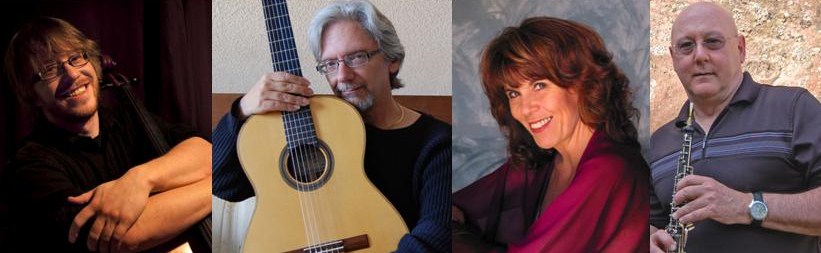
© 2015 Falling Mountain Music
Tour Blog, July 22, 2015
Dateline: Home
“Thank you…I can’t…Thank you so much.”
I could barely get the words out, I was so overcome with gratitude. But let’s rewind….
After finishing a concert in DC, then dinner with friends, I was driving out to West Virginia, where I was staying during my workshop the following week. I took a phone call from a distraught friend; while trying to help her navigate her plight I needed to stop for gas. I did something a seasoned traveler never does–I placed my wallet on the roof of the car while I fished for my credit card with one hand as I wrapped up the phone call with the other. I filled up, went in to use the restroom. I was second in line, behind a burly gentleman in a t-shirt that read:
“We piss off more hippies by 9:00 AM than you do all day”
I just stood there in my decidedly hippie-esque shirt (still dressed from the concert), pondered the meaning of that for a while. I used the restroom, and off I went.
That’s right, off I went. And, as you’ve surmised by now, off went my wallet when I drove away from the pump.
I realized my mistake within minutes; I turned around and returned to the station. I walked the parking lot, no wallet. As I was heading in to inquire if someone had found it (hope springs optimistically), thinking about my immediate future with no credit cards, no driver’s license, two time zones from home, my phone rings.
“Is this Michael De-La….”
“DeLalla…this is he…are you by chance holding my wallet?”
“Why yes sir, yes I am.”
“Wow…thanks…how can I find you?”
“Do you know the exit just north of the gas station, the Lowe’s parking lot? I’ll wait there for you. Maroon pickup pulling a trailer.”
“I’m on my way.”
He had parked so that I would find him with ease. it was he–the guy who pisses off hippies before a second cup of coffee. We shook hands, he handed me my wallet.
“I hope it was OK to look in your wallet. I’m a cop.” He pointed to his t-shirt; now the front is in view. He was a Marine MP. “When I saw the Colorado driver’s license, I was like, ‘shit, how am I gonna track this guy down?’ So I looked inside, found one of your business cards, matched the name to the license. You some kind of musician?”
“When I’m not losing wallets in parking lots. I don’t know if you’re a music lover, but I’d like to give you some downloads or CDs as a thank you.
“You don’t need to give me anything, sir. But he might like some music…” pointing to a young boy standing next to the truck.
I thanked him again, turned to leave, then turned back. “Can I ask you a question? Your t-shirt…”
He grinned sheepishly. “Don’t take offense, sir. It’s not about hippies. It’s about the Army. They used to have a slogan about all they did before 9:00. It’s just us having some fun at their expense.”
After we parted ways, I thought about what lessons The Cosmic Messenger bestowed on me that evening. The obvious–wallet stays in the car, always. But there was another insight. Perhaps the next time I encounter someone who, through a t-shirt, bumper sticker or facebook post sends what I perceive as a slight or offense, maybe I’ll try to have a conversation eye-to-eye, with a view of the front of the t-shirt.
My parting words to MP Prescott, and to all I encountered on this tour:
“Thank you…I can’t…Thank you so much.”
© 2015 Falling Mountain Music
Tour Blog: July 18, 2015
(note–photo-art sent to me by my young friend Madeleine McKnight–thanks, sweetie!)
Collaboration
“He makes me play differently than any other guitarist I’ve played with.”
“I’ve heard those pieces a hundred times, but I can’t believe the new places you guys took them.”
After our concert together last week, Andrew McKnight and I were each engaged in two separate but adjacent conversations. In the first quote, Andrew was talking to someone from the audience, referring to the singularly special music that happens when we share a stage. The second quote was another concert-goer who was telling me about how we turn familiar work into something new. The triangulated coordinates of these two quotes intersected right between my eyes. Since then, I’ve been pondering the unique dynamic of collaboration.
Collaboration is different from “sitting in.” Both have their own value: sitting in is fun and comfortable, a way to reconnect with people in an at least somewhat familiar environment, like visiting a friend who lives in a new place but still has the same books on her shelf. It’s a special synergy.
Collaboration is building something new together, not just living in a house already standing. It’s finding new levels of meaning in a piece, adding some genetic stuff that can issue some totally new beast–colLABoration. It makes each colLABORator work harder to find that tillable, creative soil in which to plant and cultivate something tasty.
Andrew and I do that for each other, despite the fact–or because of the fact–that we largely reside in the two different worlds of singer-songwriter and instrumentalist. Our concert stage is a vast musical map; comfort zones are pushbroomed to the corners. Or maybe their boundaries are expanded, embracing unfamiliar things, pulling new musical language and syntax into the conversation. So he gets to use his formidable vocal and guitar skills in different harmonic and stylistic terrain, while I get to explore new textures with mine. It’s a fusion that’s perhaps best described in culinary terms, when a whole new flavor spectrum arises out of ingredients you’ve used for a while in other recipes. If you think we just play fill lines in each other’s pieces, you haven’t been to one of our shows. Don’t fret–just come to Colorado in October for another serving.
A collaborative effort with Andrew is enough fun by itself, but I was lucky to have no shortage of other collaborations on this tour. It began in Rapid City SD, the first show, with Carrie Bartsch, who, despite being a few state lines away, is still someone I can count on to create some seriously fiery guitar/fiddle duo magic. It continued with an emergency fill-in with a band that includes my old Unfortunate Rakes friends Bruce Wilkin and Chas Fowler , when their guitarist broke his wrist. And it continued throughout the guitar workshop, with fellow teachers Candice Mowbray and Keith Filppu. Even the students found themselves in collaborative situations, with singers, a didgeridoo, and even the stray shark costume (sorry, you simply had to be there). finding their way into their collaborative processes.
As I turn the car westward again, more collaborative efforts await. Two days after I return to Colorado I have the premier concert with a consort of fabulous performers, composers and improvisors, whose purpose is to explore that special synergistic dynamic, comprised of Deborah Schmit-Lobis (piano), Phil Norman (cello) and Craig Matovich (oboe/English horn, flute). Vocalist Marta Burton and I will be sharing some stage time later in the year. And The Unfortunate Rakes will make their first visit to Colorado, with a week of shows in March. That’s a lot of opportunity to stretch and flex some muscles I don’t get to use when performing solo.
Westward, ho. Hope to see you at an upcoming show. Bring your passport.
© 2015 Falling Mountain Music
Tour Blog, July 14, 2015
Dateline: Somewhere Under the Rainbow
The drive from Stephens City VA to last night’s concert at Capon Springs WV was ominous: dark purple-black clouds, including a suspicious looking inverted cone lurking ahead for several miles along Highway 259–thankfully, I never saw it go into rotation or touch down. But the road into this usually Shangrila-like corner of the Eastern Panhandle was anything but its idyllic self, with tree …
branches littering the road that tested my car’s rack and pinion steering, along with my last nerve. A Go-Pro on the hood might have made for a good Honda commercial.
Upon arrival, I apparently had caught up with a storm of such magnitude that I had to wait it out in my car for about 25 minutes until the monsoon-like rains and wind stopped. I waited a few more minutes to let my ears, ringing a bit from the noise of the pounding hail, return to some semblance of normal attenuation.
Then, this: A rainbow, just a few feet off the ground, with 2 children walking through it.

OLYMPUS DIGITAL CAMERA
Thanks, Jonathan Bellingham and the wonderful crowd at Capon Springs and Farms. Magic happens.
© 2015 Falling Mountain Music
Tour Blog, July 3 2015
Monkey Mind Ahead: Reduce Speed
If you practice Yoga and/or meditate, you know the affliction known as Monkey Mind. On the best of days, I can sometimes quiet that leaping about from brain-branch to brain branch, albeit briefly–it actually happens more when I play than when I sit. Driving across the northern prairie lands are of absolutely no use to a sufferer of Monkey Mind. Reader, you are warned.
The first branch: with July 4th looming, I’m thinking about how the threads of recent events may be viewed in the broader historical loom. The second branch: I’m also thinking about a brand new grandson, Hayden, whom I will meet shortly. I wonder how recent events will inform his life, as events inform every life that comes along in their aftermath. There is an entire generation who knows nothing about America before the events of 9/11. The numbers are dwindling of those whose lives was framed by the World War II years. In a sense, Hayden is a first generation…what?
Older, lower branch: I’m first generation Italian, son of an Abruzzi shoemaker. My mother’s family came from the other end of the boot. If you know anything about provincial Italy, you will understand when I say I grew up with two different Italian languages. Fortunate enough to study Italian in high school since I was unfortunate enough to grow up in a household where speaking Italian was reserved for a sort of parental secret code-talking, I did readily enough discern the not-so-subtle differences in their respective dialects. My father’s Italian was easy enough to understand; my mother’s, not so much. Think of the round vowels and crisp consonants found here on the prairie juxtaposed against the elided syllables of Appalachia. For years, I thought the worst epithet one can utter, reserved for those white-knuckle moments when my mother reluctantly chose to drive and needed some verbal ammunition to feed into her gatling-gun aimed at other drivers who were impeding what she thought of as forward progress, was ‘mitigan.’
I heard ‘mitigan’ all the time when I was growing up. I didn’t need meaning, I had context. I couldn’t wait till I was old enough to utter it, like those other words I was too young to speak without repercussions, usually of the corporal variety. Later, when I was in Italian class, my teacher, Senora Cannon, remarked that it was Friday, let’s take it easy…ask her anything, how to say anything in Italian, a day of conversational hookie that teachers engage in sometimes. The usual suspects came up, with the expected giggles. My turn: I said, “Senora Cannon, when my mother is really pissed at someone she calls them a ‘mitigan.’ What is that?”
Silence.
“I’ve never heard that, Michael. Why don’t you ask her to write it down, show me on Monday?”
I went home, approached my mother: “Ma, when you’re pissed off at someone you call them a ‘mitigan.’ What is that?”
“Well…you know…it’s…’mitigan!'”
“Yeah…OK…could you write it down for me?”
All those years, what she had been saying was ‘Americano.’
Monkey Mind kicking in into high gear, new branches–now I’m thinking again about Hayden. In a sense, he’s first generation too. I hope. Maybe his generation will be the first to reap the harvest of seeds recently planted. Maybe his generation will be the first who knew nothing but at least the semblance of healthcare being provided by a government, just like in more grown-up countries. Maybe his will be the first generation that finally only sees a certain flag in the news of late in history books, that have been finally rewritten to tell the real, whole story, because we all grew up enough–a little–to admit its lie. Maybe his generation will be the first to not have to consider the societal ramifications of how one chooses to express love and to whom. It bears repeating: I hope.
This July 4th, I’ll toast our nation: here’s hoping we all just grew up a little. Just in time, for a generation that might get a more mature rearing than some of us had.
© 2015 Falling Mountain Music
Tour Blog: June 26, 2015
Fly your Confederate flag. Please.
I’m driving through the largely flag-less prairies of northeastern CO, on my way to the Dakotas for the first show of this tour. The stereo is off; in the quiet of the grasslands, I’ve been ruminating on the tragic slaughter of nine people in South Carolina. While I’ve tried to make sense of, or at the very least, mourn for nine lives that were needlessly snuffed out, this same old discussion comes up about the Confederate flag. Once again, we distract ourselves from that which truly afflicts us–deeply rooted,unacknowledged racism.
I lived in Virginia for 30 years. I saw a lot of Confederate flags. For 30 years, I screamed at people to tear them down. For 30 years, I flipped off drivers of cars with bumper stickers that said in that clever code-y Southern-ese: “Heritage, not Hate”, with a Rebel battle flag waving next to it. I heard someone in a Florida audience loudly ‘correct’ me as I introduced a piece dating back to the Civil War with an accusatory “You mean the ‘War of Northern Aggression’.” In countless towns like the one I called home for three decades, Winchester VA, there are statues of Confederate soldiers, all looking south, backs to the north, not because the sculptor misread his compass. I can’t count how many times I had discussions with dear friends who happen to speak with lilting Southern-inflected diphthongs that “it”–the war–was about “states’ rights,” not slavery. They were half-right: the war was about the states’rights to practice and profit from slavery.
When I moved to Colorado, I was, in a sense, saying “I’m done.” These days, when I travel eastward on tour the first Confederate flag I see is usually somewhere in Missouri or Kansas. I sigh, I remember how I don’t miss those 30 years of arguments. I get to those places with abundant Confederate flags and I’m thankful I no longer live there. But I didn’t come to feel this way triumphantly; I felt like I had lost my own metaphorical war. The flags still flew; ‘heritage’ was still celebrated. I was the one who left.
I’m thankful that where I now live in Boulder, many of the flags make me smile. Like Tibetan prayer flags. Or those tongue-in-cheek Corporate States of America flags. Or the rainbow flags, which speak of what I hope is the heritage my children’s children will know: inclusiveness. Even the CU buffalo–while I may not be a fan, at least I’m not offended.
In the aftermath of nine lives cut down for no other reason than being the wrong skin color in the eyes of the murderer, I have a new battle cry of my own. After 30 years of begging for those flags to come down, now I say: Fly your Confederate flag. Please. I want to know who you are.
I want to be able to identify you. While it’s not my nature to villify or shun people, I want your flag to be, at least metaphorically, like a Scarlet Letter from another era.
I want the flag to signal your presence.
For some, if your flag takes on this meaning, perhaps it will someday compel you to reflect on how wrongheaded your dedication is to said ’cause.’ Good, and thank you for desisting from defending the indefensible. To the rest of you, in the meantime, the rest of us need to be reminded that you’re out there. And it starts with the rest of us knowing who you are. Otherwise, you’ll begrudgingly take down your flag, and take your hatred into back rooms, ‘private’ clubs and camps, with guns, plans and manifestos, as many of you already do, but with renewed purpose. Fly your flag so wewill know who, and where, you are.
Then, perhaps we can get to the real work at hand–knowingourselves. Rather than be distracted by flag-symbols, we can eliminate that distraction and roll up our sleeves, look in the mirror and say “Yes, racism is still with us.” Daily. If you deny it, if you tell me about your black friends, if you tell me that you’re generations removed from that institutional hatred, then you might as well hoist your own Stars and Bars. If you don’t believe me, examine closely the coded way our sitting president is talked to and about by those who would wish he was never elected. Ask your black friends if a day goes by without a daily reminder–a hurried locking of a car door, a refusal to make eye contact, ‘special attention’ in a retail establishment–that racism, while often covert, is still palpable. Tell them that when you are approached by a stranger on a dark street you look for a cop; they will tell you that when a cop approaches them on a street they look for a witness. If you don’t believe me, if you are that delusional, as those who claim ‘heritage, not hate’ are delusional, well, we need to see your flag too.
And while we’re on the subject of flags, I wouldn’t mind a national movement to replace the Stars and Stripes as well. It represents a compromise struck by the aristocratic founding fathers: 13 stripes representing the rights of states (you know which ‘rights’ I’m talking about) and a blue field of stars representing unity. That compromise, rooted in a discussion of whether an enslaved African American was 0/5, 3/5 or 5/5 a US citizen, was wrong then. Failure to deal with it–attempting to compromise–kicked the can down the road to April of 1861. Every new generation of leaders continued to kick that can, from Reconstruction to 1954 to 1964 to 5 minutes ago. Some principles shouldn’t be compromised. Freedom and dignity and living without fear come to mind. If a flag is a symbol, acknowledge all the symbols. Then decide whether you wish to fly it or strike it.
In my perfect world–where is that?–flags are a celebration of all that we are. I don’t want us all to fly under a ‘human flag’ pretending we’re all the same. I celebrate our diversity–I’d be OK with every household flying a flag that says “This is Me, part of Us.” In the meantime, while some symbols still represent hatred and fear, let’s see those colors too. So that those who fly them are seen by the rest of us. So that we are warned.
Fly your Confederate flag. Please. So that we may know you.
© 2015 Falling Mountain Music
Michael’s Blog: January 2, 2015: Play
(Note: pretend I can intone a really spot-on Rod Serling imitation).
Yesterday I exchanged emails with Michael DeLalla. The other one. I first got to know him several years ago when he found me on the ‘net, then bought a few CD’s. He joined my email list; we exchanged a couple of emails; I was most intrigued to learn that he was a toymaker. There was something I liked about my doppelganger also being a purveyor of play.
Flash forward to yesterday, I receive an email from dear friend and musical collaborater Jim Baird from Durham NC. While at a trade show in Columbia SC, his daughter Lindsay meets a customer named Lauren DeLalla.
“Oh, I know a DeLalla. His name is Michael.”
Lauren: “Oh – that’s my dad.”
Lindsay: “Really, well my dad plays music with him.”
Lauren: “Oh – you’re talking about the famous Michael DeLalla – that’s not my dad.” (Ed. note: ‘famous’…that’s just too funny.Let’s all pause for a collective chortle.)
Lindsay: “But he has a daughter named Lauren, too…”
Lauren: “Yeah, but we’re from Boston.”
Two Michael DeLallas. A toymaker. A music maker. Each with a daughter named Lauren.
Each involved in some aspect of ‘play,” with its various meanings: to recreate, to re-create.
While fame is fleeting, play leaves on each of us, in a single infinite moment, an indelible mark: a smile…here, and in the Twilight Zone.
© 2015 Falling Mountain Music
September 16, 2014
An open letter to my dear friends in Scotland and Britain,
I’ll be thinking of you on Thursday as the good Scots people cast a vote for their future. For those of you wishing to secede, I’d like to offer some perspective from a people who also chose to leave Britain’s rule, although we chose the more daring guerrilla warfare option–it gave us a chance to sport the buckskins that just don’t get taken out very often. The facts of the matter are that some things that were never considered were changed forever when we said goodbye to Britannia, and not always for the better. I’d like you to consider what could lie ahead, and choose carefully. Our experience is that once you secede, there are some things that will never be the same:
1. Beer. Let’s get right to it. The fact that I call it beer should send off alarms. Good righteous ale was a casualty of our little secession adventure, replaced by, well, beer. Except here in Colorado, with more microbreweries than anywhere in the colonies…er…states. But we are the exception, not the rule.
2. Tea. Most Americans like theirs cold, with lemon and ‘way too much sugar. In the South, they also like to put the leaves of the mint weed in theirs. Tellingly, they actually attempted to secede from the secessionists. Like, yesterday. Don’t let it happen to you–tea here sucks. Except here in Colorado, especially Boulder, where we have several first-rate tea houses. But we are the exception, not the rule.
3. Football. I fear that football will change. A sport that should be defined by a ball, a pitch and ninety minutes of stamina will become unrecognizable. The players will be in full body armor, complete with corporate logos. They will have a break every 4.6 seconds. Each and every play, which coincidentally also takes 4.6 seconds, will be shown via instant replay at least 4 times, from several angles and at varying rates of slow-motion. This means those 90 minute matches now stretch from breakfast to warm-milk time. Then, the newscasts will dedicate four more hours to it all the next day, watching replays of the replays. Except here in Colorado, where they are STILL, at least as of five minutes ago, talking about a certain game last February that didn’t work out so well, no matter how many replays were aired. But we are the exception, not the rule.
3. Music. Oh my, where to begin…
3a.–Pipes. Try to hold on to the highland pipes. Here, they tend to come out for firemen and policemen. They only know two tunes: one of them is Amazing Grace; the other one isn’t. They wouldn’t know a Pibroch if it hit ’em in the sporum. Except here in Colorado. We have pipes…a different kind, I’ll allow. But we are the exception, not the rule.
3b.–Singing. It’s football season (see football, above). while there is one contest on the gridiron there is another on the PA system, as singers try to melismatically outdo last week’s diva, vying to make the phrase “Oh, Say Can You See” into 537 syllables. If Scotland secedes, don’t lose the old peurt-a-beul singing. I’d love to hear your national anthem in nonsense syllables, just like ours. Except here in Colorado. We don’t sing the national anthem; we just jam on it for 7 hours straight. But we are the exception, not the rule.
4. Miscellany. Hammer throws, putting the stone, and caber throwing will all come to mean something else, vaguely smarmy. Sigh. Lament for the auld ways, including spelling. Speaking: sadly, your lovely brogue will be replaced. For some reason, this can’t be helped when secession happens. Your succinct, no-nonsense “Aye” will become a diphthonged, head-scratcher that means everything and nothing at the same time: “Yeah, Boy…” And be prepared for another shock: the word Clan will come to mean another thing entirely. Be afraid. Very afraid–it became a scary force on this side of the pond after the attempted secession to the secession. Except here in Colorado. Perhaps we were too busy hitting on the pipes, watching the same football game for 8 months, and jamming for hours on end to notice the racial unrest that took hold after a Civil War that nobody here seems to know happened. But we are the exception, not the rule.
Well, I hope I’ve given you much to think about as you make your choice. Remember, nothing turns out as planned in these matters. Even your oil boom–we had one also, it’s now, alarmingly, fracking everywhere. At least, you are approaching this decision peaceably–perhaps that will be the difference. And remember, when you become homesick for the auld ways, we commiserate–many of us miss them too. Except here in Colorado, which has a curiously high (funny) occurrence of short-term memory loss. But we are the exception, not the rule.
© 2014 Falling Mountain Music
Tour Blog July 14 2014: Radar
“You gonna ride that bike all the way to Colorado?â€
I had seen him when I pulled up to the trailhead of the Greater Allegheny in Frostburg MD. With no other cars, bikes or people he would have stood out anyway, as I like to scope out such deserted sites. With no other cars, bikes or people he would have stood out anyway, as I like to scope out such deserted sites. If he had noticed my license plates what else had he surmised?
“I was thinking about something a bit more local.â€
“You’ll get a shower—rain comin’ “
“Mmm hmmm…â€
He hadn’t had a shower in a while, apparently. It seemed his worldly possessions were in tow on his bike, yet he didn’t strike me as a rider, in the way that someone who lives out of their car isn’t necessarily a driver. More of a survivor, though my stranger-radar wasn’t making me want to know what exactly he had survived. His radar wasn’t similarly attenuated. He approached. I could now read his black baseball cap with the sparkly script: “Jesus!†At first glance through the wrong part of my indexed lenses I thought it read “Vegas!â€
“You could go that way and come back uphill or go that way and come back downhill.â€
Like the Scarecrow to Dorothy, he had pretty much summed up my options on a rail-trail.
“Is Jesus travelling with you?â€
“No, I’m travelling solo.â€
“You know Jesus, don’t you?â€
“I know I need to get going if I’m going to beat the rain.â€
“Need someone to watch your car? You can’t be too careful.â€
“You know, I’m thinking I might head up to Meyersville and pick up the trail there.â€
This isn’t a story about meeting a proselytizer or someone down on his luck at a trailhead. It’s about that radar that makes me want to either engage a stranger or totally avoid him. This time, the latter. A few weeks ago while on a bike ride on the C & O with Andrew McKnight and his family I encountered a woman who was on her second trek of the AT Georgia-to-Maine, solo hiker both times. My radar at that time sent a different vibe: I was in the presence of a badass hiker. We chatted for a minute while I waited for my riding companions. We talked about the challenges of the solo traveler and the value of listening to that instinctual voice that can signal a good or bad situation. Readers of my blog know that radar homes me into some fascinating encounters with total strangers; sometimes the pings are a bit more alarming.
I loaded the bike back on the rack and headed to the Meyersville Trailhead. Just as I got there the rains came in sheets and torrents. Sometimes, it’s good to reference more than one radar.
© 2014 Falling Mountain Music
Tour Blog, July 12 2014: Charlie Haden
There are pivotal moments in every young musician’s life when everything changes. When the vague notion of “playing music†clicks into sharper focus upon hearing some player that makes that young player say “That’s it. That’s what I’m going for.†When I was that young strayaway that moment came when I heard Charlie Haden, quite possibly one of my biggest influences who wasn’t a guitarist. I remember the time, the place, the entirety of that moment: sitting in a barely furnished apartment I shared with my future bandmate Chas Fowler —sitting implies we had chairs; as I recall we had a mattress that served as sofa by day, my bed by night—listening to an odd purchase that day—Keith Jarrett’s “Eyes of the Heart.†Odd because it was a double-album live set, but only 3 sides. I don’t know why. I’m guessing that quartet said what they needed to say in 3, not 4 sides. That got my attention. Jarrett got my attention as well—his approach to solo piano improvisation would later inform my approach to solo guitar playing. Dewey Redman on sax and Paul Motian on drums would make me come to realize to how a band should listen to each other.
But Charlie Haden was the glue. His bass playing was what made everything else sing. He would hit a note and it would bloom. It transported the other players in a way I hadn’t heard before—they weren’t just playing over a harmonic foundation provided by the bass. They were being propelled by it. Whether they were aware of it or not, the bass players I would come to know and work with would all come to be compared to his voice; THAT’S what I wanted in a bass player.
The next recording I bought (yes, young ones, there was a time when we actually bought music) was a trio of guitarist Egberto Gismonti, saxophonist Jan Garbarek and Charlie Haden called “Folk Songs.†Listening geeks of that time will see the pattern—I proceeded to build an enviable collection of Manfred Eicher-produced recordings on the ECM label, many of them with Haden driving the train. At one point, those recordings would comprise half of my vinyl collection.
I heard the news of Charlie Haden’s passing last night, just as I was finishing up my two week workshop with Virginia Summer Regional Governor’s School/PAVAN. It was a profound two weeks, where I got to observe many such moments of that crystal turning, something coming into focus for these young musicians. Whether it was something said by me or Keith Filppu or Candice Mowbray, or any of the fine teachers that sent them to us, or that they will have in the future, I hope they are lucky enough to recognize that moment, when a beacon such as I had in Charlie Haden illuminates a path for them, and then I hope they dare to embark upon it.
In the meantime, I’m guessing that I’ll be able to immerse myself in his varied offerings this weekend as I’m certain that radio people will be paying him tribute. I know I will. Thank you, Charlie Haden.
© 2014 Falling Mountain Music
Tour blog, July 6 2014: Profiles Discouraged (with apologies to JFK)
“I want to thank you for hosting the post-concert reception, Trish.â€
“The pleasure is mine, Mr. DeLalla…â€
“Please—call me Michael.â€
“Of course, Michael. Everyone is excited to meet and talk with you. I’m sure you’ll hear lots of questions about Colorado.†By the way, my sister’s best friend’s daughter is engaged to a Coloradan…—that almost makes us family!â€
“Hi, Mr. DeLalla—my name is Todd. I’m an organizer.â€
“An organizer? Of what?â€
“Events, happenings…we want to raise awareness of the plight of your people.â€
“There are at least three words in that sentence that I don’t understand. But let’s start with…’my people’?â€
“We’re enraged at what’s happening to the people of Colorado since pot became legal. Unwarranted traffic stops, the profiling, all of the injustices your state has to suffer—I heard about your being pulled over in Lawrence Kansas by some jackboot. Today, Ich bin ein Colorader.â€
“Actually, the officer was exceedingly polite, he didn’t search me or my car, just asked for my license and registration and sent me on my way.â€
“Look, man, we’re standing with you. Together, we’re strong…â€
“Hi, I’m Missy—enjoyed the show! I just wanted to tell you that I’ve always wanted to visit Colorado! I’d love to see Old Faithful, really feel the power of the place!â€
“Old Faithful isn’t in Colorado, it’s in Wyoming.â€
(Slipping her arm under mine, whispering in my ear) “Is it true what they say about Colorado men…their big water pipes….â€
“I’m afraid I might disappoint. Excuse me, that’s my wife texting me. Nice chatting with you, Missy.â€
“Oh there you are, Michael—I wanted to show you the centerpiece on the buffet table. I made it myself.â€
“Interesting, Trish…it’s a…chocolate chip…cow?â€
“It’s a bull, silly. His name is Eddy. Get it?â€
Eddy…Bull…ah, edible…good one, Trish.â€
“I thought it would send a strong signal of solidarity.â€
“You know, Trish, I really need to say, all of this, all of you…I’m feeling more profiled than I ever did in Lawrence. I mean, I’ve been here three weeks and not a day has gone by that someone hasn’t asked about the legalization of marijuana back in Colorado. I mean, it’s a big state. Not everyone is a doper. Just like not everyone rides a bike, or snowboards, or does Yoga—OK, strike that last one… but not everyone is a doper.â€
“Of course! Diversity! We get that! Now, would you like to make the honorary first slice into Eddy?â€
“You mean cut the bull? I’ll leave that to you guys. I think it’s time I headed out. I have a rehearsal with my Celtic trio for a show on Sunday.†Thanks, though. Thanks for everything.â€
“Celtic trio? With a piper? Does he wear a kilt? Is it true what they say about pipers…â€
© 2014 Falling Mountain Music
Tour Blog, July 3, 2014: “It takes a long time to grow old friends”
This aphorism Is emblazoned on a wall plaque in the communal dining room of Capon Springs and Farms, located in the idyllic rolling hills of West Virginia. How long is a l…ong time? Sometimes, multiple generations. There are people who come to Capon Springs who were brought here by their parents as children, whose parents brought them here. There are families here who love to visit the same week every summer because of the deep friendships that they’ve nurtured over the years with families who visit the same weeek. When everyone sits down for dinner together, it’s not unusual hear an announcement recognizing someone’s 30th, 40th, even 50th visit. Before ‘friend’ became an internet verb, Capon Springs was practicing its own special form of social networking.
The most effective advertising campaign can sometimes be deep, fond memories. Capon Springs has relied upon its ability to foster deep connections. Not just with its visitors—I can say from first-hand experience that every time I drive past the stone pillars that stand at welcoming sentry at the edge of the property I feel another kind of connection, an inner one. I’ve felt this before in special places—places that invite contemplation and reflection, places to which I occasionally like to retreat. This may explain why I’ve played there every year since 1988. Even after moving to CO several years ago, I always look forward to my annual concert there. I’m happy to say that Capon Springs and I have become part of each other’s story.
The 19th Century hotel was resurrected from ashes in 1932 and has opened its doors, hear and spigots ever since. Yes, it’s the water. I’m sure of it. I’m so sure of it that part of my compensation always includes a half-gallon of this magic elixir. “Capon†actually comes from an old word from the indigenous people of the region that means “magic waters.†We may have just redefined the previously referenced “long time.â€
But don’t confuse timelessness with nostalgia. A visit to Capon Springs is not so much a step back into some longed-for-but-forgotten past as a step out of the sometimes-too-suppressive present. I’ve talked countless times to Jonathan Bellingham, who keeps the nurturing going as his family did before him since the 1930’s. As we chatted during our pre-concert dinner together, the way old friends do who don’t need a lot of catch-up, guests came by with greetings, questions about upcoming activities, and just to say hi. When you call Capon Springs you don’t get voice mail; once you’re here, you have direct contact with everyone.
Every age is represented. Walk around the rec room and you’ll see children playing games—on boards, and with cards, not on screens with thumbs. There’s tennis, Yoga, fishing. A mixed-doubles shuffleboard tournament was quickly filling up for the next day—during dinner a woman came up inquiring if Jonathan had been able to secure partners for her and her friend. He replied that he had, a pair of willing teenagers, asI smiled inwardly at how quaint it was—a quiet little shuffleboard tournament. Until she said: “And remember, I said I was looking for “fierce.†These guys—are they fierce?â€
I left Capon Springs a couple of days ago, dictated by the tour and workshop schedule. But it hasn’t left me. I hope I can hold onto that special feeling for the next 51 weeks before I return to this magical place. I hope you get to visit and see for yourself. In the meantime, on this off-day, Today, I’m down for some fierce relaxing.
© 2014 Falling Mountain Music
Tour Blog, June 17 2014: Tribes
“I want to study Textiles.â€
The morning after my concert at Sun Meadow Resort, Elaine and I were having a chat with a young woman who works there, along with Margie Cantlon, one of the owners. The young wom…an was talking about her pending college plans.
Said Margie, smiling: “Isn’t that ironic?â€
Indeed, given that in her community “Textiles†is also a tribal distinction. Think “Jews and Gentilesâ€â€”“Nudists and Textiles.†The last stop on the tour, Sun Meadow, is a nudist resort. We were talking to a nudist who wishes to major in textiles. The industry/art or the culture? She’ll decide.
It had been several years since I (along with singer-songwriter Andrew McKnight) had performed at Sun Meadow, a beautiful venue in a most picturesque corner of Idaho, outside of Worley. Some of the main facility, including the stage, was still under construction; it’s now complete—inviting, with warm acoustics, a sound system and engineer and lighting trees. The food, top-notch then (note to Margie: I have kitchen lust), is still fabulous. In a word, Sun Meadow is a nurturing place, a great final stop on this Northwest journey.
One other thing has changed—Margie’s husband and partner/dreamer in the Sun Meadow odyssey, Chas, passed away recently. Well, he passed—some of his ashes remain atop the piano onstage, so I wouldn’t call him “awayâ€. In fact, his presence, along with my memories of a late-night chat that addressed at least half of the problems of the world, was so on my mind. I found myself glancing and quietly nodding in his direction while on stage; I also dedicated a piece to him, and another special person who died six years ago this June 19th: my father, Luigi DeLalla. From a conversation with Margie as she showed me around the resort, including the memorial sculpture by the gazebo:
“Take a look at the sculpture. See the double-arced motif? When we all gathered to celebrate Chas’ life, we were treated to a double rainbow.†I stopped, stunned. On the day of my father’s wake we were also treated to a double rainbow, first observed by my sister Jean. The coincidence moved me. I told Margie I would dedicate a piece at that evening’s concert to both of their memories. Which I did, but I kept the introduction to the piece a bit short (for me); maybe keeping it a bit more personal. Said Margie, afterwards:
“I thought you might mention the double rainbow.â€
“I thought I would too, but I don’t think I could have gotten through the piece. Our secret.â€
It should be noted that nudists do, for practicality’s sake, still enjoy certain textiles. As Margie told Elaine, she places an order for $500 worth of sarongs on a regular basis. Women and men alike carried or wore a sarong, an easy way to have your own seat cover. Bicycling nude? While not my preference (give me as much barrier between the saddle and me as possible), why not? As we packed to leave the next morning, several people had biked over for breakfast. Evidently, a small towel over the saddle makes it less of an issue, at least within the confines and privacy of Sun Meadow. I did manage to make it to 7:00 AM Yoga (Did you hear that, Cindy Lusk—7;00! No more excuses for missing your 8:30 class.); the sarongs became a mat cover. Almost everyone wears some kind of footwear between buildings.
Many of you are probably curious about the nudist lifestyle; some may be dismissive some may even be derisive. Personally, while I would technically be classified as a “Textile†(playing guitar naked adds a whole other set of challenges to a challenging instrument, though after the show, all bets and clothes might be off) I find it a peculiar way to categorize tribes. I had conversations with many people those two days—some were engaging, others not so much. I tried to hide my horror when, during a wine and cheese pre-concert gathering, one gentleman said to another “I saw some gophers down the hill. Let’s go shoot some.†I guess my discomfort was not hidden by my threads—he said to me “We just shoot ‘em, leave ‘em for the vultures. It’s like feeding the birds.†Oh. But I also recall a discussion with another gentleman about Civil War history. Another about Colorado real estate. And sailing—another distinct tribe I’ve encountered. My point is that classifying a tribe by their nudity is as inaccurate as classifying a tribe by their textiles, something to which anyone who went to a public high school can attest. There is a whole range of activity and mindset behind the groupthink of a pair of designer sneakers as there is behind a bare behind.
Thanks, Margie, and everyone who made for such a satisfying concert and stay at Sun Meadow. If you’re interested, check them out at www.sunmeadow.org .
Time to point the car toward Colorado. In the meantime, the concept of Tribes will continue to roll around in my head like a Brazuca. Sorry, that’s a reference to one of my tribes: The One True Football. Hail World Cup.
© 2014 Falling Mountain Music
Tour Blog, June 15 2014: ‘Car d’Alene’
Shhh. Be still. Be very quiet. Since arriving in Couer d’Alene it’s been a non-stop aural assault. For starters: “Car d’Alene”…really? A town-wide “classic car” rally? Evidently, you pay for a sticker that gives you the privilege of parking, cruising and–most annoying–revving your shined up machine anywhere in town. I asked if I could clip on a playing card to my spokes and they showed me the way out of town. Then–dinner last night, more noise (and horrendous food); a hotel with flimsy walls; and finally, a pickup truck growls into the space outside our window. When I get up to see what fresh hell was visiting I read this on his bumper: “Save 100 elks. Kill a wolf!”
I can’t get packed fast enough. Au revoir, Orielle d’ ‘Pain’…
© 2014 Falling Mountain Music
Tour Blog, June 14 2014: Keepers of the Stories
“Nice office you have here.â€
“They told me it came with air-conditioning, but I had no idea.â€
We had seen the pull-off and the signage referring to Chief Joseph and the Nez Perce tribe but we didn’t pay much attention to the pick-up truck parked there. We stopped the car to take in the sweeping views of Joseph Canyon, when we were joined by a gent…leman wearing one of those brimmed hats favored by rangers. We were in the presence of “Wallowa Man,†aka Kerry Johnson. Kerry works for the other NRA—the National Recreation Area. His office consists of the cab of his pickup and the canyon as far as the eye could see.
Oregon State Route 3 is one of the most beautiful drives I’ve ever been on, and suffice it to say I have a basis for comparison. But neither of us was prepared for the drive from Enterprise OR to Couer d’Alene ID. It cuts through cool green stands of pine, then open meadow and ranchland, then skirts the canyon, plunging you into it with sobering switchbacks. Meeting Wallowa Man along the way was merely a continuation of that day’s good fortune.
“Somewhere below us is the cave where Joseph was born.†I took this in. I hadn’t come looking for Joseph, though he is one of my favorite figures in Native American history. While I appreciate the idea of pilgrimages, I tend to revere deeds and thought more than birthplaces and homesteads. If I find myself in Memphis again I’d rather visit Stax Records than Graceland. Deeds and thoughts endure. Birthplace…an accident of timing. But all that said, I was moved by the events that had transpired in the canyon below.
The Nez Perce, or Ne-Mee-Po, lived in this canyon. I had always understood—or misunderstood—that they were a nomadic people; in fact, they moved only enough to move their cattle and horses from pasture to pasture, both preventing over-grazing, and following a practical cycle of the seasons. Practical, but daunting: according to the season, the snowfall and the available pastureland, they would ascend and descend the 8600 feet of elevation afforded by the canyon. That’s 8600’ vertical, but in terms of climate and weather it was the equivalent of travelling between Arizona and Alaska.
No wonder they scratched their heads in 1803 as Lewis and Clark’s expedition, starving and ill, attempted to traverse the canyon in exactly the wrong season. But the Ne-Mee-Po were too polite to press the point when the white people insisted they could do it, though privately they complained about the fact that they smelled horrible and that their heads were on upside down—bald on top with thick hair under their chins. One member of the clan wanted to kill them then and there, but Chief Twisted Hair shrugged and said “Why bother?†They’ve nothing of value, their horses are scrawny and they’ll be dead by midwinter.†They did, however, agree to watch over their horses and kept their word. This same courtesy was not returned decades later when the “Pierced Noses†were forced into a treaty that moved them out of their canyon lands onto a reservation.
“So Kerry, I know that history is usually written by the victors, but I’ve read that General Terry had tremendous respect and admiration for Chief Joseph, even as he sent Gibbon and Miles to chase him down.â€
Kerry smiled. “Well, there are other accounts you should read, not just those written by white apologists. In fact, Chief Joseph was given an impossible ultimatum. Terry told him “You need to be out in 30 days.†Joseph responded “We can’t even round up our livestock in 30 days.†To which Terry responded: “Then we will annihilate you.†So much for the benevolent Terry, whose only compassionate decision was to not send Sherman instead of the incompetent Gibbon and Miles. Joseph outwitted them at every turn, vastly outgunned and outnumbered. The cavalry’s decision to exact casualties on women and children was too much for Joseph—he finally surrendered with his famous “I will fight no more forever†letter, one of the most beautifully poignant examples of the written word known to history.
“Wallowa Man†shared plenty more with us—that, contrary to popular opinion, “Wallowa†does not mean “Winding River.†Instead, he told us that it referred to a tripod used by the tribe for textiles and fish-drying. It dawned on me how important the Kerry’s of the world are. Truth. Lies. Victors. Vanquished. All form a complicated calculus we call history. Except it isn’t. That kind of history is simply the last story standing. It’s why oral tradition is so important—it keeps the record straight like no other kind of history.
When I mentioned this to Kerry, telling him of the Griots in Mali, the keepers of hundreds of years of history—and incapable of lying—he didn’t look at all surprised. “Of course—how else can a people keep their stories? Do you trust a victor to tell the whole story, without apology?â€
What a gift to have crossed paths with this truth-keeper.
© 2014 Falling Mountain Music
Tour Blog June 13 2014: So long San Juans
Michael: “Over there. One just surfaced.â€
Elaine: “How far out?â€
Michael “That was the most far out thing I saw all day.â€
(While looking for whales off of Lime Kiln Lighthouse on San Juan Island)
I love islands. It’s a totally different vibe, an insular culture that breeds self-reliance, a measure of diffidence for the turnings of the universe outside and an inviting eccentricity. I don’t know if I could do it, but I enjoy doing it every now and then.
The rhythms of the San Juans are measured by the mostly regular pulse of the ferry boats coming and going. Washington State Dept. of Transportation (WSDOT) operates a system serving Puget Sound and the islands that is the largest passenger and automobile ferry fleet in the United States and the third largest in the world by fleet size. We had no trouble getting from island to island with our bikes, save the final ride to Anacortes, when our bikes were pinned against the wall of the vehicle compartment by a tractor-trailer. We could either wait until the entire ferry emptied before being able to leave or heave-ho our fully loaded bikes across the connecting beams of the trailer, then weave through the cars, separated by spaces smaller than anything except the slits of the eyes of drivers who didn’t want their fenders dinged by our fenders. Oh well. If travel were easy there would be no stories.
Our final day of biking Washington was on the island of San Juan. With only one day remaining hard choices had to be made. Take the ferry to Lopez Island, bike for a while, ferry over to Friday Harbor on San Juan. But the last ferry of the day back to our base on Orcas made that challenging, if you call missing happy hour and a leisurely dinner a hardship. So we decided to spend the entire day on San Juan. Once again, hardship turned into opportunity.
Islands are a metaphor for what we can perceive and what is hidden. A throwaway phrase like “on the surface†carries a bit, um, deeper meaning on San Juan. I became aware of this as we biked along the western coast of the island, a rocky stretch of cliff that rose a couple of hundred feet above the Haro Strait that forms the border between Canada and the island. As I pondered how many times I’d bounce on the way down the cliff I recalled some earlier reading that described the Haro as one of the deepest channels in San Juans—from the shore the water reaches a depth of about 1630 feet pretty immediately. That’s a long way down after a long way down. I hugged the white line shared by the sparse car traffic.
We had received a tip from a ranger that some whale pods had been moving off the lighthouse at Lime Kiln, so off we went. Apparently, the local rangers know these whales by name, identified by the height of their dorsal fin (an adult whale’s stands about 6 feet) and the scars and blemishes on their flukes. Whale fingerprints. We heard a most touching, and telling, story. From our conversation with a ranger:
“We have three pods of whales that travel along our part of the Haro Strait. Pods J, K and L. Each has about 25 whales.â€
“Do they ever mix?â€
“Not usually, but it does happen. Right now, for instance, we have Onyx, an orphaned male who has been seeking a new granny. He only likes to hang around with grannies; it doesn’t matter which pod.â€
“So Onyx isn’t looking for a mate?â€
“That would appear to be the case, yes.â€
“So Onyx doesn’t like girl whales?â€
“He doesn’t seem to.â€
“So Onyx isn’t interested in girl whales, only grannies, and all the pods are fine with this, even accepting and welcoming. In fact, the rest of the whale society couldn’t care less about with whom Onyx associates. Is this about the size of it?â€
“That’s right.â€
“This is why beings from other worlds haven’t wanted to talk to us. They find the whales much more reasonable. Thanks for all the information.â€
We caught the morning ferry back to the mainland, both frowning a bit as we made our way to our car stashed in the parking lot. 300 miles to the next show, in Enterprise OR. We’ve once again changed pods—from an inviting island community to the more isolated culture that is inhabited by the ultimate anti-pod: the automobile. All swimming upstream, alone together. Elaine just reminded me as I write this that it probably explains why we so easily fall into conversation with total strangers at waysides, roadsides and astern on a ferry. We’re always interested in seeing how the other pod lives. See you in Enterprise.
© 2014 Falling Mountain Music
Tour Blog June 10 2014: No-Plan
“I wanted to be lost. I was tired of Chicken Caesar Salad and blond blue-eyed people.â€
This, from our opening conversation with Doug Tidwell, innkeeper at the Orcas Hotel on Orcas Island. We were talking about travelling. One day, before becoming an island innkeeper(“I don’t know how to live on the mainland anymoreâ€), he said those words to his wife. They made sure their travel documents were in order, then went. A verb with no destination. They left. Among other places devoid of Chicken Caesar Salad and blond blue-eyed people, they wound up in Turkey. Their only itinerary was having no itinerary. Oh, and comfort zones were not packed.
I love the idea of shifting the paradigm of travel. Since this tour began Elaine and I have been on the road for little more than a week. That’s 11,520 minutes, 11,510 of which have involved a rather tight, structured travel schedule. And I treasure every one of those minutes—week 1 of this trip to the Pacific Northwest has been memorable.
Now, with a break in the concert schedule, we are in the middle of a 3-day stay on the San Juan Islands. The only plan has been no plan. No shows, no guitars—they await our return to Seattle. Oh, and no car. If it didn’t fit in the bike panniers we didn’t need it. So we and the bikes boarded the ferry at Anacordes, which brought us to Orcas. There, the non-plan commenced.
People have forgotten how to disconnect from the forces that structure their lives. At dinner tonight I watched a woman on her phone for an uninterrupted 45 minutes. No judgment—for all I know her best friend just discovered a cure for something previously incurable. Like the need to not totally leave a place you left to go on vacation. But we also watched a sailboat moored just a few hundred feet away, owned by a guy who built the boat to become his floating, mobile, no-itinerary home, with his Bengal cats.
Back to our non-plan: we began with a bike ride to see as much of the island as possible. Circumnavigation is impossible—the island is shaped like the lobes of a maple seed; we used to call them “helicopters†back when we were too young to be too busy to play with these gift-from-nature toys. Orcas is surprisingly hilly—next time I might not pack the hubris that snuck into the panniers of a Coloradan cycling 4800 feet lower than he’s accustomed–I was definitely feeling those hills. We made it to a beautiful lake on the other lobe of the island and had to come back the way we came. A little unplanned detour to West Sound gave us the gift of a most picturesque little harbor. We had heard about a café there that was excellent; alas, no-plan sometimes disappoints. Closed on Mondays. But that was a small disappointment, mitigated by sightings of deer, a pair of bald eagles dive-bombing the sound, and the local high-schoolers in their graduation gowns, running around the island for photo opps. I’m guessing a lot of these kids were graduating with friends with whom they went to kindergarten. They are probably trying to formulate a plan as I write this—I hope they save a little time in their lives for no-plan.
Today, off to another island or two—the inter-island ferries are free once you’re here. I’ll try to post some pics and more thoughts tonight. But don’t plan on it.
© 2014 Falling Mountain Music
Tour Blog, June 4 2014: Structure
Eastern Oregon is like no other terrain you’ll likely see in the US. It’s a lunar landscape, a high barren desert with a jaw-dropping beauty. Cross the state line from Idaho with enough fuel to get you to Baker City–the next hour’s drive will afford little in the way of man-made structures, let alone a gas pump. It’s beautiful, with few apparent fingerprints.
Wyoming, on the other hand (so to speak), has evidence of much handling everywhere you look. I can qualify ‘everywhere’ pretty succinctly. After driving a good part of the day through Wyoming I discovered there was not one moment where a complete 360 look-around didn’t yield view of at least one drilling operation. Countless times this calculus yielded several wells or tanks in one field of view. All day. When Sarah Palin said “Drill, baby, drill” she had certain approving Zip codes in mind.
Utah shows other fingerprints, geological handling. The Great Salt Lake is all that’s left of a huge inland sea that escaped when a natural dam broke 11,000 years ago, sending a 350 foot wall of water to do a carving job on the landscape, leaving the gorgeous Snake River Canyon, and a falls often compared to Niagra.
Idaho’s vast farms look innocuous enough until you see the crop-dusting planes. If I had time I might have gotten out for a closer look–I’m sure I would have seen Monsanto’s fingerprints all over the fields.
Back to eastern Oregon. I got to wondering about untouched beauty. Once a landscape has been altered, can it ever be beautiful again? I don’t see much evidence of eastern Oregon’s untouched beauty getting smudged up soon–there simply aren’t enough people. Another calculus: there are so few people in eastern Oregon that the time change to Pacific Coast time doesn’t happen at the state line, as it usually does, but further west, about 50 miles in. Why bother with a time change when the rocks don’t wear watches? I digress–I was talking about beauty, which led me to think about Structure. I’ve been thinking a lot about structure lately; it’s a pretty major component of a chapter on Music Composition in my new book The Mindful Guitarist (soon). Structure carries a few meanings. It’s a physical entity, something built onto a place that previously held no such entity. It’s an organizational state–structure gives shape to that which was previously formless–a blissfully free Saturday morning becomes structured with the proverbial “to do” list. In terms of a creative process, it gives a piece of art a foundation from which it flows and grows.
One way the untouched beauty of a landscape garners fingerprints is from the structures that get placed there. This isn’t always bad—we’ve all seen the picturesque farmhouse on the tranquil landscape or the rose trellis in the yard that makes us smile and say “Beautiful.†Why do some structures strike me as beautiful while others make me recoil? A fracking operation or a gas well is not only not beautiful, but strikes an inherently sinister chord with me. Meanwhile, another vertical imposition on the landscape, the wind turbine, suggests to me a certain elegant beauty. I’m not offended one bit by two solid hours of wind turbines along the Columbia River Gorge as I am by a whole day’s worth of episodes of “Live From Wyoming: 24/7 Extraction.” That’s it, I think. Drilling’s visual carries a visceral sense of taking; the act of extraction makes me feel like I’m witnessing an assault. Wind turbines strike me as a cooperation: the earth says “I’ll share this resource with you if you can harness it.†I know—the science is still out on wind technology. But it’s pretty much in on fracking.
Obviously, I’m not the only one thinking that beauty is subjective. As one enters a region of wind turbines in Idaho a billboard depicting a tri-blade reads: “Caution: Red Light District Ahead. NOT the world’s oldest profession, but the same result. Idaho isn’t ready [for wind energy].†Funny how both this Idahoan and I use a sexual metaphor with totally opposite notions of what is assaulting and what is invited.
Structure. It’s also a paradigm. Ours needs a shift. Structure suggests Form. Form follows function; does function inform Beauty? Form as noun, form as verb, and its progeny: inform, deform, reform. The all-powerful misinform of the already ill-informed. Does misinformation keep us in formation? If I were a freestylist I’d have my opening riff for today’s show. Such as it is, I kick off this tour in Portland, with a performance at The Historic Old Church, noon. May you find or create some beauty of your own today.
© 2014 Falling Mountain Music
May 23, 2014
Accordion Crimes (with humble apologies to friends Moira Smiley, Dave Willey and Amy Denio, and author Annie Proulx)
Let’s talk accordion for a moment.
Now, I know what you’re thinking. Accordion jokes. Yes, they are legion. But I want to have a serious discussion about this instrument that has found a home in traditions worldwide. If any accordion jokes surface I will blast them with a pre-emptive strike of parenthetical containment as quickly as I can muster.
I usually leave the household soundtrack decisions to Elaine—she is, in fact, one of the most brilliant radio programmers I’ve ever known, so this is what she does, selecting the music anytime we need some deep listening at home. Recently, she pulled off of the shelf a boxed set called Planet Squeezebox. I was wary. You see, I’ve had a complicated relationship with the accordion—I sucked at making music on it (That makes two of you…). It also scared me—I was a shy child. And this: its utterances more closely resemble human utterances than any instrument. I’m not talking about the sweet oboe emulating a plaintive cry, or a pulsating bodhran becoming a heartbeat in a reel or jig. No, the accordion sounds like those noises polite humans make behind closed doors—it burps, it wheezes, it chuckles. It pants and farts. Sometimes all at once. It makes all the impolite sounds, across a world of traditions. It’s music’s most irreverent instrument.
Organology—get your mind out of the gutter; it’s the study of musical instruments—classifies the accordion as a free-reed instrument (what fool would pay for such a…). Unlike my instrument, whose lineage is a bit blurred by various ancestral dalliances such as the lute and vihuela (the true begetter of the guitar, no joke), the accordion has a birth certificate marking the exact date it came into this world (did the doctor smack the baby or the mother…). On this date, May 23, 1829, the accordion was born of a patent issued in Vienna Austria, then the center of Europe’s musical universe (I guess that was the first ‘Crash of ’29…). It spread throughout Europe like wildfire (coincidentally, along with syphilis, probably by much the same means…). The accordion could provide melody, harmony and rhythm all at once. It allowed the player to also sing. The one-man/woman band was born. (What do you call an accordion player with a gig calendar? An optimist…)
The accordion, like the people whose noises it emulates, comes in a lot of configurations. The earliest had a single row of buttons on one side, and two bass notes on the other. Later, in 1852, a marriage of close cousins, the harmonica and the piano, bred the piano accordion (Are in-breeding jokes allowed here?…). The concertina, portable enough for a sailor to pack aboard a ship, had alternating buttons on both sides. The bandoneon had full chromatic possibilities on both sides; the player had to learn two complete fingering systems. One-row diatonic, three-row diatonic…the list goes on (Because they couldn’t get it right?…).
Being more portable than, say, a tracker organ, the accordion has found its place in traditions worldwide (can I bring up the spread of syphilis again…). In Argentina, the bandoneon is a staple (hmm, staples in the bellows—that should shut it the $#%& up…) in Tango, a music born of the dockside bordellos of Buenos Aires to accompany the steamy dance style by the same name. When Tango became a dance craze at the turn of the 20th Century it was accurately described by one critic as “the vertical expression of horizontal pleasure†(Ha—that’s why the accordion sits in the lap: it’s the world’s largest sex toy…). In Cajun music, Celtic music, Polka music (I feel a whole other stream of jokes coming on…), even South African music, the accordion has become a musical ambassador.
If you were a child of Italian immigrant parents in the 20th Century, even if you had hit the economic skids (speaking of skids: What’s the difference between a squashed accordion in the road and a squashed squirrel in the road? There are skid marks in front of the squirrel…) you probably had a piano accordion strapped on (please, that one’s too easy…). It was an interesting lesson in physics and geometry: a rectangular body at rest that sat just at eye level of a 7-yr old made it impossible to read the music. When said rectangular body was set into motion, its width was seemingly twice the reach of same 7 yr. old’s fully extended arms. And then, there was the artistic inquisitiveness I had even back then, but almost extinguished by Mervin Conn, Washington DC’s most renowned accordion instructor, and a most patient gentleman (Ooh, ooh, I got one: what’s the definition of a gentleman?
Someone who knows how to play the accordion and doesn’t….), when I asked about the “other†buttons—diminished, augmented…no, he wanted me playing major and minor. Oh, and if you ever studied accordion as a child, odds are you worked out of the Palmer-Hughes method books, complete with silly cartoons. I didn’t know it then, but Palmer and Hughes were dedicated to making the accordion a “legitimate†instrument—this most “illegitimate†of instruments. (Speaking of legitimate—how do you protect your Stradivarius violin from being stolen? Hide it in an accordion case…)
So today, let us celebrate this special instrument. My soundtrack today will include Jacques Beauchamp (Bretagne), Mario Salvi (Italy), Palmer-Hughes Trio (playing Debussy), Phil Cunningham (Ireland), Astor Piazzolla (Argentina), Moses Mchunu (South Africa/Zulu) and Steve Riley and the Mamou Playboys (Cajun).
Thank you. Oh, whatever you do, kindly refrain from posting any accordion jokes, no matter how funny, in the space below, which is a free and open space in a free and open society and I really have no control over who posts what anyway….
© 2014 Falling Mountain Music
December 31, 2013
Hurtling into the New Year, a glance back as 2013 recedes in the rear-view mirror. I see:
I toured more music miles than any previous year in my life. I played fewer concerts here at home than any year since I moved to CO.
I heard about several former students doing great things. I had a current student commit suicide.
As a wonderful daughter married a wonderful man I realized things don’t end …or begin; the wheels of the universe turn.
I got to see up close and personal the devastation exacted upon my community by a five-hundred year flood. Odds are I’ll see it again within the next few years.
I finished many good books. I hope I started one of my own.
I camped and biked in the high cold desert. I saw the sun rise over the Atlantic and the sun set into the Pacific. For the first time I biked in every time zone in the US in one calendar year. For the first time I XC-skied up to 9000 feet. On the way back down it was also the highest altitude ever at which I fell on my ass. Every year it’s good to climb—and fall—higher than you ever have before.
I saw my daughters reach for brilliance in their respective professions. I watched a beloved brilliant 94 year-old slide into dementia.
Most days I could play a little guitar. Occasionally—very occasionally– I could transcend the instrument.
Every day I tried to 1) learn one new thing, 2) learn and use one new word, and 3) perform one random act of kindness. Most days I succeeded in doing at least 2 out of 3.
The occasional hurt by someone close was mitigated many times over by the smile brought to me by a random encounter with a stranger.
In the span of a week I performed concerts in a city of over 9 million and a town of about 1400. Perhaps my favorite performance of the whole year was that of a certain 8 year old in her first piano recital.
While in lessons, classes and workshops I endeavored to teach how to learn I continued my personal quest to learn how to teach.
My penmanship moved one scratch closer to decrepit illegibility. I hope my writing moved a notch closer to a place of more clarity.
In many of these endeavors my beloved walked, biked or rode alongside me. In the rest she was in my heart.
In the coming year, remember and hold close these words by Jonathan Swift:
“May you live all the days of your life”
Happy New Year.
December 21, 2013
It’s another episode of Mommy and Dearest, just in time for the Holidays!
(Note: this is the last episode of Mommy and Dearest for 2013, and possibly beyond. It is rumored that they’ve suddenly been given their own reality show on the Arts & Entertainment Network, filling a sudden recent void in the schedule. We’ll keep you up to date on this late breaking story).
“Mommy, I can tell it’s almost Christmas. I keep seeing the man with the long beard who lives in a remote part of the world all over Facebook. See, here’s his picture. Mommy, isn’t that Santa Claus up in the North Pole?â€
“No, Dearest, that’s Phil Robertson, down in Louisiana. He’s in the news because he has a television show. The people who make the show didn’t like some things he said about some people, so they took away his show.â€
“Like when you take away my TV time when I say mean things to Little Brother?â€
“It’s not the same thing, Dear One. Mr. Robertson is a God-fearing Christian who was just speaking about his belief in the Bible. And what a pleasant place Louisiana was to live if you were a black person during the Jim Crow era.â€
“So it’s the Bible that says bad things about the way some people love each other? And he was just saying what he had read in the Bible? The same Bible that says we should love everyone unconditionally? I guess I find this a little confusing. Unless the TV people thought that what he said was wrong. Was Mr. Robertson wrong to say that the Bible says that vaginas are better than anuses? Or is it ani? Where in the Bible does it talk about vaginas and anuses, Mommy? I don’t think you’ve read me that part.â€
“Goodness, so many questions! And I’m not sure I’ve ever heard the word ‘anus’ used in the plural sense in any conversation—it’s probably proof that our society is going down the toilet, just as Mr. Robertson says. But here’s all that matters: he should be allowed to say what he wants, Darling. In this country we support Freedom of Speech.â€
“But don’t the people who make the television show also have the right to promote the things they believe in? And don’t other people have a right not to turn on the TV show if they don’t agree? Aren’t the very people defending Mr. Robertson also stalwart defenders of the forces of the free market? And how is it possible that anytime someone says something hateful and demeaning they can get away with it by merely saying “I was exercising my ‘Freedom of Speech?’ So the next time I say that ‘Little Brother is an ugly little bugger who is ‘way too close to his teddy bear’, you won’t give me a time out if I call it “Freedom of Speech?â€
That’s different, Dearest. Now finish your duck a l’orange and I’ll let you watch the Fox News Special “Santa Claus: Portrait of a Straight White Man.â€
© 2013 Falling Mountain Music
November 24, 2013
I thought I was going to write a blog about music producers. This morning’s soundtrack is “Acadieâ€, Daniel Lanois’ 1989 release. It got me pondering a few things about production and the creative process, both in and outside of a musical context.
Musicians often talk about those who came before them and served as influences–I certainly know who my guitarist lineage is. I also have a short list of producers who influenced me in my studio work–Manfred Eicher, founder of the ECM label, would top that list, maybe Don Was as a close second. Brian Eno would certainly be up there (how’s that for an eclectic lineup?). Early on when I started producing I paid a lot of attention to Daniel Lanois as well—I picked up more than a few tricks that came in handy later when I needed, for instance, a more atmospheric vocal track. Funny, listening to “Acadie†now, it sounds pretty dated. So instead of lingering on why I originally liked this recording so much, my mind and my keyboard are wandering elsewhere—to the role of editing in the production process. If I had a good editor this blog would begin right here.
Good production is like good playing, good art, good writing—when it’s spot on it’s timeless. Recently, I had occasion to spend some quality listening time with “Birth of the Coolâ€, which has Gil Evans’ production fingerprints all over it. I still love every note of that recording, but I also love every breath of life that Evans gave to those wonderful players , from Miles on down. He also had the good sense to know that takes 1 and 2 would probably be the freshest, most immediate. A good producer, like a good editor, knows not only when to say “more pleaseâ€, but when to say “that’s it.â€
If I haven’t lost you yet in the esoterica of the recording process, try this: we’re in an age where it’s so easy to produce anything we want, in any medium. We self-publish with our blogs; we can be our own photojournalists with our smartphones; with a key-click or two in Garage Band we’re all George Martin. On a higher, more professional level, our tools of productivity are boundless—if I can hear it in my mind’s ear, I can make it so. And perhaps that perceived omnipotence is the problem—where is the editorial voice that says “Hold on there, young feller, you’re heading off the cliff into an abyss of self-indulgence there; grab this rope.†See? If I had had an editor just now that sentence would have never made it into this blog—I mean, really, it sucks.
I realize that a democratization has taken place—or maybe it’s a removal of the lines of demarcation that used to separate the output of a creative, critical artist vs. the output of a creative, non-critical dilettante. If you have Microsoft Publisher on your desktop why would you ever hire a professional print house for your concert flyers? Need some graphic design, or perhaps wedding invitations? Why hire a graphic artist when you have a bootleg copy of Photoshop? We’ve removed some other very critical lines—the difference between having a hammer and knowing how to drive a nail straight and true.
Democratization can be a good thing, say, when everyone is given access to the opportunity to clear a high bar. But it can have the opposite consequence—when the bar is set so low that those printers and graphic artists and CD duplication houses will now offer their services to mass-render whatever it is you have created on your laptop, regardless of its quality, regardless of whether you’ve critically evaluated it and edited it. Democratization then becomes the freedom to create anything of any quality—or none at all. It means lowering the aesthetic bar, not raising it.
I also see the lack of quality editing in film—the latest attempt to adapt The Great Gatsby is a perfect example of a film without an external, guiding voice to help shape Baz Luhrmann’s unbridled fascination with green screens. Since the film had 3 editors I can only assume none of them could stand up to such a strong personality (Luhrmann both wrote and directed) and say “you know, the CGI’s behind DiCaprio look great—do we have a take where his acting is equally 3-dimensional?†I hear it in more music than I care to, with “self-produced†projects that need both a nudge and restraint, along with a heaping tablespoon of basic production values. I see it in print, even in august publications like the Washington Post online, where the drive to get out hourly quantities of “content†exceeds the drive to provide it with excellence. Student essays…my internal editor is paring it all down to: Oy. Don’t even get me going on books—have all the publishing houses given their staff editors the proverbial gold watch and good-bye?
Regardless of our creative endeavors, we all need the abilities to be both expansive and reductive: the extra influx that easily procured tools bring to the Creative Voice, the Motivator, the Doer, the Fixer, the Hanuman. And: the polished, practiced eye and ear of the Editor, the Guiding Hand, She/He-With-Reins. Today, hug the producer in your life. Then turn around and give your editor a slow, slurpy kiss.
© 2013 Falling Mountain Music
October 20, 2013
Dateline: Ann Arbor MI
“Thanks for the walking tour of Ann Arbor—it reminds me a bit of Boulder…hey, what’s that?â€
“You’re welcome, Michael, glad you guys could visit. That…that’s just an alley, a dead-end covered in graffiti—you don’t want to go in there. I’m certainly not going in thereâ€
“Of course I do. I’ll catch upâ€.
My summer tour was winding down, one more show in Michigan, then home, where I know the allies pretty well. So into the alley I went, fascinated as always with graffiti art. I snapped a few pics, rejoined my hosts/tourguides.
“Well, I hope you found looking at vandals’ defacement of our town uplifting.â€
“Defacement? I think it’s beautiful in its own way. We’ve even found graffiti art in the ruins of Pompeii.â€
“I think it’s pretty horrible, and we can’t even keep up with it, trying to cover it up.â€
And there it was, not half a block later, another spray-can rendering, this time a “paint-by-numbersâ€, very literal rendition of famous literary figures. Not in an alley, but on a downtown wall.
“Is that also vandalism?â€
“No, Michael, that’s art. It was sanctioned by the city.â€
“What makes it art, and the alley vandalism?â€
“Well, you know, it’s sanctioned…â€
I recalled this conversation with my sister-in-law in Ann Arbor a couple of months ago when I read this morning about Banksy in NY. Do we not have enough sense of judgment about what is good and not good that we can only value that which a municipal—or state—entity sanctions as such? Must we have such narrow definitions of what Art is? Fire away…
© 2013 Falling Mountain Music
October 9, 2013
Sadly, time for another episode of Mommy and Dearest…
“Mommy, whose fault is the default?â€
“Dearest, it’s complicated. Mr. Boehner just wants President Obama to negotiate, to give up something he has already won, that the people elected him to do–health care for everyone.â€
“But Mommy, why doesn’t Mr. Boehner want to implement the plan that President Obama was elected to introduce, that the …Congress and Senate passed, that the President signed into law, and that the Supreme Court ruled in favor of?â€
“Dearest, I like when you correctly use words like implement, but in this case, Mr. Boehner and 40 of his closest friends think that they should try one more time to keep Obamacare from seeing the light of day. The government shouldn’t be involved in our decisions about our bodies. Unless we’re talking about abortions. And try not to end a sentence with a preposition.â€
“OK, Mommy, and I really like your new orange makeup base, ‘Monsieur Bane de la Nation’. So if I remember correctly, Mr. Boehner said in Oct 2008: ‘You’ll never get elected and pass healthcare’, and in Nov 2008 he said ‘We’ll never let you pass healthcare’, then in Jan 2009: ‘We are going to shout you down every time you try to pass healthcare’, and then in July 2009: ‘We will fight to the death every attempt you make to pass healthcare’, in Dec 2009: ‘We will destroy you if you even consider passing healthcare’, in March 2010: ‘We can’t believe you just passed healthcare’, in April 2010: ‘We are going to overturn healthcare’, and then in Sept 2010: ‘We are going to repeal healthcare’, and in Jan 2011: ‘We are going to destroy healthcare’, then in Feb 2012: ‘We are going to elect a candidate who will immediately revoke healthcare’, flash forward to June 2012: ‘We will go to the Supreme Court, and they will overturn healthcare’, and in Aug 2012: ‘The American people will never re-elect you, because they don’t want healthcare’, then in Oct 2012: ‘We can’t wait to win the election and explode healthcare’, and Nov 2012: ‘We can’t believe you just got re-elected and that we can’t repeal healthcare’, followed in Feb 2013 with: ‘We’re still going to vote to obliterate healthcare’, and in June 2013: ‘We can’t believe the Supreme Court just upheld healthcare’, and in July 2013: ‘We’re going to vote like 35 more times to erase healthcare’, then in Sept 2013: ‘We are going to leverage a government shutdown into defunding, destroying, obliterating, overturning, repealing, dismantling, erasing and ripping apart healthcare’. And now he says: ‘WHY AREN’T YOU NEGOTIATING???’ Mommy, what planet, galaxy or universe does Mr. Boehner represent in Congress?â€
“It isn’t easy being an orange alien, Dearest. Finish your carrotsâ€.
© 2013 Falling Mountain Music
Sept. 8, 2013
Dateline: on the Diagonal Highway somewhere between Niwot and Boulder CO.
“Do you need a ride into Boulder?â€
I long ago stopped the practice of hitch-hiking or picking up hitch-hikers–been there, thumbed that. But the slightly built man in flowing yellow robes swinging a tennis racquet as he walked down the Diagonal Highway in the blazing mid-day heat seemed harmless enough, so I had pulled over.
“Thank you, maybe if you had a pick-up truck, so I could keep practicing my swing. I like walking.” He glanced at my back seat, perhaps doing his racquet-swinging calculus. “You play music?”
“I do. I’m on my way now to play a wedding in Granby, It’s a two hour drive one way to play for half an hour, but it’s a living.”
“I’m walking two hours to play tennis for a half hour with a friend. It’s living!”
His perpetual smile erupted into a chuckle. I’ve known more than a few monks, from Trappists to Buddhists and points in between on the spiritual spectrum, and all had a great capacity for un-ironic, infectious laughter. Perhaps it’s a short line that connects the dots between the contemplative and the comic.
I hoped my sunglasses masked my looking him up and down, imagining him on the tennis court. His racquet was decidedly old school, ash frame (Rod Laver’s signature? Really?), in one of those wooden clamps to keep it from warping between strolls down the highway. I asked: “Do you play a lot of tennis?”
“I’ve never played before in my life. I guess we’ll see.” Again, the laughter. “Just like you, going to play today. Maybe you’ll see! I mean, even if you’ve played a long time, who knows how you’ll play today?”
Game, set, match.
A quick digression from yesterday’s encounter on the Diagonal. The day began calmly enough, with my typical brand of morning contentment: I arose, I caffeinated, I read the paper online before preparing for the day’s gig. Then, the rumble of tremors, the seismic spikes to my morning flatline. Like most of us I use a plethora of devices in my day-to-day life, none of which is operating on all cylinders at the moment. My phone holds a charge for roughly one lap around a particle accelerator. One computer is dying a slow death, while its replacement isn’t quite set up for prime time. Another doesn’t recognize my printer. My GPS is having trouble finding the satellite signals that it triangulates for my location, not an optimal start to a day that includes the traversing of mountain passes. All of these problems are solvable; I just haven’t had time to make it so.
I usually view these devices as links to productivity. As I left for Granby I was thinking how they were more like links in a chain, like the one worn by Dickens’ Jacob Marley in “A Christmas Carol”, forged day after day, year after year, clanking around my ankles, waist, and wrists with so much weight wrought of dependence I couldn’t raise a tennis racquet if I tried.
Those of you who have been to one of my concerts know that I often conjure a character I call The Cosmic Messenger that I spin into a story introduction of a piece of mine called “Wear a Tie So I’ll Know You”. Encounters with the Cosmic Messenger usually involve random meetings like the one I had yesterday, with everyday people, the kinds of meetings that impart Wisdom if one is only open to it. One time it was a woman in Leavenworth WA who, the morning after a concert, shared the gift of showing me a million salmon during their spawning run on the Yakima River. I don’t remember what she wore but the salmon were in glittering scaly swimsuits. Another time it was perhaps the only (certainly the oldest) prostitute in Joshua Tree CA; she favored bike shorts under a woolen Burberry skirt in the 3-digit heat of the desert. I thought better than to seek too much Wisdom from her lest I’d get it—sometimes Wisdom is a cautionary tale. Still another time it was a jazz quartet in Romania with whom I shared a profound musical, and comical, experience. They favored American sportswear as I recall. The Cosmic Messenger has varied guises and an extensive wardrobe—maybe instead of looking for an identifying tie I should keep my apparel options open.
Back to my encounter on the Diagonal, which happened only moments after I left the house in a techno-grumble. Elaine thinks she has seen this monk before, so perhaps we will meet again. Too bad I didn’t get a picture—see above rant on devices and their recent failures. As I wished my yellow-clad friend well and nosed back onto the highway, I couldn’t help but think: If you meet The Buddha on the road, challenge him to the best 2 out of 3 sets. But to even the playing field, I’d like to trade in the chains for a yellow robe and an old-school wooden racquet.
© 2013 Falling Mountain Music
Tour Blog 8/16/13: Blog epilogue, Fog
I’ve been home for five days after 7 weeks of rambling, both in the ambulatory and elocutionary modes. After musing about this fog I’ve been in all week I’ve diagnosed myself with tour hangover. I’m an ardent believer in the curative properties of the hair of the dog that bit you, so we unpacked, did some laundry, repacked, loaded the bikes and came up to Aspen. Cheers, and pass the salt shaker.
A long weekend is going to have to suffice—my college begins classes on Monday so I’ve been working pretty feverishly on prepping my Jazz History, Music Appreciation and both the online and traditional classroom version of World Mythology. Of those classes three have been given a bit of an overhaul , tour hangover and all. This morning I read a post from another teacher and dear bud T about being back in the saddle, getting her classes prepped. I decided it was time to get back in another saddle—unfinished syllabi be damned, this beautiful Aspen morning demands a bike ride. Hair of the dog…saddles…these Western metaphors really need to take a ride into the sunset. Yee-Ha.
We headed for the East Aspen trail which runs roughly parallel with Highway 82 which climbs up to Independence Pass. Did I mention that the Pro Cycling Challenge begins in a couple of days? We were wondering if we’d see any riders putting in their final training. We didn’t have to wait long—Team Sky blew by us, including Chris Froome, this year’s winner of the Tour de France, and Olympic Gold Medalist Bradley Wiggins. I can assure you that, though I was coincidentally wearing similar blue and black colors no one would mistake me for a member of the team. Off they went up to Independence Pass; off we went on much gentler terrain. On the return, we were met by Alberto Contador. Who gave a wave at Elaine. I guess I was still in a bit of a fog—I didn’t even see him.
Tomorrow, another ride out north of town, then lunch at the Cantina with some friends from the Aspen Music Festival and Elaine’s mother. In between I’ll continue tweaking those classes. I’ll also try to get some more tour photos posted; Elaine has already posted a bunch on my timeline. In the meantime, whatever saddle you’re in, ride hard.
© 2013 Falling Mountain Music
Tour Blog Aug 8, 2013: Divergent streams converge
“Wow, Emily, that’s one low-cut wedding dress.”
“That’s the back, dumbass.”
I know, most fathers would pick a more sentimental exchange to remember their daughter’s wedding. But that one, between her and her soon-to-be father-in-law just struck a smiling chord with me. Welcome to your families, both of you.
Weddings, family, and yes, dumbasses …have been on my mind this week, the final of a seven week sojourn. We can’t pick our families, but we can pick our partners. And our tribes. And the messages with which we choose to associate, and the beliefs we choose to share. Can three divergent streams converge into some kind of meaningful blog to this road-weary writer? We’ll see–commence riffing in 3-part counterpoint.
First, weddings. My daughter Emily just married her longtime guy Brooks; the wedding was beautiful, they were beautiful, seeing people dear to me, some for the first time in years, was beautiful. The week before that I was playing in New York City, with several old friends in the audience. One, John, had just told me that he and his partner Daniel were marrying shortly. I dedicated a piece to them from the stage, an Argentine wedding dance. Another friend, Bill, told us all afterwards that he and his longtime lover, Doug were marrying next month. Beautiful, and beautiful. My niece Beth sat at our table at Emily’s wedding, with her partner Justin. As of the moment, they are not planning on marrying. Also beautiful.
The point of my expounding on all this beauty? Love is alive and well, in all its guises and permutations. In more and more places, people may choose marriage–or not–without regard as to whether the state recognizes their expression of love or grants equal benefits to all who choose to commit their lives to each other. Are we there yet? No. But the barriers are falling. Remember the old euphemism “out of the closet”? I hated that expression. A closet is where I put things so I don’t need to deal with them, see them, acknowledge they are in my life in a vital, active way. But perhaps that expression can be repurposed with new meaning today. Perhaps those who still resist the idea that love is for all who love, not just for those who love in some proscribed manner will find that closet turned inside out. Those who were formerly forced into it, and later, out of it, don’t need a closet, while those who still hate or resist embracing love that doesn’t meet their framework of acceptance–well, your numbers are shrinking. Without the power of those numbers, abetted by the apathy of others, a closet awaits you. Ask anyone who had to live there.
Family comes next in this little fugue. The tour map took me to places that allowed me to connect with a lot of family: two daughters, one mother, one brother, two sisters, a gaggle of nieces and nephews, brothers and sisters-in-law, all at the wedding. Elaine’s brother and his beautiful family in Queens; also, her sister, her husband and their extended family in Michigan before the last show. I needed a scorecard. Family can move in wide, non-genetic arcs as well–shortly after meeting the newest member of the family, Elaine’s 2-month old great-nephew Adam, we received word that our longtime friend Jill had finally succumbed to a long illness. The Great Wheel turns.
Maybe dumbass is a bit strong of a word, even when used playfully between soon-to-be in-laws who love each other deeply. I’m a person who meets and greets people readily, able to quickly find a thread of engagement that can make even a brief exchange pleasant, sometimes even meaningful. But in this day and age, we don’t talk to each other so much as utter one-liners, not with the intention of engaging in a dialogue, but to instead stake out our claim, piss the perimeter, like a Kansas homesteader racing out of the blocks to rope off his forty acres. And, metaphorically, a mule–a dumb ass. We hurl these sound bites from our t-shirts, our bumper-stickers, our facebook pages: Get it? If not, you must be a dumbass.
Rather than refer to myself with such a pejorative term I prefer to say that sometimes I feel like a stranger in a strange land, even when that land was a place I formerly called home. In the last two weeks I’ve charted a few gems. Not one of them made me feel inclined to go up to the person and chat, for fear of being called a dumbass. Here goes:
T-shirts on the subway in New York City:
“Do I look like a fucking people person?”
“I swear to drunk I’m not god.”
On billboards in Pennsylvania, where coal still shouts loudly if not truthfully:
“The wind dies, the sun sets. You’ll still need electricity.”
“Your taxes subsidize wind energy.”
“Drilling is just the beginning.”
On I-70 in Ohio, a casket company truck, extolling the virtues of its hermetically sealed cargo:
“Heaven can wait.”
In Virginia, these bumper stickers:
“I pray. Get use to it.”* (*not a typo–‘use’, not ‘used’)
“My dog is smarter than the president.”
And lastly, but perhaps most telling, as 4 lanes converge to 2 entering Winchester VA:
“Keep Right”
I have no doubt they will.
And now Michigan, the last show of the tour, at Sandhill Cranes Vineyard in Jackson. Wine and music, music that is a discourse with the listener, not a unidirectional you’re-with-me-or-you-don’t-ge
© 2013 Falling Mountain Music
Tour Blog 7/30/13: Terroir
This past weekend’s shows, in Lubec Maine and New York City, respectively, got me thinking about the effect of place on music. Can those things that give any place a distinct flavor, a vibe, inform the way I play?
Stephen Rigby knows how a place can impart flavor. He has to—his business, and passion, is wine. He has visited a lot of vineyards, helping winemakers find their sense of place, so as to select the fruit that is best suited for that place. He knows that this sense of place, known as terroir, finds its way into the wine, leaving notes that give each wine its signature character. It’s not enough to just want to grow, say, Malbec grapes, ferment the juice and bottle it. The resulting wine will carry flavors that begin with the very soil in which the vines are grown. And it’s not only winemakers who know terroir, but cheese makers, brew masters, and bakers. Why not musicians?
After the Lubec show Stephen and I had one of those fascinating discussions for which we should all be thankful when they happen: when the conversation is about something bigger than the thing being talked about. This is wisdom of the highest order, itself a form of terroir. Were we talking about wine? Of course. But upon reflection the rich fertile soil of that conversation imparted notes of wisdom on all manner of things I’ve encountered on this tour. Is it possible that the different places I’ve been have had an effect on the way I performed in those places, specifically where my improvisations are concerned? This intrigued me, since I had decided before the tour began that every show would include one free improvisation, one spontaneous, in-the-moment-in-the-place composition.
New Orleans is a place where the fruits of musical terroir have been in evidence for over a century. First, the lay of the land: New Orleans’ fertile musical ground is informed by influences from Spain, France, Britain and West Africa. All of these visitors, along with the indigenous peoples of the Delta, tossed something into the cook pot that became that succulent dish known as Jazz. Other spices and flavors permeated the dish. Jazz was essentially born in the neighborhood called Storeyville, New Orleans’ fabled red light district. The early 20th Century piano style known as stride developed from the heavy percussive octaves in the left hand as the right hand executed light, syncopated riffs. This was style born of necessity. The prostitution houses wanted the musician to provide a dual function: to provide a rhythmic soundtrack for the, um, rhythmic activities upstairs, and to provide a mask of sound to the world outside. Sometimes terroir is rooted in the mundane.
The term terroir comes from the French; there may be no other people who better connect the dots between the land and flavor. Musically, France has absorbed centuries of influences into its soil. In my concerts I will frequently perform a song from Bretagne (Brittany), the region of France’s northwest peninsula that juts into the Atlantic. The song isn’t even in French; rather, it’s in Breton, a language related to Gaelic. This region of France is decidedly more Gaelic than French. I know; I’ve been there. These people hold a fierce pride for their ancient culture even though until recently it was threatened to be absorbed by contemporary French culture. In matters of culture, as in matters of over-cooking, absorbed usually means lost, a flavor no more. Thankfully, the Breton people have salvaged their own sense of terroir—the Breton language is once again taught in schools.
Some years ago, when my World Music ensemble Oxymora released its recording “Thundering Silenceâ€, I did an interview with National Public Radio’s Tom Cole for Morning Edition, NPR’s morning news program. In one of the rare moments where an interviewer has asked me a question that totally flummoxed me he referred to our music as “pastoral jazzâ€, making the observation that our brand of improvisation was not rooted in the urban experience, as most jazz is, but was more rooted in the pastoral, as other forms of music around the world might be characterized. His question: did living in Virginia’s Shenandoah Valley, a decidedly pastoral setting, have any influence on our sound? I confessed that I had never thought about it before, but I have since embraced the idea—place informs music like soil informs wine.
I had that conversation with Tom in mind when I decided to include on every show of this tour a free improvisation. How would they differ from night to night? Would Lubec, Maine provide a different musical terroir than New York City; would I play differently in Williamstown, West Virginia than Jackson, Michigan? I’ve been recording these shows so it will be fun to line up those improvised pieces and listen to them all, taste them all and see how they differ, like a flight in a winery or brewery tasting room. If I think it’s a good vintage, I’ll share. If not, into the spittoon they go.
I’ll be performing Sunday evening at the Barns of Rose Hill in Berryville, Virginia, about 10 miles from where I lived in the Shenandoah Valley for almost 30 years. I think it’s safe to say that in that time I came to know the lay of the land, its terroir, pretty intimately. Let’s see what plays out that night when it comes time for my nightly improvisation. Salut.
© 2013 Falling Mountain Music
Tour Blog 7/25/13: Chowder has an ‘r’*
*(Note: unless you’re a native, please refrain from the toursista urge to pronounce it “chowdah†)
Portsmouth NH must be the best coifed town in the US. Along Market Street and the surrounding bustling downtown it seems every other place of business is a hair salon. Maybe it’s because of the humidity that accompanies a seaside town. Salt-laden frizzies, keep on rolling—don’t stop in Portsmouth. We will hunt you down, shampoo and clip you.
Second only to hair salons is the number of eating establishments. If you leave Portsmouth hungry you didn’t try hard enough. My last time through, two years ago, followed a similar tour route. Then, somewhere along I-95 the gastric alarms sounded “find dinnerâ€; Portsmouth lay ahead. Towns on the ocean hold special attractions for me, in the form of shellfish, crustaceans and the variety of white-fleshed fish that are the only meat I eat. Oh, and beer. Portsmouth Brewery would be right at home in Boulder, with a varied lineup of ales light to dark, IPA’s, specialty flavors, and a true bitters that would even impress the most discerning Yorkshireman looking for something to wash down his ploughman’s lunch. But two years ago the enduring memory was the blackened haddock chowder.
How enduring? This chowder sent me over the precipice of obsession—I vowed to learn to make this dish. Daunting, but I had established the precedent by once eating and becoming entranced with a fish stew in Malaucene, a tiny village in the Vaucluse region of Provence with exactly one café. I went back to the same café and ordered the same stew for 8 straight nights—I was on a mission of gustatory memorization. With every visit a new piece of the recipe revealed itself to me: what is that flavor, familiar, literally on the tip of my tongue—right, fennel. And so on, until I returned home to Virginia and proceeded to make the stew my first full day back, jet-lag be damned. It was horrible. But informative. All of the pieces were there, just badly out of balance. Inventing a recipe is very much like writing music or an essay—it takes a few drafts and some critical thinking, tasting and editing. Like some of my music, there can also be an improvisational element to cooking, but a different set of brain muscles gets flexed here. I define improvisation as spontaneous composition– where the compositional process is compressed into the present moment. With the stew, I wasn’t after playing/cooking in the moment; I was after a baseline of perpetuity from which I could freely riff.
The second time I made that stew I nailed it, if I do say so. It’s a magnum opus—since it’s basically almost a day in the making the dish demands a special blend of circumstances, ingredients and people to be worthwhile. Much like a performance, it wants to be an event in and of itself. It can’t happen without the availability of the freshest whitefish, preferably Atlantic cod, black cod, or haddock. The people partaking in this feast must be open to a new way of eating a stew, referred to by the chef in Malaucene as “Le Systemeâ€. The prelude involves rubbing down a round of toasted French bread with a garlic clove. A saffron and mayonnaise rouille then makes an entrance, in the form of a dollop on the crouton. The whole construction is dropped into the stew, then spooned into the mouth, crouton, garlic, rouille and stew all at once. The resulting sensation is not just a combination of flavors—that’s two dimensional, non-musical cooking. It’s a culinary fugue. One flavor sensation enters, followed by another and another, until all of the parts have made their entrance and created a most delicious counterpoint. It’s ritual. It’s slow food, not a three-minute made-for-radio pop tune.
The blackened haddock chowder had this effect on me during that first stop in Portsmouth. It’s hard to believe one can procure decent seafood in a shoreless place such as Niwot CO, where I now live, but it can be done with a short stroll to Bert Steele’s Niwot Market. When I first endeavored to make the chowder I went to Bert’s in search of haddock, not always readily available in even more notable fish markets. Seth, who runs the fish counter—by the way, it’s to your every advantage to know on a first name basis those who feed you, whether they be farmers, grocers or fishmongers—said “we had some haddock, but not now. I’ll let you know if we get more.†Which I took to mean the chowder was on hold. Less than a week later, while on a bike ride near Niwot, we came upon Seth. “You’re the haddock people, right? (a good title for a horror movie?) I got some haddock in this morning.†As I said—know the people who feed you.
The chowder premiered to excellent reviews and has had some repeat performances, becoming a repertoire standard much quicker than the stew from Malaucene. Sometimes cooking is luck; but sometimes all the ingredients and the cook are in such concert, so in the moment, that magic happens. Combine that magic with a receptive and appreciative table of hungry people and magic slips into the profound.
Friday June 26 ends my three days off in New Hampshire and Maine—back to the musical kitchen to whip what I hope is a sumptuous show for the wonderful hungry folks in Lubec Maine. “Easternmost†Fred Pierce is hosting this house concert; you can get details or make reservations at www.fallingmountain.com . Bring an appetite.
© 2013 Falling Mountain Music
Tour Blog 7/24/13: Don’t Forget to Breathe
Pardon the long blog-silence. Even a multi-tasker like me can’t drive and keyboard at the same time, though after 5432 miles I’ve seen evidence that mine may be the minority opinion. A quick update…. The PAVAN guitar workshop ended Friday with a smashing concert, theatre and visual arts presentation. To my teaching partners Candice and Keith—words cannot convey how I feel about our collective teaching energy. I hope this team is in place for a long time to come.
I had about 14 minutes to savor the success of the workshop. I arose Saturday morning, packed the car and drove west to Powell OH for an afternoon workshop and house concert at the home of new friend Jim Wiliams. Jim and I became acquainted through another friend Bryan Helm. What a great time in Ohio—Bryan, thanks for getting Jim and I together. I foresee another deep connection in the making.
Another early departure on Sunday morning to make it to an afternoon concert in Williamstown WV, and the unmatchable hospitality of Nelle and Jeff Howard. From the Regrets sidebar: I’m truly sorry I couldn’t stop and peek in on the Roaring Winds Bikers’ Church, passed on the way to Williamstown. I would have loved to seen the minister’s vestments—a black leather cossack? A stole adorned with Harley orange? Maybe next time.
These last few days were a marathon, but Nelle and Jeff’s piece of heaven in the hills of WV’s Ohio Valley is an oasis. Your heart rate comes back to earth. You breathe deeply. Your speech patterns slow a bit, offering real conversation and reflection by all in the room. Most refreshing—I don’t use that word the way the beer commercials do, I truly mean a re-freshening of one’s soul—are Nelle and Jeff themselves. These are people who should bottle and sell perspective. I’m in. Their perspective is informed by what they wake up to every morning—a beautifully stewarded piece of land that occupies many of their waking hours. But a homestead like that builds a structure to one’s routine—every day presents itself with what needs to be done, in this garden or that field. Ignoring it is not an option. The task will still be there, more insistently, the next day. When life can be distilled to such a clean view of what needs to be done it puts a polish on perspective like nothing a multi-tasker’s To-Do list could possibly accomplish.
And now, my first day off in almost 3 weeks. Maine is next on the schedule, with a return visit to Lubec, the town that holds the distinction of sitting furthest east in the continental US. I love it: far out isn’t far enough on this tour. The show is Friday, 8:30—check the schedule at www.fallingmountain.com for details. See you soon, Maine coast.
© 2013 Falling Mountain Music
7/13/2013 Tour blog: Footprints
Apricat: AP-ri-cat, n. (prunus felinus); pl. Aprikitties. A species of house cat found in habitats such as the household of Keith Filppu (guitaristicus Finlandus); this species lives symbiotically or parasitically off of the unsuspecting visiting guitar player/instructor who carelessly leaves on the kitchen counter such delicacies as a bag of dried Turkish apricots (prunus Armeniaca). P.felinus (sub-species “Whiskeyâ€, â€Jasmineâ€) are well-known opportunivores who never miss a trick. See: “Low hanging fruitâ€.
This blog entry isn’t about cats or Turkish apricots, actually—that opening was more of a l’amuse bouche, a culinary non-sequitor offered by some chefs to get the conversation going between mouth and stomach, a tease of an appetizer . I’m actually thinking about footprints (and pawprints, I suppose).
I first started thinking about footprints a week or so ago, as I made my way from the Charlottesville area to Winchester in Virginia’s Shenandoah Valley—a short 2 hour drive that spans decades. I lived here; I left a few footprints. Footprints are both transitory and surprisingly resilient—a walk on the beach to the north followed by a southward return proves it as the surf wipes out any trace of your passage. The same surf that holds the plastic footprint of billions of humans thinking that throwing their plastic wrapper in the trashcan is not-littering. Ignorance and apathy can leave a deep, heavy footprint.
Driving up through Madison and Rappahannock Counties evoked another kind of footprint—memory. I have many from these places—treks up Old Rag, canoeing on the Thornton River with my friend Ray, doing business with a face-to-face when my CD duplicator, Oasis, was based right in “downtown†Sperryville, population count-on-your-fingers.
These places evoke another kind of memory that isn’t based on the visual. Time and place make an impact—isn’t a footprint a type of impact?—on one’s brain and outlook. I remember dinners with Robin and Ray at their do it yourself cabin (my first and most enduring experience with an outhouse). They had some impressive neighbors who left their footprints on the course of American events: down the road lived former Senator and presidential candidate Eugene McCarthy. His next door neighbor was the conservative columnist and wordsmith James J. Kilpatrick. They lived on adjacent farms on opposite ends of the political spectrum, and they were the best of friends. Imagine that today: if Reid tried to move into McConnell’s neighborhood there would be restraining orders. But back then, the footprints of political disagreement were as transitory as those on the beach. “You’re wrong, Gene, you’ve always been wrong. More scotch?â€
Brain-mapping involves a type of footprint. I didn’t know until relatively recently that when the brain gains a new wrinkle, say, the one that instructs the index finger to pluck a guitar string, it also maps an opposite action: pluck vs. don’t-not-pluck. Yes, it’s a double-negative, which equals a positive). In physiological terms this instruction is known as adduction, the moving of a body part toward the central axis of that body; its opposite is abduction. The way it works is the brain tells the finger to adduct (move into the hand) and don’t-abduct (move away from the hand, say, pointing off into space) at the same time. If sometimes we don’t know if we’re coming or going, maybe it’s because we’re doing both at the same time.
I had a conversation about this with former student and current maestro Ricardo Marlow (guitaristicus flamencus superbus), on whom I may have left a footprint of two and who is now returning the favor with his Flamenco wizardry (google him!). I had never heard of focal dystonia before he told me about a Flamenco guitarist who suffered from this bit of circuit-crossing. I’ve since learned that it occurs in people who perform at the very highest levels of what they do, particularly concert musicians and athletes. We spend so much time, training and practice telling our muscles, tendons and ligaments what to do/not-do, maybe sometimes the footprints start to get confused, pointed in odd directions. We’re disoriented. Some players have simply had to stop, after reaching the pinnacle of their careers. Others find a way to remap. As if learning it all once wasn’t challenging enough.
My workshop students got to leave some footprints of their own this week as the four corners of their feet rooted down through yoga mats (I can hope). AJ Ikner, a dear friend, musician, Yogi, and the workshop coordinator took them through a session of Yoga for Guitarists. Most of these young students probably thought they were getting stretches that would enhance a healthy approach to a decidedly unhealthy instrument (I mean really, why doesn’t the body just scream “no mas!†when asked to sit or stand in awkward imbalance, jut elbows, wrists, and shoulders, twist and curve the back…more scotch, Gene?). A few might actually make the connection down the road that healthy guitar playing is all about adduction—moving toward the midline, and not-not-moving away from the midline. Yoga and guitar? Of course.
Finally, even a well-trod path can earn new footprints. Besides Keith and me, the third guitarist of our teaching team is Candice Mowbray (guitaristica sublima). Candice and I have left a lot of footprints together—as a graduate student she was a member of the best guitar ensemble I ever conducted anywhere, anytime. I produced her first solo guitar recording, still one of my favorites. She is now Dr.Mowbray (I love saying that—if I ever have my own apricat I may have to name her Dr. Mowbray). Every word she utters to these students is a footprint of immense import. Do you notice all the parenthetical phrases in this essay? Candice doesn’t clutter her teaching with parentheticals the way I do—her economy and precision of words match her playing—it’s as sublime a beauty to witness her in a teachable moment as it is to hear her play, as witnessed by her new CD with Nora Suggs on flute and shakuhachi. When I saw the pieces that were listed on the back of the CD, I knew many of them—some of them have left such deep footprints that I can probably play them in my sleep. But after listening to Candice and Nora approach them it was as if I was in new terrain. An exquisite journey.
Time to get ready for this afternoon’s concert, featuring some of the workshop faculty (free, 3:00, Mercer Middle School, South Riding VA—come!). If it’s a good day the footprints will guide me effortlessly through the program. If it’s a great day I’ll find some new terrain to explore.
© 2013 Falling Mountain Music
7/6/2013 Tour blog: Re: charging
I’m wrapping up several days off between shows, spent visiting sis Jean and her husband Brian in southern MD. They are currently caring for my aging mother; many of my generation know what this challenge entails. I planned this block of time to be whatever help I could, give them some relief and, selfishly, just hang and catch up with a couple of my favorite people. Aging–it’s not for the faint of heart, the saying goes. This goes equally for the care-givers as well as those receiving care. Bless them.
So I spent the week doing what I could do, which is mostly of secondary importance to what they do. I cooked a bit–challenging, given that it’s charitable to say my mother’s gustatory tendencies differ greatly from my own. While Brian and Jean are enthusiastic adventurers in eating, my mother is reluctantly dragged to an experimental table, furiously making the sign of the cross whenever something green is put on her plate. Or fish tacos. Or vegetarian baked ziti. Or watching me sprinkle Brian’s indescribably tasty dried pepper concoction on everything except the yogurt. Cooking/eating with Michael–it’s not for the faint of heart.
Perhaps I was most of service when I sent Brian and Jean off for the day for a southern MD explore, finally able to hear only the sound of each other’s voices. I hope so. We all need a battery-boost when we can get it. I hope these days off between shows came at a most strategic time for them.
Did I say “days off?” I smiled when my niece Kristin, who came to visit my mother with her beautiful family, asked if I was enjoying some downtime. I don’t know how my fellow musicians deal with down time but I seem to have absolutely no trouble filling it, and no small amount of trouble feeling like I haven’t done everything I set out to accomplish. But I did OK–In the six days I’ve been here I’ve put the finishing production touches on a CD I’ve been working on of the guitar music of NC-based composer Mark Charles Smith (we’re almost there, my friend), wrote an arrangement for a string quartet to be played at Emily’s wedding in a few weeks, taught my online class daily, publicized upcoming shows, and worked on bookings for fall/winter. I’ve also gotten in two good bike rides; I’ve had two car-free days.I got to hear a fabulous evening of Flamenco by amigo Ricardo. On my “off-days”.
Now it’s back to “work”–a show tonight in Capon Springs WV.
Touring–it’s not for the faint of heart.
© 2013 Falling Mountain Music
7/1/2013 Tour Blog: Old Friends/New Friends
The first three shows are done, Ohio, Virginia, Maryland; I finally have a moment to breathe here in Southern Maryland. Pics coming. Highlights already here. In the old friends category–a big thank you to John Holbrook and his lovely wife Sue for the hospitality after the Eaton OH show. Your collection of guitars is something to behold, as is your flatpicking. What fun, brief that it was.
I also caught up with my longtime brothers from the Unfortunate Rakes Chas Fowler and Bruce Wilkin. I managed to catch a show of theirs with their new band, Merlin’s Beard, in Brunswick MD. Check them out if you can; they rock socks. It was fabulous sitting in with them–OK, standing/dancing in with them–on some Breton tunes. I hope we get to share a stage again sometime. The next day, at my concert at Glenview Mansion (packed!), I returned the favor and had Bruce join me onstage for some Breton kan e diskan vocals. After 35 years of playing together it’s like breathing–automatic and nourishing.
New friendships also happen on a journey such as this. I’ve already written a bit about Renee Blue O’Connell, who did an opening set and joined me for a couple of pieces during the Wayne Theatre concert at the in Waynesboro VA. When it comes to guitarists like Blue (and a marvel of a singer and songwriter), I like to say we went to different schools together–our influences run to us in parallel streams. Blue also got me reflecting on the creative process. A deaf person has a different point of reference when it comes to composing music. When I write I have an external point of reference–the sound is there, coming back to me via my ears. Blue hears it all within, then sends it out to those of us listening. This process provides an unfiltered honesty to the music that, upon hearing it in performance, left me breathless and wanting more. I’m working on that very thing–I’d love to have her join me for another show.
Off for a bike ride, perhaps the Indian Head Rail Trail. I’ll get wet, but that’s OK. Here’s hoping to see you at a show.
© 2013 Falling Mountain Music
6/24/13 Tour Blog: leaving Colorado
I’m finally on the road–first show of the tour is at Taffy’s in Eaton
(Note to my friends in the other 49 states: Eight counties in northeast CO wish to secede and become the 51st state, citing feelings of being “ignored and disenfranchisedâ€. As I was driving through those counties on my way to the first show in Ohio, I started thinking about this, in the way one thinks when he is trapped in a vehicle with only his imagination for company. If you’d like to read more about it: https://abcnews.go.com/blogs/politics/2013/06/northeast-corner-of-colo-seeks-statehood/)
“Look, I get it. You’re leaving me. For what, greener pastures? Good luck with that. Those endless waves of sage are green now, but just wait till July.
“However, I think I at least deserve an explanation. Was it all the bicycles? The yoga studios? The dispensaries? Our gay congressman? Would it have made any difference if our Buddhist university fielded a football team? We discussed that, remember? You didn’t appreciate my koan about the sound of one hand tackling.
“You’re not the first to feel the urge to leave. Who even remembers that Maine was originally part of Massachusetts? Or when West Virginia was part of Virginia, as was Tennessee.
“Secession, even under amicable circumstances, is tricky business. Have you thought this through? We share a lot of history that you’re willing to flush down the lo-flo. Another chapter of brazen Caucasian conquest. Those heady times of rushes for gold, silver, and more recently, green. Do these memories hold nothing for you?
“And what about the children? They need a sense of security–you can’t just plop them into a new place. What’s this place going to be called? It’s not like you have a scenic river that graces the appellation like the Colorado. The Platte? Please. First, it breaks more rules in spelling vs. pronunciation of any one-syllable word since “phlegm”.
Oh, you could borrow a word from the original Native Americans of the region, maybe Ogallala, if nearby Nebraska doesn’t mind. But I have it on good authority that names with too many L’s are a bit of a mouthful.
“Greeley? Really? The corners of my mouth grimace just pulling themselves back to say it. North Colorado? Oh, that’s original. Just ask your friends the Dakotas and Carolinas.
“And what about culture? Do you really think you can sustain any sort of cultural growth by yourselves? That’s what this is really all about, isn’t it? That Devotchka and Dave Matthews make regular tour stops in Denver and Boulder. When was the last big show in Brush? Rumor has it that Slim Whitman came through once, but he kept the motor running.
“And you might consider what this will do to me. For almost 150 years I’ve enjoyed a certain 4-cornered symmetry, shared by only one other state. If you leave, I’ll be missing a corner, reduced to an elongated version of that truncated parallelogram to the west. It pains me to think of children playing with their puzzle maps and mixing me up with…I can’t even say it…Utah.
“I suppose we have to discuss the division of property. I keep the Flatirons, you keep…flat. And don’t even think about the 14-ers. But hey, even though it’s not in your 8 counties, maybe you can take Colorado Springs while I keep the hot springs.
“I suppose you’ll be wanting the 51st star on the flag. I guess you deserve at least that much.
“Well, there it is. There really isn’t more to say, is there? It was inevitable; we’re worlds apart. I’m Prius, you’re F-250. I’m bike-rack, you’re gun rack. I’m freak to your frack. Let’s just call the whole thing off.”
© 2013 Falling Mountain Music
2/20/13 Weight not Volume
There are musicians who transcend–their instrument, their musical genre, the way they talk about music. Flamenco maestro Paco Pena, featured performer for CU’s First International Guitar Festival this past weekend (bravo, Nicolo Spera for hosting what I hope becomes an annual celebration of the guitar) falls into that category. I think if a trombone player played for him in a masterclass he would come away with some valuable insight to a new level of musicality.
Sr. Pena’s masterclass was, well, masterful. He spoke eloquently about commitment. Because it was Valentine’s Day? Perhaps. Or maybe because a young player who ultimately grew two sizes due to his time with the Maestro played a line entirely correctly, and with absolutely no commitment. Every note was right. Just. The young student knew the roadmap but missed the journey. Sr.Pena’s message: sometimes a totally committed path is better than one without mis-steps.
Another student, playing Rodgrigo’s Junto al Generalife (quite well, I might add) got the gift of a great lesson from the Maestro in the difference between Weight and Volume–not how one buys corn flakes, but how one executes a rest-stroke with thumb. My apologies to the non-guitarists here–just nod knowingly as I talk about this rather parochial issue. Classical guitarists are taught to use their thumb rest-stroke to provide power to a melodic line, usually in the bass. Sr. Pena demonstrated that while volume is important (he delivers plenty) weight is often more important, and more challenging to execute. Because a musical line needs weight, even when it’s quiet. And when the piece calls for the player to flex some muscle, well, a Flamenco player uses the big ones, delivering that stroke with the whole arm, not just the thumb. It’s powerful. It’s weighty. Even when it’s quiet.
Weight. It’s about importance, it’s about emphasis. It’s about Value. John McPhee wrote about this in “Giving Good Weight”, relating his experiences one summer at a Brooklyn farmer’s market. Giving good weight means throwing an extra tomato onto the scales but not adding to the price. It’s a gift, a bonus; it’s asking the customer to come back again for more. When a player can play all along the volume spectrum, from the quietest whispering pianissimo to the most pronounced sforzando, all with weight, it’s a gift that resonates beyond the last encore. Maestro Pena’s visit to Boulder was such a gift. I hope those students treasure it as such.
© 2013 Falling Mountain Music
1/19/13
Because of all the publicity around the Lance-pology my segment with Oprah was bumped. Here it is, in its entirety. Warning: geeky studio humor lies ahead.
“Did you cheat?”
“Yes.”
“Auto-tune?”
“Yes”.
“Beat-align? Quantizing? Reverb?
“Yes. Yes. Yes(s)(s)(s)(s)…”
“But it’s more complicated than that, Oprah. I looked up cheating in the dictionary. The first definition mumbled something about dishonesty, but right there, in definition number 17, it stated “gaining an unfair advantage”. That resonated with me like a 2.5 second reverb tail. If everybody is looking at the engineer after a zillion bad takes and saying ‘you can fix it, right?’…I’m just leveling the playing field. In fact, I also admit to using master leveling to level the playing field…”
“At this phase of the business–and yes I used phase shifting–it’s not easy to succeed when everyone is using performance-enhancing techniques. PET’s are the norm in recording, the great equalizer–yep, that one too–how else can we get everything to sound the same so that the listener isn’t distracted by the occasional sibilance–yes, I admit to de-essing with aplomb.
“Put yourself in my slippers for a minute, Oprah. The guitarist comes in to put down his tracks. His idea of playing in tune is reading his little clip-on Snark and muttering “close enough”. He seems to not have gotten the memo that the track was supposed to be for 12-string. At that moment I’m not having a huge philosophical debate on whether to chorus or not to chorus. I do what I need to do. For art.”
“It’s not like this is all new to music, Oprah. Before there was “Cathedral” there were, well, cathedrals. And echo…I remember my first experience, back in the 70’s, with Echo-plex. A lot of great Rock-Steady tracks would have never seen the light of day without it–I mean, once you go slack you can’t go back…but those machines are huge, loosy-goosy analog tape is messy…now I insert a plug in and I’m in Dub City.”
“And the thing is, Oprah, I know I’m a fallible human being. Mis-takes were made. But in this day and age of YouTube I have to live with this. For the rest of my life.”
© 2013 Falling Mountain Music
1/3/13
Eugenia Evans was a remarkable human being. She died on Christmas Day; she was 103.
I didn’t know Ginny for the first 70-or-so years of her life. I met her when she was a piano teacher at Shenandoah Conservatory. Her one failure in life was quite possibly her inability to turn me into a competent pianist during my graduate studies. I never held it against her; more importantly, she never held it against me–we became fast friends. Maybe it wasn’t a complete failure–while I am a dreadful pianist she perhaps inadvertantly showed me how to approach the guitar pianistically.
I remember helping her with a video project on piano instruction–she was an “old-school” Leschetizky-style teacher, a tradition that had fallen out of favor with some more modern instructors. This puzzled me, since she was one of the most innately musical people I’ve ever known. I had no idea that a piano could elicit the breadth of tone she could coax out of it, as opposed to just soft-and-loud–its original name is, after all, the “piano-forte” (Italian for soft-loud), not “piano-forte-brilliante-dolce-expressivo…Eugenia-esque”. But helping her edit this video was eye–and ear–opening. She was, in a word, brilliant.
I had become used to her touching my arm while making an edit–I’d never consider such a gesture an interruption from Ginny, since it usually preceded a great story of her youth in Odessa, her pre-war escape from Prague, or her early career as a concert pianist (she was the first nationally recognized recording artist on Shenandoah’s faculty; I believe I and Oxymora might have been the third). Her stories were always multi-leveled lessons that I reference to this day.
Ginny forgot to grow old. One day during editing, she touched my arm and said out-of-the blue (literally, it would turn out) in her still heavy accent: “Michael, I have gentleman friend in North Carolina, he would like me to come visit him. He has his own plane. He wants to fly up here to take me to NC. I’ve never been on small plane. What should I do? I want to see this gentleman…” Before I could answer, she shrugged and flashed her Ginny-smile and answered her own dilemma: “Michael, I’m 87 years old, and a gentleman wants me to visit…what do I care if plane crashes?”
Thanks for the long years of friendship, music and life-lessons, Eugenia.
© 2013 Falling Mountain Music
https://www.legacy.com/obituaries/gastongazette/obituary.aspx?pid=161971985#fbLoggedOut
12/15/12
Over the last 24 hours the horrific events in Newtown have compelled people to post things here that have touched me, shocked me, engaged me, and even enraged me. while I usually have no trouble putting into words my feelings in any given moment, I just haven’t found them yet.
I heard yesterday’s news just as I was shutting down the computer before heading out the door for an afternoon show in fr…ont of 300 elementary school kids in Elizabeth CO. While I got no indication that any of them knew what had happened in CT I can say that it was one of the most profound performances for me. I guess I’m still feeling the need to meditate on it before I have anything more to offer. In the meantime, I would suggest that one of the most healing and cathartic things I can imagine is spending a FaceBook-free day with whatever children or other loved ones you might have in your life. With all the talk about the 2nd amendment, putting god back into schools, taking pharmaceuticals out of our children, violence on TV/movies/media…maybe re-engaging in a direct way with each other might be the best next thing toward healing, instead of bumpersticker-esque one-way rants on FB (I hate bumperstickers–they don’t listen).
To the 300 kids I met yesterday–I love you all, and not just because you gave it up so warmly for my free-styling on dinosaurs. Thanks for helping me through a most difficult day.
© 2012 Falling Mountain Music
12/14/12
Wow. Maybe I’m collectible. Or a relic. I don’t know but it was brought to my attention that Amazon has my Holiday CD from 1995 for…wait for it….39.95. No really…wait for it…;-)…So, if you’d like this rare (ha) out-of-print (not s…o!) collectible (??), you can go to Amazon: https://www.amazon.com/s/ref=nb_sb_noss?url=search-alias%3Dpopular&field-keywords=michael+delalla+there+is+one+story+and+one+story+only and pay 39.95 (or just read it for your own amusement) or go to www.fallingmountain.com and pay considerably less, CD or digital download. May your holiday be filled with music.
© 2012 Falling Mountain Music
12/11/12 Michael’s Blog: This is Why.
Lucky for me, when I have the bird’s eye view I wake up every morning loving all of the musical activities that I endeavor to do. From the day-to-day POV, just like any other job, some days are better than othe…rs. In the end we all hope to keep both perspectives in perspective, we all hope to have days that make us smile and say “This is why I do this”.
Some time ago–15 years? 20 years?–I’m teaching a guitar workshop in Greensboro NC with dear friend Kami Rowan, with whom I would log a lot of guitar workshops in VA and NC. To open the workshop we play a little performance. As usual, the players are watching our fingers perhaps more than using ears and brains to try to process what we are doing. Except one 14 year old–he gets it. He gets it on a guitaristic level, a compositional level and an innately musical level. Afterwards, as he stood there excitedly telling me what he heard and how it all worked, I smile to myself and think “This is why I perform”.
Later in the week, the same kid brings me some of his compositions–some guitar solo pieces, a duet and a fully realized string quartet. He plays through one of the solo pieces; I marvel at the maturity of both his tone/technique as a player and his voice as a composer. He starts telling me how the quartet works, composer to composer. It’s good. Young, but well put together. Like this guitarist. I smile to myself and think “This is why I teach”.
Years later this same young guitarist/composer moves to Boulder CO for graduate studies after high school at The North Carolina School of the Arts and undergrad work at Guilford College, studying guitar with Kami.
I lose track of him except occasional updates from Kami. A few years ago I find myself moving to Boulder; I get to have exactly one cup of coffee with him because he is in the process of moving back east. But it was good to catch up. He had written much more music; in fact, that next summer I would conduct one of his ensemble pieces in a summer workshop. I love it when the circle happens that way, another “This is why…” moment.
Now, Mark Charles Smith has an opportunity to realize his rich body of guitar works, solo and ensemble, in a way they should be–as the program of a CD. As a guitarist, composer, teacher and producer I know it is important for projects like this to happen. We live in a time when we need occasional reminders of why it’s important to support and sustain the creative process. Mark will be recording his solo and ensemble guitar works, joined by guitarists Kami Rowan, Carey Harwood, and Laura Boswell on the chamber works; all important players and teachers in his musical growth. After the tracks are recorded in NC I will help in the production process, mixing and mastering them. I’m honored–it completes the circle. Projects like this make me think “This is why I produce”.
For this project to succeed it needs your help through Kickstarter. Even a small contribution helps get him there. Visit the site, watch the video of Mark explaining the project. If you need to ask why this recording is important, it will give you the answer. This is Why.
https://www.kickstarter.com/projects/16667467/mark-charles-smith-debut-cd
© 2012 Falling Mountain Music
12/10/12
Nobody catches the essence of brilliance like Wim Wenders, one of my favorite documentarians. His film on the late German choreographer Pina Bausch “Pina–Dance Dance Otherwise We Are Lost” is simply beautiful. Her Rite of Spring is my new second-favorite (nod to Nijinsky’s original choreography), performed on a stage covered in soil…powerful.
The saying goes “Talking about music is like dancing about architecture”. But I could easily talk about music in reference to Pina’s choreography. She sings like I want to dance.
© 2012 Falling Mountain Music
12/6/12
All great musicians have their own voice. Sometimes that voice changes, as an adolescent’s voice takes on timbres borne of maturity. I would have thought I would recognize saxophonist Paul Winter’s voice anywhere, any context. Then I got to…hear the 50th anniversary release of him with his sextet from 1962-63, sent to EC, who will be interviewing him next week. What a wonderful collection, drawn from his work right out of Northwestern University, when he was recommended by Dizzie Gillespie and John Hammond to become a “jazz ambassador”; the State Department subsequently sent him on tour throughout Latin America. Strands of cool, bossa, even a bit of bop played with such joy as to be infectious. I’d love to be in on that interview–he was a pretty big influence on the voice I would develop. I’d love to tell him the story about hearing him with the Paul Winter Consort in Washington DC in the ’80’s, at Carter-Barron Amphitheatre, elephant-trumpeting distance from the zoo–this I know because of the elephant who joined in during what was intended to be an unaccompanied soprano sax solo. Thanks for 50 years of great music, Paul; here’s hoping for much, much more. Listen for yourself: www.paulwinter.com/sextet
© 2012 Falling Mountain Music
12/5/12
Three more shows added yesterday, in far-flung places–nice. Playing Friday evening right down the street at the Niwot Inn for First Friday Art Walk–even nicer. The halls will be decked, the fireplace will be lit. And I’ll have a table full of CD titles for you to peruse for stuffing that stray Christmas stocking. Music, wine and cheese starts at 6:00.
© 2012 Falling Mountain Music
12/3/12
Your tuition dollars are at work in very good ways. At FRCC, the students and faculty were treated to a “stress free zone” for exam week: a table full of veggie trays, juices, cheese, crackers, laid out in the main hallway. Inside the community room: a table for coloring (!), a ping-pong table (the sound of the knip-knop was therapeutic by itself)–and a massage therapist. The only stressed student I saw is the one I schooled in a best of 3 ping-pong match. Great job, Front Range. Good luck, students. Taking all ping-pong challengers on Wednesday, 11:30 AM.
© 2012 Falling Mountain Music
10/7/12
“Don’t let me interrupt your gymnastics. I just wanted to see if your Green Room was greener than mine.”
“It’s a sun salutation–yoga”. Come on in. Nice to meet you. Have a banana from the fruit plate”.
“Thanks, they gave me a fruit plate t…oo…nice folks here…you’re in the other theater, right?”
So began one of my more memorable pre-concert conversations last nigth at Swallow Hill, a 20 minute riffing ramble with a straw-brimmed hat, sunglasses, moustache, and a voice of velvet gravel, touching on a million subjects and possibilities, ending with his saying:
“OK, showtime…when you’re done I have a new job for you: president. It’s time for some anarchy”.
I don’t know about the Anarchy. But it was a pleasure meeting you, Leon Redbone. Safe travels.
© 2012 Falling Mountain Music
7/21/12 Tour Blog: The Meaning of Main Street?
Westward on Interstate 64 from the Kentucky/Indiana border into southern Illinois is a stretch of highway with a dearth of exits and the hotels that accompany them. After consulting my new best friend, bookings.com, my best shot at landing a hotel for the night was a place called Mt. Vernon IL.
If you place a mirror under the nose of Mt. Vernon, a little condensation will appear, but its pulse is faint. The town’s not dead but it may be in a deep coma. Other vital signs were telling: judging from the number of boarded up buildings your stock in Home Depot is probably safe.The businesses that weren’t boarded up tended to be pawn shops and those places that trumpet “Instant Loan for Your Car Title!” One even had a drive-up window. I didn’t notice if it also had a walk-away lane.
These aren’t healthy signs for a town, when the only businesses that are thriving are those designed to take what little you have left so you can meet the ever-increasing bill load. I thought about the last time I came through, how in my blog that year I wrote with some vehemence about how Illinois had cut state funding for Arts Councils to zero. It’s been enlightening, even humbling, to see more of the equation. Plain and simple: there are parts of this country that are hurting badly, but the gaps between social strata have grown to such a degree that many of us miss that hurt until we get off the interstate and walk around a bit. In a culture where some have two, three and even four-door garages, It’s hard to notice someone giving up title to their car.
Back on the road, heading ever westward. I approach gleaming St. Louis, with its casinos and new buildings along the waterfront. Once again, the ever dependable Catherine showed me a valuable view. (Sidebar: she’s my GPS, and it’s pronounced Cat-er-EEN, as she speaks her directions in French to me.) As she has done with eerie regularity when I need a reality check, Catherine took me on a detour that was frought with insight–I swear there is a wise woman-spirit in that little screen, my very own Cosmic Messenger. Behind the tinsel of the waterfront were shells of buildings–they literally looked bombed out, windows looking like the empty eye sockets of a skull. Amidst all this decimation were graffiti tags, all by an ambitious Banksy-wannabe named RatFag. I don’t know RatFag’s rodent status or his sexual preferences; what I do know is that he possesses Spiderman-like agility. Like Banksy, RatFag saves his tags for the most precarious locations–he seems to live for the “how did he do that?” reaction. At least, I hope he lives–some of those locations are accompanied by a long way down. While some see such tagging as vandalism with a touch of despair, I see it as something approaching art, with a dash of defiance. A spirit as strong as RatFag’s actually gives me hope. Tag on, RF.
Finally, Nebraska. I’ve avoided tolls this entire tour (merci, Catherine); today, I cheerfully shelled out all of 1.25 where US 34 crosses the Mo into Nebraska via a two-lane 15 mph bridge. At the other side, an old-fashioned toll booth with an elderly woman taking cash–no cards, no transponders. Then I had another Main Street moment: just beyond the tollbooth, a sign that bespoke at least one opinion of the 6559 residents of Plattsmouth as to its status as a Main St. Community (see accompanying picture). 
If you’re looking for some blog-gem from me that ties all this up with some neat conclusion, I’m afraid I’ve wasted your time. I don’t know what to make of all this, but I do feel all things are connected. We (well, some) still call ourselves the greatest country on earth, yet the social disparities are there, staring back at us through empty window eyesockets and spraypainted eyeshadow. I don’t know if the equation reduces to the 99% vs. 1% soundbite so prevalent of late, but there is a serious hurt-quotient going on–I’ve seen it. Can we translate pride into action? What action?
Thoughts? The nice thing about a blog is that you the reader can help write its conclusion. Or at least we have a discussion that acknowledges the problem.
Next stop: home.
© 2012 Falling Mountain Music
7/13/12 Tour Blog: Connections
I’m sorry I’ve been neglecting the tour blog for the last week. I’ve been making Connections.
Not the kind that you make with “a clever tie and a firm handshake” (thank you, Pink Floyd), where there is a business objective to be met, though I have managed to secure a couple of dates in July 2013–I guess my handshake is firm enough. Those kinds of connections aim to run wide. This week, my connections ran deep.
My connection with the VA Governor’s School PAVAN workshop runs deep–24 years deep. This is a fabulous crop of young guitarists, thirsty for
every drop of knowledge (and, I admit, the occasional humorous shovelful of manure to keep them growing honestly). We’ve got a week to go, but the harvest is looking promising.
I’m staying with teaching partner and guitar brother Keith Filppu at his home in Virginia, where the harvest is already coming in: Keith is a first rate gardener. Every evening we go grocery shopping in his backyard: peppers in Aisle 4. Tomatoes in Aisle 3. And sow on.
Sometimes the connections are literal: when a dear friend with deep roots and reaching branches of her own works her massage magic on a troublesome shoulder after Wednesday’s show. Thank you, Ginny–connecting with you, and disconnecting with my shoulder pain is a double blessing.
Sometimes the connections are multiple: two other dear friends came out for the same show; they met while connecting with me in a previous workshop. Now they are forging their own deep connection with each other.
Musical connections are often deep and wide, encompassing many root networks. At last night’s show in Clear Spring MD, guitarist Candice Mowbray joined me for a couple of pieces. Candice is one of the most beautiful players I know–her exquisite tone makes me reach higher. If I could play with Candice every night my branches would touch the stars.
Finally, the best connections are spiritual ones, because they touch, or should, every other thing. During the workshop yesterday, Keith and I had a special guest who guided the guitarists through a Yoga session. AJ Ikner is brilliant, with roots in many soils–she shared not only how to wrangle this beast of an instrument that we play without winding up in braces, slings and splints, but how to connect with inner roots and branches to deal with performance anxiety issues. Amazing is in Aisle 6: when a roomful of self-conscious teenagers chattering away through the beginning of her session like the worst case of Monkey Mind (Yogis know what I mean by this) gave way to AJ’s guidance with a quiet that was deafening.
More connections await tomorrow: I have a concert with two people with whom I share three decades of music making (and centuries of connections, if we are to believe a certain mystic who told us as much some years ago). My Celtic trio The Unfortunate Rakes re-connect Sunday in Romney WV. Come join us, connect with us.
Connections between the soil and my fork, my fork and my music, my music and my soul. Us. Hope to see you soon.
© 2012 Falling Mountain Music
6/28/12 Tour Blog: Main Street
Several venues on this tour have a Main Steet address. Since I tend to focus on small towns and muncipalities, no big surprise there. But I think it’s notable.
I think a lot about what Main Street means, since I travel so many of them. I travel the ones in Nebraska and Missouri, where local arts councils keep the arts alive in places like Beatrice and Hannibal, and I travel the ones in… Kansas and Illinois, where state funding for arts councils has been eliminated.
I am also pleased to note that many of the shows on this tour are free admission. A few others are up to you: pay what you think the music is worth. When making that decision, I hope you think about what music, dance, and art is worth in your life, what your life would be without them. Don’t think about what Michael DeLalla’s music is worth; it’s bigger than me. Though I did hear a good one recently, from a musician quoting yet another musician who was asked by a fan if she could get a CD “at cost”: “I’d love to sell you a CD at cost. When I add it all up they cost about 65.00 per CD…”
I’m also thinking about Main Streets in Boulder, Ft. Collins, and Colorado Springs as the denizens of those places, my friends and neighbors, hope Main Street doesn’t go up in flames. I think about Main Streets in Syria, Egypt, Paraguay. All heartache is local heartache. So I dedicate this tour to Main Streets worldwide
Today’s selection from “This Is How I Disappear is “Variations on Sakura”. My take on this venerable Japanese folk song attempts to paint a scenario that has been a fantasy of mine for some time: I travel to Japan, meet up with some wizened koto and shamisen players; the three of us have a moment of sharing that transcends musical hemispheres. With some extended technique I try to evoke each of our three instruments throughout the piece. Enjoy. https://www.reverbnation.com/
© 2012 Falling Mountain Music
6/27/12: 13 Strings and a Million Possibilities
Today’s sample from “This Is How I Disappear” celebrates the berimbau of Brazil with a piece written with friend and stellar percussionist N. Scott Robinson, playing the berimbau, an instrument with roots in Africa. When the Portuguese brought over slaves from Angola they were not allowed to bring instruments; however, they fashioned the berimbau after instruments remembered, and left behind, in t…he homeland. It has one string and a million possibilities. I have altered the tuning of the 12-string, as I imagined what an Angolan slave might have done with a coursed-string left behind by a Portuguese slave owner after the slave revolt that resulted in freedom. Enjoy “13 Strings”. https://www.reverbnation.com/
© 2012 Falling Mountain Music
6/24/12 Tour Blog: Giants Among Us
Bryan Bowers is a giant. Both literally and musically. He’s a big man who requires looking up to, on a lot of levels. If I were choosing up sides for pickup hoops for, say, the Falling Mountain Roundball Classic, I’d pick him first, to fill the paint and deny the baseline. Given the Boston Celtics jacket that he had hanging in the room we shared for the autoharp gathering, he knows what I would expect of him. Next picks might be pre-ACL Andrew McKnight at shooting guard, with whom I’m looking forward to spending some quality stage time this fall in Colorado; or perhaps fiddler Bruce Wilkin at forward, as I’ll be doing a show with him later this tour. But I have digressed–I want to talk about giants.
Bryan’s voice booms, like a country preacher in an old wooden church; when I return to the producing desk next month I will name a reverb setting after his voice. Even his whisper resonates; he tried to talk quietly while attempting an early morning departure to catch a plane out of Harrisburg. It’s a stage whisper worthy of Robert Prosky in his theatrical prime.
When he talks to you he calls you “my brother” or “my sister”, but don’t take it personally. He talks to everybody like that, as he feels deeply and truly the inherent connections among all of us.
Bryan is also a musical giant. He may well be responsible for all the virtuosity I’ve seen on display this weekend as he is recognized as the instrument’s standard-bearer, that individual found in every pursuit, professional or recreational, who endeavors to bring a new generation into the fold. He embodies my single qualification of virtuosity: he transcends the instrument. He shows the next generation of players that dazzling chops, the technical facility and command of an instrument’s possibilities, is a means, not an end. When a player transcends the instrument he or she gets my attention, whether it’s a white-maned giant who scrapes the ceiling like Bryan, or a quiet 5’4″ woman who lets her music do her talking like Heidi Cerrigione, this year’s champion in the autoharp competition. She’s a worthy winner–she transcends the instrument.
As for my pick-up team, I guess I’m good at this–I picked the five finalists of the competition, then picked how they would place in the correct order. Maybe I should be spending off-days at the off-track…
Wonderful concert last night with Bonnie, another who transcends, another giant, perhaps 5’6″. Our last show together for a while as this tour continues for me solo for the next couple of weeks. We’ll meet up again in Colorado later this summer. Now it’s off to Virginia.
© 2012 Falling Mountain Music
6/24/12 Part 2
One of the seminal events in my process of “disappearing” and “reappearing” was landing in Colorado among such a vibrant community of musicians. I share this next piece with Dexter Payne on clarinet, Anthony Salvo on violin and Raoul Rossiter on drums and percussion, along with old east-coast friend and brother bassist Jim Baird.
“Camera Obscura” celebrates two vital streams that inform my music:… my classical background and my love of jazz. In terms of form, this piece celebrates my classical background, with themes introduced, combined, and developed; the players take it to a whole other place with their improvisations–jazz may well be America’s most significant contribution to the worlds of music this CD celebrates. Enjoy. https://www.reverbnation.com/
© 2012 Falling Mountain Music
6/23/12 Tour Blog: From the Laurel Highlands Autoharp Gathering
Mrs. Davis had blue hair. Not really blue, but a bluish cast that many women had of that era who were “of a certain age”, due to bad coloring jobs. And it was big hair, as if it had been piled onto her head with a frosting knife. She spoke in the same falsetto–wobbly is the word that comes to mind–with which she sang for her classes at Fort Foote Elementary School. Except when she was pissed–then she could offer up a growled baritone “GET QUIET” that would wake up road kill. She was also my first exposure to the autoharp.
You know the autoharp: It’s shaped like the state of Georgia, lots of strings and bars. The way Mrs. Davis played it: strummed, three chords not quite in tune. It’s amazing I had any love for music after Mrs. Davis.
So suffice it to say that it was years before I had any appreciation for the autoharp. This weekend I have nothing but appreciation for it–I’m playing a concert tonight at an autoharp gathering in Pennsylvania with past Winfield champion Bonnie Phipps, who makes the thing sing in counterpoint and doesn’t have blue hair. I arived last night in time for the competition–it reminded me that virtuosity happens on every instrument. Virtuosity deserves its own blog; more later. But I will say that it’s been a joy to be around so much joy centered around a single instrument, with some truly world class players. I’m looking forward to tonight’s concert. If you’re within striking distance of Newport PA (see the falling mountain website) come visit.
© 2012 Falling Mountain Music
6/22/12 Tour Blog: What’s On My iPod?
I don’t listen to much music when I’m in the final throes of production. I can’t listen without critically evaluating; it’s like doing a chromatic analysis of a Monet instead of just enjoying the moment of beauty.That means I don’t have a lot of good music with me when I travel, especially since, despite possessing a few musical skills, programming isn’t one of them. Luckily I have some…one who excels at putting together a good music program. Props to my sweetie Elaine for loading me up with so much great music on the stick that plugs in so handily in the new car. The random function gives me such a mix that I think I’m listening to one of her shows. Thanks! And speaking of the listening here’s another piece from “This Is How I Disappear”, a nod to all the great Irish music sessions I’ve been to nationwide: The Seisiun Set. Enjoy. https://www.reverbnation.com/
© 2012 Falling Mountain Music
6/21/12 Tour Blog: It Begins
It begins. Touring has changed so much in recent years. Woke up in Iowa underneath a canopy of wind turbines. Nice–there’s hope. I stayed up late because a film-maker wants to use some of my music (documentary on Argentine/Peruvian sheep-herders in CO); I was able to accommodate because I had sound files ready for him on the laptop I travel with. Nice–there’s hope.
© 2012 Falling Mountain Music
Recording Beyond Time Zones
Throughout history, technology has helped advance music. At the Neolithic moment when an Ur-man or woman first struck a rock with a stick, music left the realm of the uttered and became something produced by an external agent—an instrument. Hollow tubes were first given holes, then eventually gained complex keys and valves. In the 1700’s luthiery reached heights of artistry as Stradivarius and Amati experimented with new finishes and woods, producing violins that expanded the tonal range, spurring composers to score works in new ways with an expanded palette of tonal colors.
In the late 1800’s, a performance could be fixed in permanence—almost. Wax cylinders weren’t impervious to the stress of time, but we have enough that survived to understand a bit about performance practices of the likes of Mahler, Caruso, Native American pow-wow music, even Mark Twain. Vinyl records also promised durability and delivered—almost. Multi-track recording technology provided unprecedented control over the interaction of instruments, leading to a new kind of creativity—that found in the studio. CDs promised a pristine digital medium that was not only impervious to degradation—almost—but allowed for exact duplication, which also led to piracy, and changed an industry forever.
Today, those of us who produce music have a whole new array of tools that have expanded our creative potential even further. As I write this, I am currently involved in five recording projects that couldn’t have happened not so long ago: new CDs by Oxymora, Planina, Bosnian songstress Azra Selak, new material by The Unfortunate Rakes, and a soon-to-be completed solo guitar project with some far-flung guest artists. Let’s look at the Oxymora project for some insights to the process.
Oxymora, the improvisational chamber ensemble I co-founded with oboist Craig Matovich almost thirty years ago, is currently working on a recording where all the participants are recording their tracks in the comfort and convenience of their own studios, scattered around the country. First, we’ve all taken care to make sure our equipment is compatable and production standards are in agreement. Next, we’ve established a creative process not unlike that which we would use in the studio if we were all in the same place, where we begin by trading preliminary “scratch†tracks which we load into our respective recording programs. We then each take the time needed to develop our individual contributions to the piece, trading tracks back to the others at every step. If needed, any of us can revisit how our contribution fits, try new things, find new connections within the music. An end to live performance and recording? Hardly. The process has kept a group of musicians artistically engaged with each other who might otherwise have to settle for the occasional reunion concert.
For an example of the process, check out the Christmas video spearheaded by Craig, from an arrangement of “Angels We Have Heard On High†by another Oxymora alumnus, Wayne Dooley. The piece features Craig (CO) on piano and oboe, Jim Baird (NC) on bass, with Wayne (FL) providing the original keyboard tracks. No frequent flier miles were used in the making of this video!
Look for more stories from the virtual road in future blogs. Till then, thanks for reading, and thanks for listening.